
党的政治纪律和政治规矩

Search documents
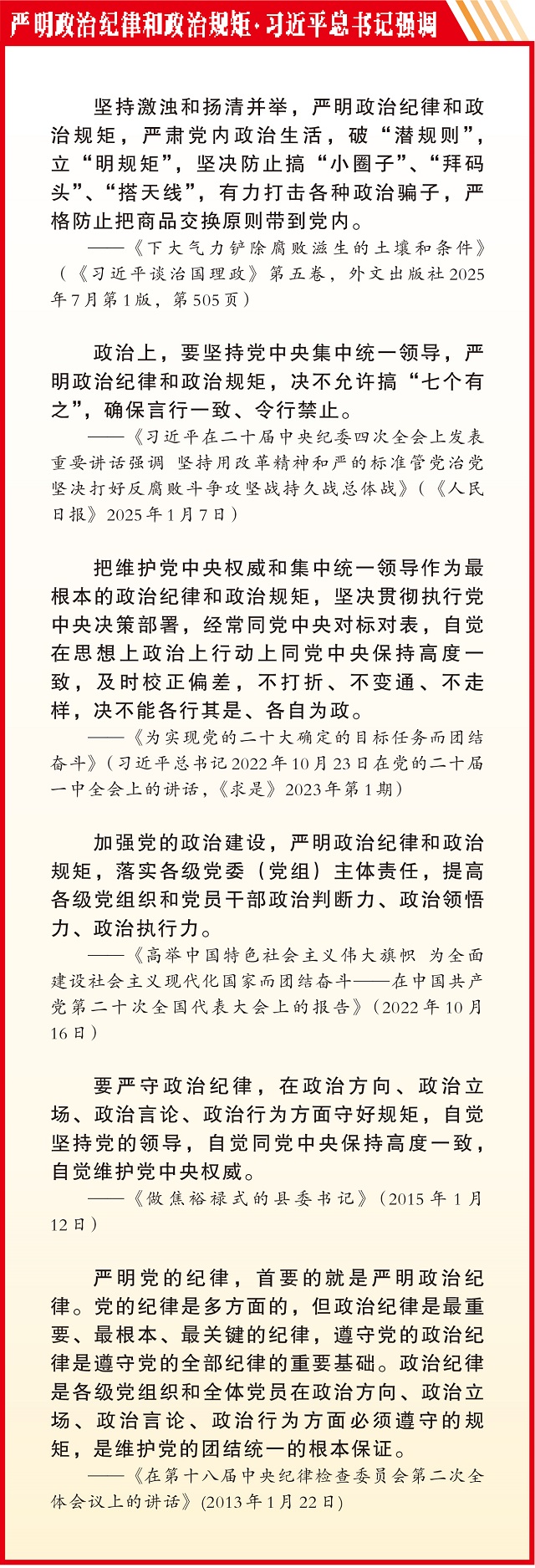
思想体悟 | 严守党的政治纪律和政治规矩
Zhong Yang Ji Wei Guo Jia Jian Wei Wang Zhan· 2025-11-23 23:18
Core Points - The article emphasizes the importance of political discipline within the Communist Party of China, highlighting it as the most fundamental and critical discipline that must be adhered to by all party members [3][14][17] - It discusses the necessity of maintaining a high degree of consistency with the central leadership of the Party, which is framed as a major political principle [4][5][16] - The article outlines the historical context and evolution of political discipline since the 18th National Congress, noting that it has been increasingly prioritized in the Party's governance and discipline framework [14][17][19] Summary by Sections Political Discipline - Political discipline is described as a rigid constraint that governs the political direction, stance, statements, and actions of the entire Party [3][14] - The article states that violations of political discipline ultimately undermine the Party's governance foundation, making adherence to it essential [3][17] Importance of Central Leadership - The article stresses that maintaining alignment with the central leadership is not merely a slogan but a significant political principle that must be actively practiced [4][5] - It highlights that any deviation from this alignment can lead to serious consequences for the Party's unity and effectiveness [4][17] Historical Context and Evolution - Since the 18th National Congress, the Party has integrated political discipline into its broader governance framework, emphasizing its critical role in maintaining Party integrity [14][17] - The article notes that the Party has faced various internal challenges, which have been linked to lapses in political discipline, prompting a renewed focus on this area [6][17] Implementation and Enforcement - The article outlines the need for strict enforcement of political discipline, with mechanisms in place to ensure compliance and address violations [10][11] - It emphasizes the role of disciplinary bodies in monitoring adherence to political discipline and the importance of creating a culture of accountability within the Party [11][18]

前沿访谈丨旗帜鲜明讲政治 不断提高政治能力访中共中央党校(国家行政学院)马克思主义学院教授唐爱军
Zhong Yang Ji Wei Guo Jia Jian Wei Wang Zhan· 2025-10-08 23:49
Core Points - The article emphasizes the importance of political loyalty among party members as a fundamental quality for leadership and governance [3][4] - It outlines the standards for evaluating political loyalty, including adherence to party leadership and policies, and maintaining political discipline [4] - The article discusses the need for party members to enhance their political capabilities in the context of global changes, focusing on strategic planning and understanding broader trends [5][6][7] Group 1: Political Loyalty - Political loyalty is described as the primary political quality for Communist Party members, essential for the party's success [3] - The evaluation of political loyalty includes the ability to uphold party leadership and execute party policies effectively [4] - The concept of loyalty is framed as unconditional and must manifest in various forms, including faith in the party and adherence to its principles [3][4] Group 2: Enhancing Political Capabilities - The article stresses the need for party members to improve their ability to grasp direction, trends, and the overall situation [5][6] - Understanding the correct political direction is crucial for ensuring that actions align with party goals and strategies [6] - The ability to discern major trends and historical contexts is highlighted as essential for effective decision-making and policy formulation [7] Group 3: Practical Application of Political Skills - The article outlines the importance of distinguishing right from wrong and maintaining political resolve in challenging situations [8][9] - It emphasizes the need for party members to manage political situations proactively and prevent potential risks [9][10] - The cultivation of a deep understanding of Marxist theory is presented as vital for enhancing political sensitivity and decision-making capabilities [10][11]