全球深渊探索计划(GHEP)

Search documents
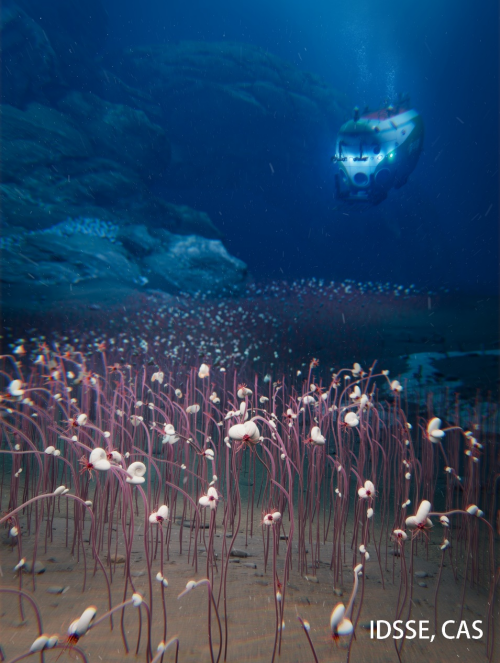
9533米!这里有全球最深“化能生命”
Huan Qiu Wang Zi Xun· 2025-08-04 02:46
Core Insights - The discovery of a deep-sea chemosynthetic ecosystem at a record depth of 9,533 meters in the Northwest Pacific challenges previous understandings of life in extreme depths and highlights the complexity of deep-sea ecosystems [1][4][8] Group 1: Discovery and Research Findings - An international team led by researchers from the Chinese Academy of Sciences has identified a large-scale chemosynthetic community in the deep-sea trenches, extending over 2,500 kilometers in the North Pacific subduction zone [3][8] - The chemosynthetic organisms utilize chemical reactions from deep-sea fluids, converting inorganic substances like carbon dioxide into organic matter, thus sustaining their life processes [2][3] - The research indicates that these ecosystems are supported by fluids rich in hydrogen sulfide and methane, with the presence of unique symbiotic bacteria in deep-sea tube worms and bivalves [3][4] Group 2: Methodology and Exploration - The discovery was serendipitous, occurring during an unplanned dive by the "Fendouzhe" submersible, which led to a shift in research focus to investigate the scale of chemosynthetic communities [5][6] - The team faced significant operational challenges due to low visibility and harsh conditions, yet successfully mapped the distribution of these communities [6][7] Group 3: Implications for Carbon Cycle and Ecosystem Understanding - The findings suggest a hidden carbon reservoir in the form of methane hydrates, challenging the traditional view that deep-sea ecosystems primarily rely on organic matter from surface waters [8][9] - The research opens new avenues for understanding inorganic carbon storage mechanisms in deep-sea environments, indicating that chemosynthetic ecosystems may be more widespread than previously thought [8][9] Group 4: Future Research Directions - The study raises critical questions about the existence of chemosynthetic corridors in other deep-sea trenches globally and the interactions between symbiotic microorganisms and their hosts [9][10] - Future expeditions, including one planned for the Chilean trench, aim to further explore these questions and deepen the understanding of deep-sea carbon cycles [10]
【央视新闻】万米海底,“奋斗者”号发现生命绿洲
Yang Shi Xin Wen· 2025-07-31 01:21
Core Insights - An international research team led by the Institute of Deep Sea Science and Engineering, Chinese Academy of Sciences, discovered the deepest known chemosynthetic life community at a depth of 9,533 meters in the Northwest Pacific Ocean [3][4] - The research, published in the journal Nature, reveals that these life forms do not rely on sunlight for energy but instead utilize chemical reactions from geological fluids for metabolism [3][5] Group 1: Discovery of Chemosynthetic Life - The study marks the first direct observation of the largest and deepest chemosynthetic life community, spanning over 2,500 kilometers of ocean trench [4] - The communities are primarily composed of deep-sea tube worms and bivalve mollusks, which sustain life by utilizing fluids rich in hydrogen sulfide and methane [4] Group 2: Implications for Deep Sea Carbon Cycle - The research has significant implications for understanding the Earth's deep carbon cycle, revealing that methane in these environments is produced by microbial activity deep within sediment layers [5] - This finding suggests the existence of a previously unknown, large, and active deep biosphere that continuously converts buried carbon into methane, challenging traditional models of deep-sea carbon cycling [5] - The study indicates that chemosynthetic life may play a more crucial role in deep-sea ecosystems than previously thought, impacting the structure of these ecosystems [5] Group 3: Global Hadal Exploration Programme - This research is a key component of the Global Hadal Exploration Programme (GHEP), a ten-year international scientific initiative aimed at uncovering the mysteries of Earth's deep oceanic trenches using advanced deep-sea technology [5]