公司内控缺陷

Search documents
捷强装备:内控崩塌、实控人涉刑与业绩困局的三重绞杀丨大A避雷针
Quan Jing Wang· 2025-12-01 10:44
Core Viewpoint - The company, Jieqiang Equipment, is facing severe operational deterioration and significant governance risks, leading to a critical situation for its future [1] Group 1: Internal Control Issues - The company has long-standing internal control deficiencies, including chaotic fund management, contract fraud, and lack of financial systems, which have persisted across management transitions [2] - The company received an administrative penalty from the Tianjin Securities Regulatory Bureau due to these internal control issues, with a mandate for rectification by November 2025 [2][3] - The internal control failures have been linked to a pattern of misconduct, including the use of personal accounts for transactions and signing of false contracts, which have exacerbated the company's vulnerabilities [3] Group 2: Financial Performance - The company's revenue fluctuated significantly from 2020 to 2024, with figures of 268 million, 198 million, 240 million, 293 million, and 138 million yuan, indicating instability [5] - The overall gross margin has declined from 59.61% in 2020 to -6.88% in 2024, reflecting a rapid deterioration in profitability [5] - The net losses have increased dramatically, with figures of 100 million, 31 million, -17 million, -68 million, and -278 million yuan from 2020 to 2024, showing a trend of escalating financial distress [5] Group 3: Cash Flow and Liquidity - The company has experienced continuous negative operating cash flow from 2022 to 2025, with cash flow figures of -123 million, 0, -36 million, and -100 million yuan [7] - As of the end of the third quarter of 2025, the company had only 83 million yuan in cash, a significant decrease from 218 million yuan in 2024 and 715 million yuan at the end of 2021, indicating a critical liquidity situation [8] Group 4: Governance and Market Perception - The company's major shareholder has indicated a lack of confidence in its future by reducing their stake, further clouding the company's outlook [9] - The combination of ongoing governance failures, declining gross margins, and shrinking cash reserves suggests a fundamental collapse of the company's business model [9]


688184,共同控制人被立案侦查
Zheng Quan Shi Bao· 2025-08-03 10:39
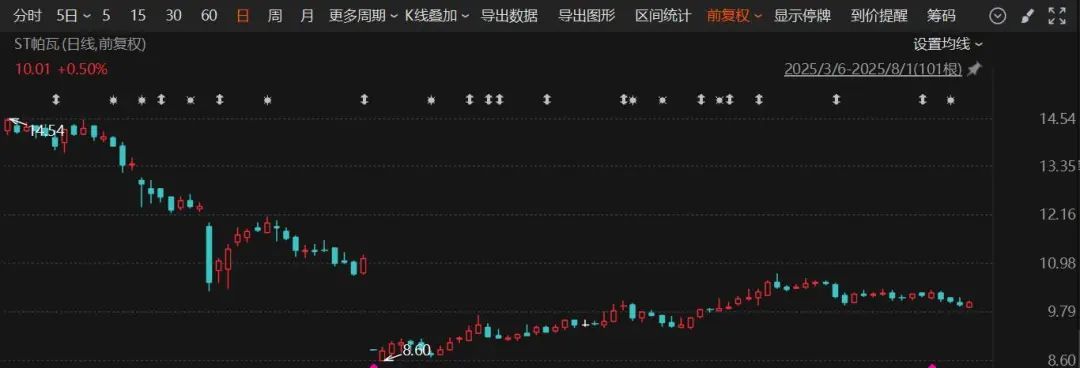
Core Viewpoint - ST Pava is facing significant governance and financial challenges due to the investigation of its co-controller and director, Zhang Bao, for alleged embezzlement, which has led to a risk warning on its stock and concerns over its internal controls [1][2][3]. Company Overview - ST Pava, established in July 2014, specializes in the production, research, and sales of lithium-ion battery ternary cathode material precursors for electric vehicles. The company was listed on the Sci-Tech Innovation Board in September 2022 [2]. Financial and Operational Issues - The company has been flagged for internal control deficiencies, leading to a negative audit opinion from Tianjian Accounting Firm regarding its 2024 financial report. This has resulted in a risk warning for its A-share stock, changing its name to ST Pava [2]. - ST Pava reported overpayment to suppliers totaling 180 million yuan due to management issues, with Zhang Bao committing to recover this amount and assume joint liability for the losses [2]. - Zhang Bao has allegedly occupied company funds amounting to 191 million yuan, with a breakdown of 74.03 million yuan for 2022, 85.39 million yuan for 2023, and 31.92 million yuan for 2024, plus interest of 912,500 yuan, primarily for personal consumption and investments [3]. Management Changes - On May 21, ST Pava announced a change in its board and executive team, with Zhang Bao resigning due to health reasons. Wang Baoliang, a former chairman, has taken over as chairman and general manager [4]. - The new management has initiated a "stop-loss and efficiency enhancement" plan, focusing on strengthening internal governance, streamlining operations, shutting down inefficient production lines, and enhancing asset utilization to achieve profitability by 2025 [4].