关税退坡+财货双松

Search documents
一切为了中选!明年上半年的美国政策组合:关税退坡+财货双松?
智通财经网· 2025-11-22 07:59
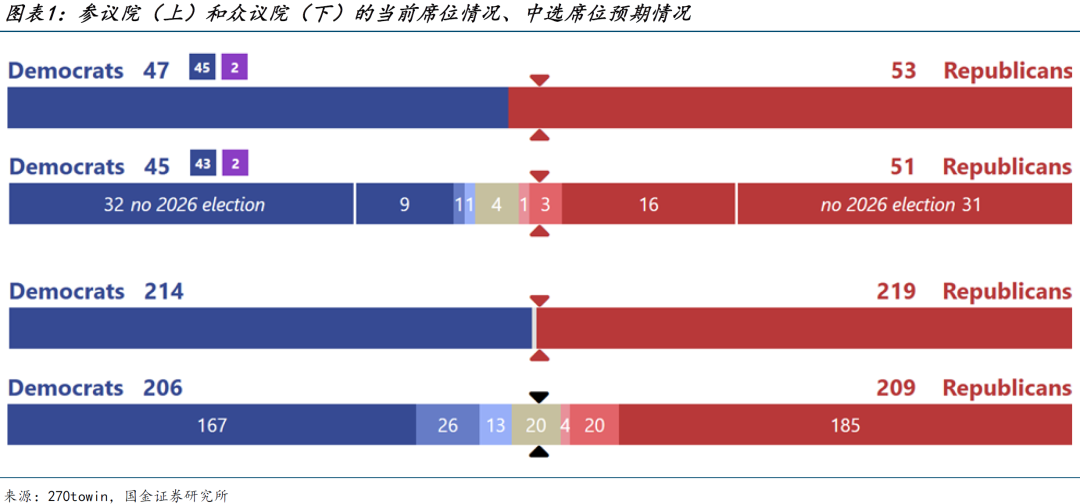
Group 1 - The Republican Party, led by Trump, gained control of both houses of Congress after the last presidential election, providing a strong foundation for the Trump administration's domestic and foreign policy initiatives [1] - The upcoming midterm elections on November 3 will be a significant test for the Trump administration, as both houses will face re-election [1][2] - Historically, it is common for the sitting president's party to lose control of Congress during midterm elections, which can hinder legislative efforts and diminish international influence [1][6] Group 2 - The Republican Party is expected to maintain control of the Senate, with 53 seats compared to 47 for the Democrats, but the House of Representatives presents a more precarious situation [2] - In the House, the Republican Party holds a slim majority of 219 seats to the Democrats' 214, with 19 highly competitive seats that could determine control [2][3] Group 3 - Trump is pressuring Republican-led state governments to redraw congressional district lines to gain electoral advantages, a tactic that has intensified due to increasing partisan divisions [3] - Despite potential advantages from redistricting, historical trends indicate that the president's party often loses seats in midterm elections, with an average loss of 26 seats since World War II [3][6] Group 4 - The Trump administration's focus for the upcoming year should be on addressing pressing social and economic issues, particularly rising living costs and income inequality [4][12] - Economic challenges have worsened under the Trump administration, with rising costs of living and increasing unemployment risks due to structural changes in the job market [7][8] Group 5 - The wealth gap in the U.S. has widened, with the top 1% of households holding 30.9% of the nation's wealth, while the bottom 50% hold only 2.5% [8] - Recent local election losses for the Republican Party highlight the impact of these economic issues on voter sentiment [8] Group 6 - Trump's political strategies are likely to focus on mitigating existing economic problems while avoiding new challenges, particularly as the midterm elections approach [12][13] - The administration may need to implement new fiscal policies to address the growing economic disparities and dissatisfaction among lower-income voters [12][13] Group 7 - The relationship between the U.S. and China is expected to remain stable in the coming year, with potential negotiations on tariffs and trade agreements [17][18] - Trump's planned visit to China in April may yield significant outcomes, particularly regarding tariff reductions on fentanyl [17][18]