养老目标日期基金

Search documents
2025年度FOF成绩单:华商嘉逸养老目标2045五年回报39.58%领跑 上银恒泰稳健养老目标一年回报仅为1.77%
Xin Lang Cai Jing· 2026-01-07 07:36
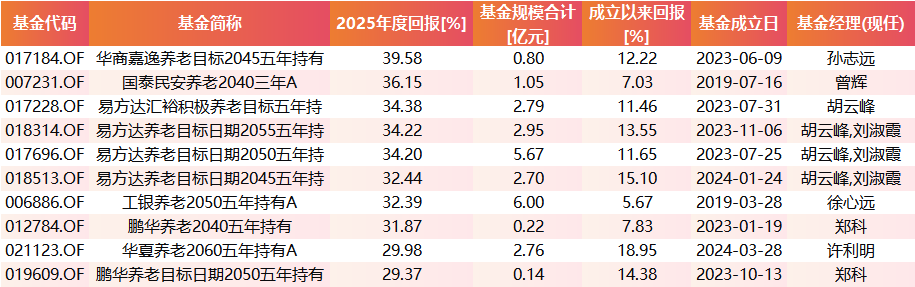
Core Insights - In 2025, equity funds emerged as market leaders, with Yongying Technology Smart Selection A achieving a remarkable annual growth of 233.29%, and Guotai Fund's Communication ETF leading stock ETFs with a 126.13% increase [1][8] - The overall performance of FOF (Fund of Funds) products in 2025 was outstanding, particularly among target date funds, with Huashang Jiayi Pension Target 2045 Five-Year Holding (017184.OF) leading with a 39.58% annual return [2][9] - Some conservative and stable FOF funds underperformed, with annual returns concentrated in the 1% to 4% range, contrasting sharply with the top-performing FOF products [5][12] FOF Fund Performance Highlights - Huashang Jiayi Pension Target 2045 Five-Year Holding (017184.OF) achieved a 39.58% annual return, with a total size of 0.80 billion and a cumulative return of 12.22% since its inception in June 2023, managed by Sun Zhiyuan [2][10] - Guotai Min'an Pension 2040 Three-Year A (007231.OF) followed closely with a 36.15% return, a size of 1.05 billion, and a cumulative return of 7.03% since its inception in July 2019, managed by Zeng Hui [2][10] - E Fund's four target date funds also performed well, with returns of 34.38% for E Fund Huayu Active Pension Target Five-Year Holding (017228.OF), 34.22% for E Fund Pension Target Date 2055 (018314.OF), and 34.20% for E Fund Pension Target Date 2050 (017696.OF) [11] Underperforming FOF Funds - The worst-performing FOF fund was Shangyin Hengtai Stable Pension Target One-Year Holding (013139.OF), with a mere 1.77% return and a cumulative return of -0.12% since its inception in September 2021, managed by Wang Zhenxiong [5][12] - Other underperformers included Dongfanghong Yi'an Stable Pension One-Year Holding A (017775.OF) with a 2.22% return and Dongfanghong Yihe Stable Pension Target Two-Year Holding (009174.OF) with a 3.03% return [5][12] - The performance disparity among FOF products is attributed to their different product positioning and asset allocation structures, with leading products being "target date" funds benefiting from a favorable equity market [7][13]