养老观念转变

Search documents
京东调研-春节切面观察:超半数老人节后重回独居生活 子女们表示健康监测、居家安全、医疗照护是核心需求
Sou Hu Wang· 2026-02-26 11:02
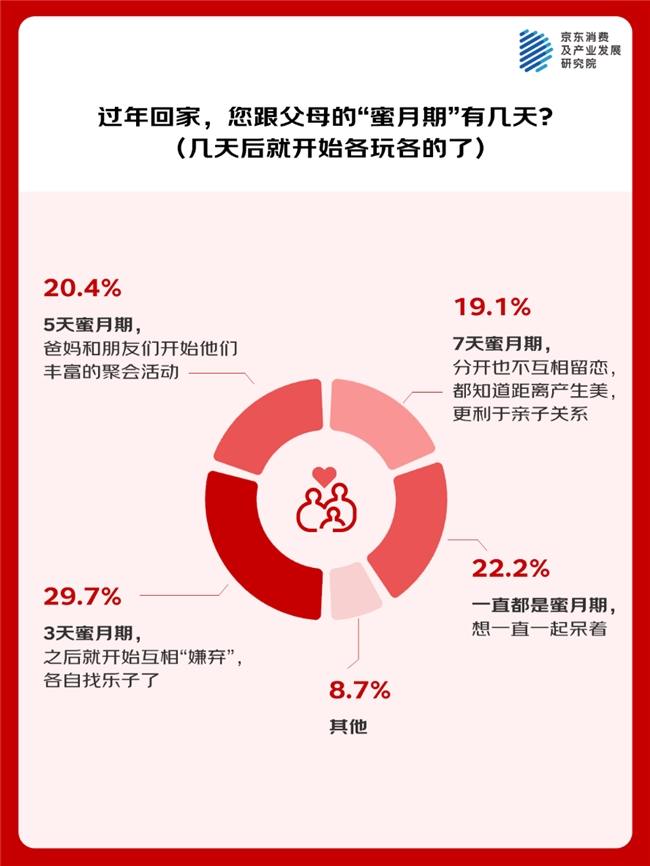
Group 1 - The core observation of this year's Spring Festival highlights new changes in family interactions and consumption trends, reflecting the evolving dynamics of intergenerational relationships in contemporary Chinese families [1][2][3] - A survey indicates that 69.2% of respondents feel that the "intimacy honeymoon period" with family lasts around 7 days, suggesting a balance between closeness and personal space during family gatherings [3][5] - The concept of "short-term intimacy + maintaining distance" has emerged as a strategy for younger generations to manage family interactions, acknowledging differences in lifestyle and values between generations [5][6] Group 2 - The survey reveals that 47.6% of respondents perceive older family members as showing signs of aging, while 45.1% of older individuals are becoming more proactive about their health management [7][10] - There is a notable increase in the search for health-related gifts for older family members during the Spring Festival, with 77.2% of consumers choosing nutritional supplements as gifts [6][7] - Approximately 56.4% of older individuals exhibit a frugal mindset, preferring to save money rather than spend it, indicating a shift towards a more quality-oriented consumption approach among the elderly [10][14] Group 3 - The survey indicates that over half of older individuals will return to an "empty nest" situation after the Spring Festival, with 54.8% of children placing greater emphasis on emotional companionship in their care for elderly parents [13][15] - Discussions around aging and retirement planning have become more open, with 57.7% of respondents indicating a shift from relying on children for support to a preference for independent living [14][15] - The demand for health monitoring and safety services for older adults is highlighted, with 53.5% of children recognizing this as a critical unmet need [15][17]

委员杨德育:让家门口养老成为品质之选
Xin Lang Cai Jing· 2026-01-28 04:16
Core Insights - The perception of nursing homes among the elderly is shifting from fear to acceptance, driven by professional care and attention to detail [1][3] - The overall occupancy rate of nursing institutions has steadily increased from 45.4%, with some high-quality facilities experiencing a shortage of beds [3] Group 1: Changes in Attitudes - An elderly man initially resistant to home services became an active participant in community activities after receiving consistent support from nursing staff [1][3] - A colleague's father, who was previously opposed to nursing homes, became an advocate for them after experiencing their services firsthand [3] Group 2: Growth of the Industry - By the end of 2024, the population aged 60 and above in China is expected to exceed 300 million, indicating a growing demand for elderly care services [3] - A nursing enterprise in Liupanshui has expanded from a 7-person team serving 7 elderly individuals to over 120 employees and nearly 500 residents [3] Group 3: Quality of Service - The improvement in elderly care services reflects a transition from "passive placement" to "active choice," highlighting a change in societal attitudes towards aging [3] - High-quality services are essential for transforming elderly care from a "last resort" to a "quality choice," ensuring that seniors feel secure in embracing new lifestyles [3]