
农业保险政策

Search documents
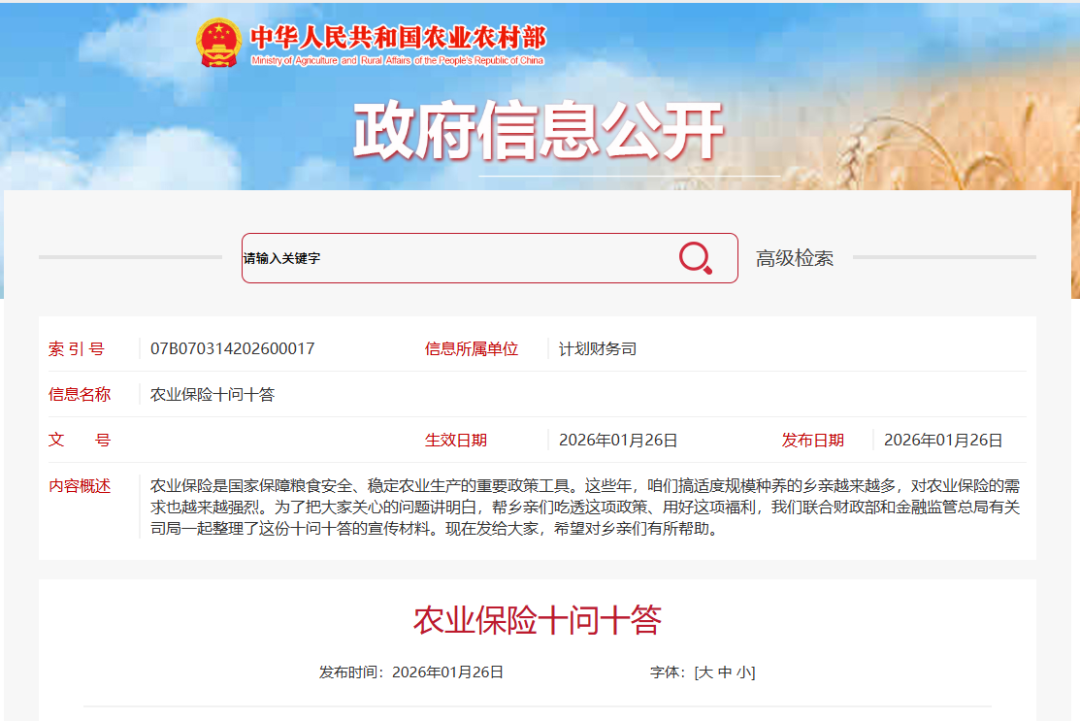
农业保险十问十答!你关心的问题都在这里→
Xin Lang Cai Jing· 2026-01-29 12:12
Core Viewpoint - Agricultural insurance is a crucial policy tool for ensuring food security and stabilizing agricultural production, with increasing demand from farmers for such insurance products [2][10]. Group 1: Importance of Agricultural Insurance - Agricultural insurance provides financial protection to farmers against natural disasters, diseases, accidents, and price drops, allowing them to recover and continue production [2][10]. - The purchase of agricultural insurance is voluntary, depending on individual circumstances, particularly in areas prone to disasters [2][10]. Group 2: Insurable Products - Insurable agricultural products are categorized into two main types: major staple crops (e.g., wheat, corn, rice) and local specialty products (e.g., fruits, vegetables) [2][10]. - The coverage for local specialty products has expanded significantly across various regions [2][10]. Group 3: Coverage and Benefits - Agricultural insurance typically covers risks such as natural disasters, pest and disease outbreaks, and accidents, with specific terms outlined in the insurance contract [11]. - Some policies may also cover income risks due to reduced yields or market price drops [11]. Group 4: Cost and Subsidies - The cost of policy-based agricultural insurance is generally low for farmers, as government subsidies can cover 30% to 90% of the premiums [12]. - For example, a farmer may only pay 10 yuan for a 1,000 yuan coverage policy after subsidies [12]. Group 5: Payment Channels - Farmers can purchase insurance through three main channels: village organization, direct contact with insurance companies, or online platforms [12][5]. - Each method is designed to accommodate different scales of farming operations [12][5]. Group 6: Policy Issuance and Claims Process - After payment, it typically takes about two weeks to receive the insurance policy due to necessary verification processes [13]. - In the event of a disaster, farmers must report claims within 24-48 hours to ensure proper assessment and compensation [14]. Group 7: Understanding Claims and Payouts - Compensation amounts may be lower than the insured amount due to actual loss assessments, which are based on the extent of damage rather than a flat payout [15]. - Factors affecting payout include the growth stage of the crops and the type of insurance coverage purchased [15]. Group 8: Technological Advancements in Claims Assessment - Insurance companies may use sampling methods for loss assessment during widespread disasters, employing technology like drones for accurate evaluations [16]. - The industry is moving towards more precise, data-driven assessments to enhance efficiency and accuracy in claims processing [16]. Group 9: Legal and Ethical Considerations - Farmers should be cautious of illegal practices where individuals receive payouts without legitimate insurance coverage, as this can lead to legal repercussions [17]. - It is essential for farmers to understand the legitimacy of their claims and the importance of adhering to proper insurance protocols [17].

今年财政部已据实拨付中央救灾资金105亿元
Zhong Guo Xin Wen Wang· 2025-10-17 11:50
同时,充分发挥保险机制对减灾救灾的支撑作用,财政部会同有关部门实施城乡居民住宅巨灾保险政 策,农业保险政策也持续发力,今年以来已向超2000万户次农户赔付超900亿元,形成"政府主导、社会 参与、多元互补"的保障格局。 本文为转载内容,授权事宜请联系原著作权人 当天在北京举行的新闻发布会上,濮剑鹏介绍,财政部和应急管理、农业、水利、交通等部门密切联 动,建立了中央财政救灾资金快速核拨机制,开辟了资金拨付的"绿色通道"。国家重大自然灾害应急或 救灾响应一旦启动,财政部即刻通过该机制下拨资金,支持地方迅速组织抢险救援,妥善安置受灾群 众。今年以来,已启动16次快速核拨机制。 对于救灾资金,濮剑鹏强调,财政部始终确保资金规范、安全、高效用于灾区和受灾群众。资金分配 上,不断完善办法,力求更加科学、公平、精准;资金使用上,通过"线上+线下"相结合的资金监管体 系,对救灾资金的下达、拨付、使用进行全流程监管,密切跟踪地方执行,全面掌握资金使用效果,坚 决防止资金滞留、挤占、挪用等违规行为。 今年财政部已据实拨付中央救灾资金105亿元 编辑:王永乐 中新网北京10月17日电 (记者 赵建华)今年以来,我国洪涝、地质灾害等 ...