农业保险

Search documents
构建高效精准金融服务体系 为粮食安全保驾护航
Jin Rong Shi Bao· 2026-02-26 05:02
Core Viewpoint - The upcoming National People's Congress in 2026 will focus on "food security," emphasizing the need for a sustainable financial support system to enhance food production efficiency amid limited arable land and changing labor structures [1][2] Group 1: Financial Support for Food Security - Financial backing is crucial for implementing the national food security strategy and strengthening food production capacity, requiring stable funding through policy loans and diversified financing [2] - A clear and efficient financial security system for food safety has begun to take shape, supported by structural monetary policy tools and significant credit investments from major financial institutions [1][2] Group 2: Agricultural Land Protection and Management - China aims to protect 1.865 billion acres of arable land and 1.546 billion acres of permanent basic farmland by 2025, with a focus on high-standard farmland construction [3] - There is a growing concern regarding the funding gap for the management of high-standard farmland, necessitating innovative financial products and services [4] Group 3: Mechanisms for Agricultural Machinery and Labor - The shortage of agricultural machinery operators due to an aging workforce poses a challenge to food production efficiency, highlighting the need for financial support that extends beyond machinery purchase to include training and operational services [5] - Financial institutions are encouraged to develop specialized products to support agricultural service centers and integrate machinery operation data into credit evaluation systems [5] Group 4: Comprehensive Financial Support for the Agricultural Industry - A complete financial chain covering research, production, and storage is essential for enhancing agricultural productivity, with a focus on connecting financial resources to the entire agricultural value chain [6][7] - Innovative financing models, such as long-term R&D loans for seed companies and the establishment of a national seed industry innovation fund, are being explored to support agricultural technology advancements [7] Group 5: Market-Oriented Grain Storage and Trade - The deepening of market-oriented reforms in grain storage requires flexible financial support to ensure fair financing opportunities for small and medium-sized grain processing enterprises [8] - The integration of digital storage facilities with financing solutions aims to create a comprehensive financial ecosystem that supports the entire grain production and trade process [8] Group 6: Risk Management and Income Protection for Farmers - Protecting the income of grain farmers is essential for sustaining food production, necessitating a robust risk management system that goes beyond basic cost coverage to include income and sustainability [9] - Future initiatives will focus on enhancing agricultural risk management capabilities and integrating ecological considerations into insurance coverage [9] Group 7: Financial Ecosystem for Food Security - The role of finance is evolving from merely providing capital to becoming a vital component in activating all elements of food production and connecting the entire industry chain [10] - The challenge ahead is to create a dynamic and secure financial ecosystem that effectively supports the integration of quality land, seeds, machinery, and methods in food production [10]
四部门:稳妥发展高标准农田建设管护、农业机械损毁等保险
Bei Jing Shang Bao· 2026-02-14 13:33
Core Viewpoint - The People's Bank of China, along with other regulatory bodies, has issued guidelines to establish a regular financial support mechanism aimed at preventing poverty and promoting rural revitalization [1] Group 1: Financial Product and Service Innovation - Financial institutions are encouraged to focus on sectors with strong employment absorption capacity and income generation effects, developing tailored financial products and services [1] - There is an emphasis on exploring various support measures such as "loans + external direct investment," technology insurance, intellectual property pledge financing, and various investment funds, all under the premise of legal compliance and risk control [1] Group 2: Capital Market Support System - The guidelines advocate for the continued promotion of "insurance + futures" in key rural revitalization counties to enhance project security [1] - There is a call for innovative development of insurance products and services, including the management and protection of high-standard farmland and insurance for agricultural machinery damage [1] - The guidelines suggest creating insurance products for supporting industrial projects to ensure financial security and stable project operations, while also urging insurance companies to optimize services and improve claims processing efficiency [1]
完善强农惠农富农保障体系
Jin Rong Shi Bao· 2026-02-11 01:32
Core Viewpoint - The "Central No. 1 Document" outlines a clear blueprint for agricultural modernization and rural revitalization, emphasizing the importance of insurance in stabilizing farmers' income and mitigating agricultural risks [1]. Group 1: Protecting Farmers' Incentives - The document prioritizes "actively promoting stable income growth for farmers" and proposes strengthening policies related to prices, subsidies, and insurance to enhance the income guarantee mechanism for grain farmers [2]. - The integration of price, subsidy, and insurance policies is recognized as essential for ensuring food security and motivating farmers to produce [2]. - Insurance is highlighted for its significant leverage effect, where a small amount of premium can mobilize substantial risk coverage, with the support scale reaching 489.37 billion yuan by 2022, accounting for 34.6% of total agricultural support [2]. Group 2: Ensuring Food Security - Ensuring national food security is identified as a fundamental task, with grain production stabilizing above 1.4 trillion jin for two consecutive years, aiming for 1.43 trillion jin by 2025 [4]. - Agricultural insurance plays a crucial role, with premium scales expected to exceed 155 billion yuan by 2025, providing over 5.2 trillion yuan in risk coverage for 125 million households [4]. - The focus of agricultural insurance is shifting from scale development to deepening guarantees, with coverage rates for major crops exceeding 70% [4]. Group 3: Developing Specialty Agricultural Products - The document emphasizes support for developing local specialty product insurance, reflecting the government's commitment to promoting tailored agricultural practices [7]. - Over 500 types of local specialty products have been included in the insurance coverage, enhancing risk management and adding value through innovative models [7]. - Recommendations for future development include integrating specialty product insurance into rural revitalization assessments and focusing on high-value, high-demand products [7]. Group 4: Improving Insurance Claims Efficiency - The document highlights the need to improve insurance claims efficiency, addressing farmers' concerns and marking a step towards high-quality agricultural insurance development [8]. - In 2024, agricultural insurance payouts are projected to reach 111.77 billion yuan, with a claims rate of 74.35%, effectively covering 68% of disaster-affected farmers [8]. - Challenges remain in claims processing, prompting regulatory bodies to issue guidelines aimed at enhancing precision in underwriting and claims [8]. Group 5: New Farmer Protection - The document proposes expanding social security coverage for flexible employment workers in rural areas, addressing the needs of new farmers engaged in various sectors [10]. - This initiative aims to provide better protection for workers in logistics, delivery, and tourism, ensuring higher benefits and reducing occupational risks [10]. - The policy is expected to enhance job retention and satisfaction among new farmers, contributing to rural employment structure upgrades and social security improvements [11].
2025年阿塞拜疆国家农业保险赔偿额同比增长43%
Shang Wu Bu Wang Zhan· 2026-02-05 17:16
Core Insights - The coverage of agricultural insurance in Azerbaijan is increasing, with compensation amounts and the number of farms covered on the rise [1] Group 1: Compensation and Growth - In 2025, the total compensation expenditure for national agricultural insurance is projected to be 9.147 million manats (5.38 million USD), representing a 43% year-on-year increase and a 1.1 times growth compared to 2023 [1] - Of the total compensation, 8.753 million manats (5.149 million USD) is allocated for crop production, which includes fruits such as peach, nectarine, almond, as well as grains and corn [1] - The remaining 394 thousand manats (232 thousand USD) is designated for livestock [1]
2026年中央一号文件:支持发展地方特色农产品保险,提高保险理赔效率
Bei Jing Shang Bao· 2026-02-03 11:10
Core Viewpoint - The central document emphasizes the importance of protecting and incentivizing farmers in agricultural production, aiming for modernization and comprehensive rural revitalization by 2026 [1] Policy Support - The document outlines the need for enhanced support through pricing, subsidies, and insurance to ensure farmers' income security [1] - It highlights the importance of strengthening insurance mechanisms specifically for rice, wheat, corn, and soybeans [1] Insurance Efficiency - There is a focus on improving the efficiency of insurance claims processing for agricultural products [1] - The document encourages the development of insurance for local specialty agricultural products [1]

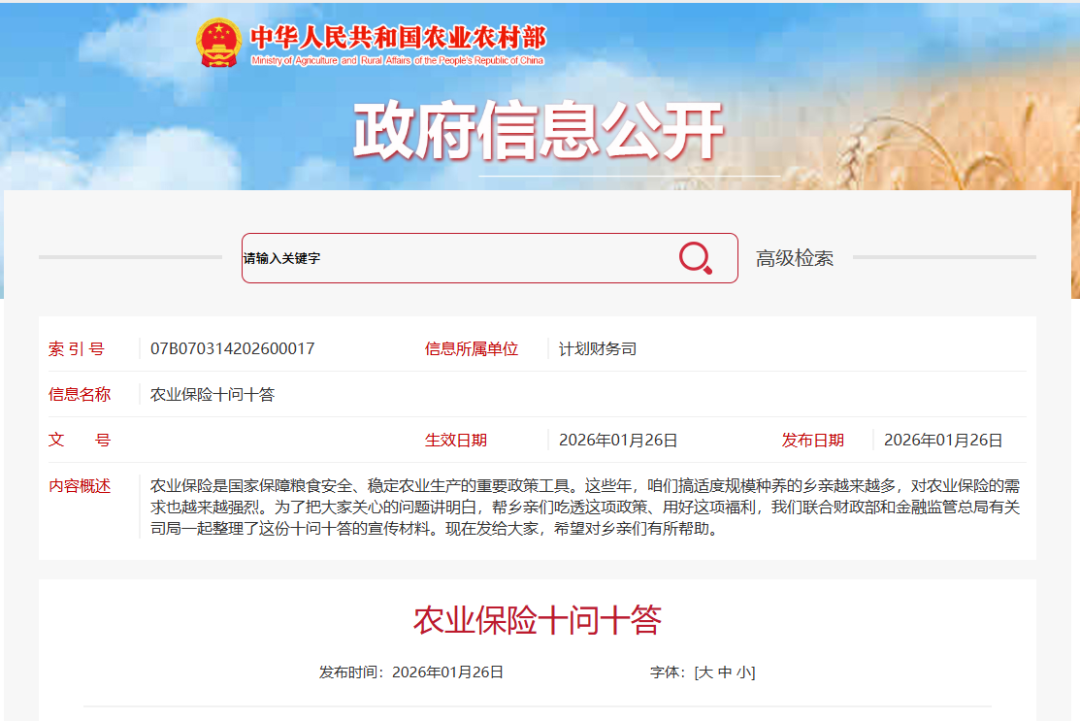
农业保险十问十答!你关心的问题都在这里→
Xin Lang Cai Jing· 2026-01-29 12:12
Core Viewpoint - Agricultural insurance is a crucial policy tool for ensuring food security and stabilizing agricultural production, with increasing demand from farmers for such insurance products [2][10]. Group 1: Importance of Agricultural Insurance - Agricultural insurance provides financial protection to farmers against natural disasters, diseases, accidents, and price drops, allowing them to recover and continue production [2][10]. - The purchase of agricultural insurance is voluntary, depending on individual circumstances, particularly in areas prone to disasters [2][10]. Group 2: Insurable Products - Insurable agricultural products are categorized into two main types: major staple crops (e.g., wheat, corn, rice) and local specialty products (e.g., fruits, vegetables) [2][10]. - The coverage for local specialty products has expanded significantly across various regions [2][10]. Group 3: Coverage and Benefits - Agricultural insurance typically covers risks such as natural disasters, pest and disease outbreaks, and accidents, with specific terms outlined in the insurance contract [11]. - Some policies may also cover income risks due to reduced yields or market price drops [11]. Group 4: Cost and Subsidies - The cost of policy-based agricultural insurance is generally low for farmers, as government subsidies can cover 30% to 90% of the premiums [12]. - For example, a farmer may only pay 10 yuan for a 1,000 yuan coverage policy after subsidies [12]. Group 5: Payment Channels - Farmers can purchase insurance through three main channels: village organization, direct contact with insurance companies, or online platforms [12][5]. - Each method is designed to accommodate different scales of farming operations [12][5]. Group 6: Policy Issuance and Claims Process - After payment, it typically takes about two weeks to receive the insurance policy due to necessary verification processes [13]. - In the event of a disaster, farmers must report claims within 24-48 hours to ensure proper assessment and compensation [14]. Group 7: Understanding Claims and Payouts - Compensation amounts may be lower than the insured amount due to actual loss assessments, which are based on the extent of damage rather than a flat payout [15]. - Factors affecting payout include the growth stage of the crops and the type of insurance coverage purchased [15]. Group 8: Technological Advancements in Claims Assessment - Insurance companies may use sampling methods for loss assessment during widespread disasters, employing technology like drones for accurate evaluations [16]. - The industry is moving towards more precise, data-driven assessments to enhance efficiency and accuracy in claims processing [16]. Group 9: Legal and Ethical Considerations - Farmers should be cautious of illegal practices where individuals receive payouts without legitimate insurance coverage, as this can lead to legal repercussions [17]. - It is essential for farmers to understand the legitimacy of their claims and the importance of adhering to proper insurance protocols [17].

多渠道增加居民收入!财政部发声
Zhong Guo Zheng Quan Bao· 2026-01-20 11:41
Group 1 - The core viewpoint is that the government will implement a more proactive fiscal policy, ensuring that total fiscal expenditure increases while optimizing the structure and improving efficiency [2][3][4] - The fiscal deficit, total debt scale, and total expenditure will maintain necessary levels in 2026, ensuring that overall expenditure intensity "only increases and does not decrease" and that key areas are guaranteed "only stronger and not weaker" [2][3] - The government will break the "base + growth" expenditure solidification pattern by actively using zero-based budgeting concepts to reduce ineffective expenditures and allocate more fiscal funds to boost consumption, invest in people, and ensure livelihood security [3][4] Group 2 - The government aims to increase residents' income through multiple channels, ensuring that funds are used in critical areas to enhance people's sense of gain [3][4] - The government will continue to arrange ultra-long-term special bonds for "two heavy" construction and "two new" work, optimizing policy implementation [3][4] - There will be a focus on deepening fiscal and tax reforms in key areas to further stimulate the internal vitality of the economy [4][5] Group 3 - The government will leverage the role of government investment funds to support early, small, long-term investments in hard technology and promote quality upgrades in key industries [6] - There will be a focus on enhancing the innovation capabilities of small and medium-sized enterprises through structural tax reductions and support policies [6] - A guiding document will be issued to promote high-quality development of agricultural insurance, emphasizing refined management and diversified collaboration [7]
财政部:“十四五”期间,农户累计获得农业保险赔款超5200亿元
Sou Hu Cai Jing· 2026-01-20 10:18
Core Viewpoint - The Chinese government is actively promoting agricultural insurance through fiscal policies, which has significantly contributed to the stability of agricultural production and food security in the country [1][3]. Group 1: Agricultural Insurance Development - Since 2007, the central government has supported agricultural insurance through premium subsidies, making it one of the earliest fiscal-financial collaborative policies [1][3]. - The average premium for complete cost insurance for rice is approximately 50 yuan per mu, with farmers paying around 10 yuan and the government covering about 40 yuan, leading to potential compensation of hundreds to thousands of yuan in case of disasters [3]. - China's agricultural insurance premium scale ranks first globally, supporting stable grain production of over 1.4 trillion jin, which is crucial for feeding nearly 20% of the world's population on just 9% of the world's arable land [3][4]. Group 2: Achievements in Agricultural Insurance - The development of agricultural insurance is characterized by "quantity and quality improvement," reflected in four continuous aspects: 1. Continuous increase in fiscal investment, with nearly 80% of agricultural insurance premiums coming from government subsidies, growing at double-digit rates annually [4]. 2. Continuous improvement of the institutional framework, with various departments collaborating to establish a comprehensive agricultural insurance system tailored to China's conditions [4]. 3. Continuous enhancement of coverage capabilities, providing high coverage for major agricultural products and implementing reward and subsidy policies for local specialty products [4]. 4. Continuous increase in benefits for farmers, with over 520 billion yuan in compensation provided to farmers during the "14th Five-Year Plan" period, aiding recovery from natural disasters [4]. Group 3: Future Directions - The Ministry of Finance plans to continue enhancing the quality and efficiency of agricultural insurance and will issue a guiding document in 2026 aimed at promoting high-quality development in this sector [5].
金融助力“大国粮仓”根基稳固
Jin Rong Shi Bao· 2025-12-31 02:10
Core Insights - The article emphasizes the stability and sufficiency of China's grain market during the "14th Five-Year Plan" period, with grain production consistently exceeding 1.3 trillion jin and projected to reach 1.4 trillion jin in 2024, ensuring food security for the population [1][8] - Financial support has been crucial in achieving these results, with a focus on enhancing the grain security system and adapting to complex domestic and international environments [1][8] Financial Support Framework - A clear and efficient financial support policy framework for grain security has been established, with collaboration between financial management departments and agricultural sectors [2] - Structural monetary policy tools have been optimized to direct more credit resources towards grain production and related sectors, with significant increases in agricultural insurance subsidies [2] Credit Supply and Services - Financial institutions have prioritized support for grain production, with agricultural loans reaching 53.4 trillion yuan, a year-on-year increase of 6.8% [3] - Specialized loan products have been developed to support key areas such as seed industry innovation and high-standard farmland construction, enhancing grain storage and logistics capabilities [3][4] Agricultural Bank Initiatives - The Agricultural Development Bank has actively implemented policies, with over 1 trillion yuan in loans for food security initiatives, including significant funding for grain circulation and production capacity [4] - The Agricultural Bank has also provided substantial loans to grain producers, enhancing financial services for the agricultural sector [4] Seasonal and Customized Financial Products - Financial institutions have introduced seasonal and customized loan products to support agricultural inputs and operations, stabilizing planting areas and improving yield levels [5] - Targeted financial products have been developed for family farms and cooperatives, addressing financing challenges and enhancing their capacity to support modern agriculture [5] Agricultural Insurance Role - Agricultural insurance has played a vital role in mitigating risks associated with grain production, with comprehensive coverage for major crops and increased subsidy rates encouraging farmer participation [6] - The integration of insurance with financial tools has created a robust risk-sharing mechanism, enhancing the resilience of grain production against natural disasters and market fluctuations [6] Technological Integration in Financial Services - The application of financial technology has transformed financial services in the grain sector, with online credit products becoming widely accessible to farmers [7] - Collaboration between financial institutions and agricultural tech companies has led to integrated services that enhance credit availability and risk management [7] Overall Achievements and Future Outlook - The financial system has significantly improved its capacity to support national grain security, with a multi-layered policy framework and increased credit supply [8] - Looking ahead, the financial sector is expected to strengthen its role in ensuring food security, adapting to ongoing challenges, and enhancing resource allocation and service innovation [8]
首换董事长!净利问鼎农险榜首、赔付率高达74%,中原农险如何续写新十年?
Xin Lang Cai Jing· 2025-12-22 11:02
Core Viewpoint - The recent leadership change at Zhongyuan Agricultural Insurance marks a significant transformation for the company, with new Chairman Diao Yuxin set to lead the firm into a new era of reform and growth [1][36]. Leadership Change - Diao Yuxin has been approved as the new Chairman, concluding a 9-month transition period following the departure of former Chairman Bi Zhijun due to age [2][36]. - Diao Yuxin has a strong background in agricultural finance, having previously served as Chairman of Henan Agricultural Credit Guarantee Co., where he developed innovative cooperation models [4][39]. Company Performance - As of the end of 2024, Zhongyuan Agricultural Insurance ranked first among five specialized agricultural insurance companies in net profit, with a rapid increase in premium scale [1][36]. - The company reported a claims expenditure of 4.653 billion yuan in 2024, with a claims ratio of 73.87% [1][36][67]. - The company aims to enhance risk management, address shortcomings, and improve operational efficiency as part of its strategic goals for 2025 [1][5]. Strategic Focus - Zhongyuan Agricultural Insurance has designated 2025 as the "Year of Compliance Management," emphasizing the need for risk prevention and quality development [5][40]. - The company is focusing on deepening its understanding of the agricultural industry and innovating financial service models to meet current market demands [41][42]. Market Position - Zhongyuan Agricultural Insurance has established a robust network with 206 branches across various provinces, focusing on agricultural regions [10][45]. - The company has seen significant growth in its insurance business revenue, reaching 6.299 billion yuan by the end of 2024, with a year-on-year increase of 11.54% [22][61]. Financial Overview - The total assets of Zhongyuan Agricultural Insurance reached 9.703 billion yuan by the end of 2024, reflecting a 2.66% increase year-on-year [25][60]. - The company’s net profit for 2024 was 419 million yuan, leading among its peers, with a profit of 357 million yuan reported in Q3 2025 [24][59][63].