农历与公历历法差异

Search documents
马年“无春”不宜结婚?是真的吗?
Xin Lang Cai Jing· 2026-02-15 04:15
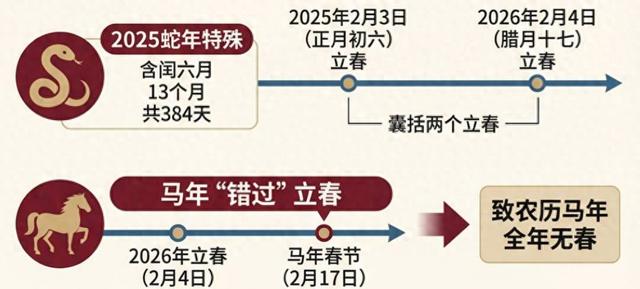
Core Viewpoint - The upcoming Year of the Horse will experience a "no spring year" phenomenon, which has led to widespread superstitions regarding marriage and auspiciousness, but these claims lack scientific basis [1][4]. Group 1: Explanation of "No Spring Year" - The "no spring year" occurs when there is no "Lichun" (the beginning of spring) in the lunar calendar, a phenomenon that averages 7 occurrences every 19 years and is unrelated to fortune or misfortune [1][2]. - The phenomenon is a result of the differences between the lunar and solar calendars, where the lunar calendar is based on moon phases and solar cycles, leading to variations in the corresponding dates of solar terms [1][2]. - In the 21st century, there have been 37 instances of both "no spring years" and "two spring years," indicating that "no spring years" are not rare, occurring approximately every 2 to 3 years [2]. Group 2: Cultural Beliefs and Misconceptions - The term "widow year" originates from "no spring year," reflecting ancient beliefs that link the absence of spring to fertility and marriage, leading to the superstition that marrying in a "no spring year" is inauspicious [4][5]. - Historical references indicate that the belief in "no spring year" being unlucky for marriage has been debunked by experts, who emphasize that such notions are based on folklore rather than scientific evidence [5]. - Various scholars have criticized the superstition surrounding "no spring year," labeling it as a form of superstition that should be challenged and corrected [5].