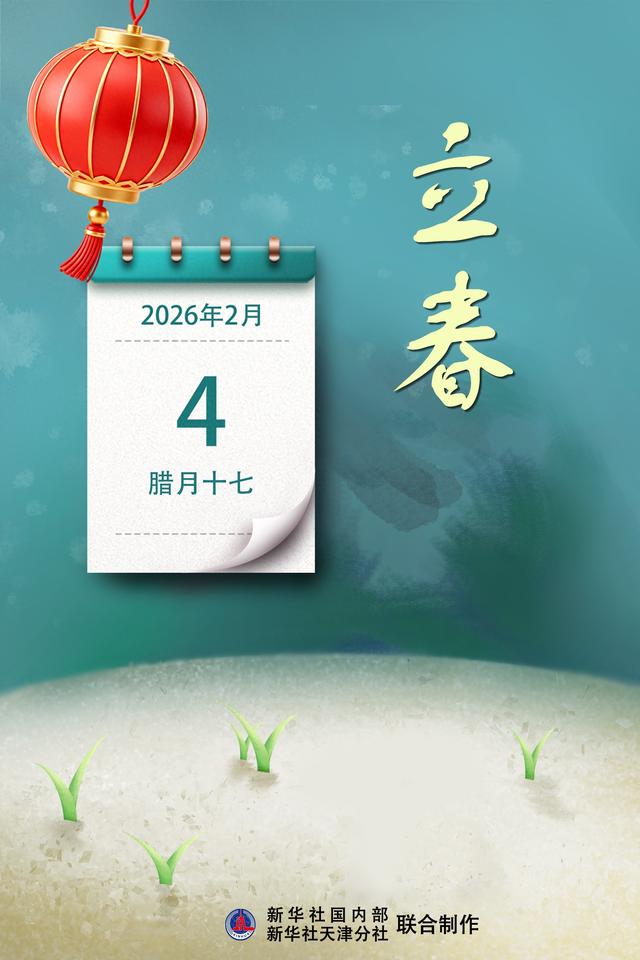
无春年

Search documents
“马年无春不宜结婚”是真的吗?天文专家揭秘
Yang Shi Wang· 2026-02-26 21:38
Core Viewpoint - The notion that the Year of the Horse (丙午马年) will have no "Lichun" (立春) is a misconception, as the year does indeed contain this solar term, albeit at the end of the year [1][3]. Group 1: Misconceptions about "No Spring Year" - The term "No Spring Year" refers to the year 2026, where the Lichun falls on February 4, which is still within the lunar calendar of the previous year [1]. - The claim that "No Spring Year" is a rare occurrence is a cognitive bias; such years are not uncommon [4]. - The concept of "Double Spring" (双春) or "Two Springs" is also prevalent, indicating that these phenomena are part of the natural calendar cycle [4]. Group 2: Calendar Mechanics - Lichun is fixed in the solar calendar around February 4, while the lunar calendar varies, leading to discrepancies in the timing of solar terms [5]. - The lunar calendar's adjustments, such as leap months, cause the solar terms to shift within the lunar year [5][7]. - On average, "No Spring Years" or "Double Spring Years" occur approximately every 19 years, with 7 occurrences, roughly every 2 to 3 years [7]. Group 3: Historical Context - Historical texts have never classified "No Spring" as a wedding taboo; this belief is a modern misinterpretation [8]. - The original term for a year without Lichun was "寡春年" (Guachun Year), which was later misinterpreted as "widow year" due to linguistic confusion [9]. - Traditional marriage practices in ancient China were not influenced by the presence or absence of Lichun, as evidenced by numerous marriage records from "No Spring Years" [9][11].

【8点见】提醒!中国公民近期避免前往日本
Yang Shi Wang· 2026-02-16 00:09
Group 1 - The Ministry of Industry and Information Technology is seeking public opinion on new standards that will increase requirements for physical control components in automobiles [1] - As of the end of 2025, the scale of public funds in China is expected to reach 37.71 trillion yuan [1] - New regulations in Nanjing for ride-hailing services will remove restrictions on driver residency and require platforms to disclose the maximum commission rates [8] Group 2 - The Spring Festival travel season will see over 175,000 youth volunteers providing services [1] - The weather conditions during the Spring Festival are generally suitable for travel, although some areas in central and eastern China may experience strong winds and rain or snow [1] - In 2026, Beijing will issue an additional 80,000 new energy vehicle license plates [1]

“马年‘无春’不宜结婚”疯传,真相来了
21世纪经济报道· 2026-02-15 12:42
Core Viewpoint - The notion that the Year of the Horse in 2026 is a "no spring year" is inaccurate, as it still includes the spring of 2027, which falls on February 4, 2027 [1][2]. Group 1: Lunar Calendar and Spring - The Year of the Horse (2026) will have its New Year on February 17, 2026, and will include the spring date of February 4, 2027, thus it is not a "no spring year" [1][2]. - The concept of "no spring year" and "double spring year" is a common phenomenon in the lunar calendar, which does not correlate with auspiciousness for marriage [2][3]. Group 2: Cultural Beliefs and Misconceptions - The belief that "no spring year" is inauspicious for marriage stems from ancient associations of spring with fertility and growth, leading to superstitions that lack scientific basis [2]. - Despite the misconceptions, millions of couples marry each year, and their marital success is not influenced by the presence or absence of spring in the lunar calendar [2].

马年“无春”不宜结婚?是真的吗?
Xin Lang Cai Jing· 2026-02-15 08:32
Core Viewpoint - The article discusses the phenomenon of "no spring year" in the upcoming Year of the Horse in 2026, which has led to various superstitions regarding marriage and fertility, despite being a natural result of the differences between lunar and solar calendars [1][4]. Group 1: Definition and Explanation - "No spring year" refers to a year without the solar term "Lichun" (立春), which is significant in Chinese culture, and is also known as "寡年" (guā nián) or "寡妇年" (widow year) [3][6]. - The occurrence of "no spring year" is a result of the lunar calendar's reliance on moon phases and solar cycles, leading to years where there may be no "Lichun" [4][5]. Group 2: Frequency and Historical Context - "No spring year" occurs approximately every 2 to 3 years in the lunar calendar, with examples including the years 2019, 2021, and 2024 [4]. - The concept of "no spring year" has been historically linked to fertility and marriage, with traditional beliefs suggesting it is inauspicious for weddings [6]. Group 3: Debunking Myths - Experts assert that the belief in "no spring year" being unlucky for marriage is unfounded and lacks scientific basis, emphasizing that it is merely a coincidence of calendar systems [5][6]. - The article encourages people to avoid spreading rumors and to embrace the upcoming Year of the Horse without superstition [6].

专家辟谣“马年无春”!称适不适合婚嫁也与历法现象无关
Nan Fang Du Shi Bao· 2026-02-15 07:37
Core Viewpoint - The notion that the Year of the Horse in 2026 is a "no spring year" is inaccurate, as it actually includes the spring festival of 2027, which falls on February 6, 2027 [1]. Group 1: Lunar Calendar and Spring Festival - The Year of the Horse (2026) will have its spring festival on February 17, 2026, and it includes the spring day of February 4, 2027, making the claim of a "no spring year" misleading [1]. - The lunar calendar has specific rules regarding leap months and the occurrence of spring days, which can lead to years with "no spring" or "double spring" [1]. Group 2: Cultural Beliefs and Marriage - The belief that "no spring years" are inauspicious for marriage stems from ancient associations of spring with fertility and growth, leading to superstitions that lack scientific basis [2]. - Despite these beliefs, millions of couples marry each year, and their marital success is not dependent on whether the lunar year has a spring [2]. - The next true "no spring year" will be in 2027, during the Year of the Sheep, further illustrating that such phenomena are common in the lunar calendar and do not affect individual destinies [2].
马年“无春”不宜结婚?是真的吗?
Xin Lang Cai Jing· 2026-02-15 04:15
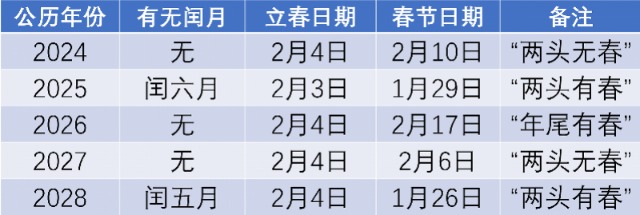
Core Viewpoint - The upcoming Year of the Horse will experience a "no spring year" phenomenon, which has led to widespread superstitions regarding marriage and auspiciousness, but these claims lack scientific basis [1][4]. Group 1: Explanation of "No Spring Year" - The "no spring year" occurs when there is no "Lichun" (the beginning of spring) in the lunar calendar, a phenomenon that averages 7 occurrences every 19 years and is unrelated to fortune or misfortune [1][2]. - The phenomenon is a result of the differences between the lunar and solar calendars, where the lunar calendar is based on moon phases and solar cycles, leading to variations in the corresponding dates of solar terms [1][2]. - In the 21st century, there have been 37 instances of both "no spring years" and "two spring years," indicating that "no spring years" are not rare, occurring approximately every 2 to 3 years [2]. Group 2: Cultural Beliefs and Misconceptions - The term "widow year" originates from "no spring year," reflecting ancient beliefs that link the absence of spring to fertility and marriage, leading to the superstition that marrying in a "no spring year" is inauspicious [4][5]. - Historical references indicate that the belief in "no spring year" being unlucky for marriage has been debunked by experts, who emphasize that such notions are based on folklore rather than scientific evidence [5]. - Various scholars have criticized the superstition surrounding "no spring year," labeling it as a form of superstition that should be challenged and corrected [5].
关于立春,这些趣味知识你了解吗?
Xin Lang Cai Jing· 2026-02-03 11:32
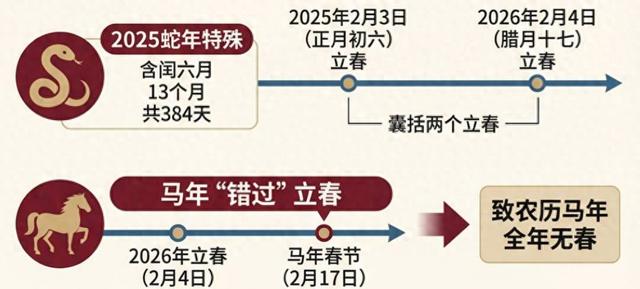
Group 1 - The beginning of spring is marked by the arrival of Lichun, which typically occurs on February 3rd, 4th, or 5th in the Gregorian calendar [4][3] - The concept of "counting the nines" starts from the winter solstice, totaling 81 days, indicating the cold period of winter [1] - Lichun signifies the start of spring farming activities and is associated with the agricultural calendar, indicating a fruitful year ahead [3][4] Group 2 - There are interesting phenomena related to Lichun, such as "no spring year," "single spring year," and "double spring year," which refer to the occurrences of Lichun in the lunar calendar [4] - The upcoming lunar year of the Horse will have only one Lichun on February 4, 2027, categorizing it as a "single spring year" [7] - Lichun can coincide with the Spring Festival, creating a unique overlap that signifies the start of both the solar and lunar new years [7]