出清

Search documents
风云变幻之下,景区行业压不住的“欠薪潮”
3 6 Ke· 2026-02-06 02:38
Core Viewpoint - The tourism industry is experiencing a wave of wage arrears and bankruptcies among small and medium-sized scenic spots, which is seen as a necessary process for the industry to hit rock bottom and rebound towards a market-oriented recovery [2][12]. Group 1: Wage Arrears Cases - A 4A scenic spot has been reported for long-term wage and social security arrears, with court documents indicating that wage delays began as early as the second half of 2024 [3][4]. - In 2023, a theme park in Huzhou, Zhejiang, owed over 2 million yuan to 32 employees due to poor management and subsequently ceased operations [5]. - In 2024, a 4A scenic spot in Maoming, Guangdong, faced over 5 million yuan in wage and social security arrears and sought government assistance [6]. Group 2: Industry Analysis - The tourism industry has shown a "Pareto principle" effect, where 20% of top scenic spots attract 80% of visitors, leaving 80% of smaller scenic spots to compete for only 20% of the traffic [8]. - The changing consumer habits, influenced by factors like consumption downgrade, have led to a decline in visitor numbers and revenue for smaller scenic spots, even during peak seasons [8][10]. - The internal issues of smaller scenic spots, such as outdated services and mismanagement, have exacerbated their financial struggles, leading to a cycle of operational failures [9][10]. Group 3: Industry Restructuring - The wave of wage arrears is often followed by a more severe wave of bankruptcies, with several scenic spots already filing for bankruptcy or being put up for sale due to poor management [12][14]. - The concept of "cleansing" in economics suggests that the industry must eliminate inefficient operators to return to healthy market development, which is currently hindered by many "zombie scenic spots" that lack operational capability [14][15]. - The current crisis is viewed as an opportunity for the industry to restructure, allowing for the emergence of new operators and improved resource allocation, ultimately leading to a healthier tourism sector [17][19].


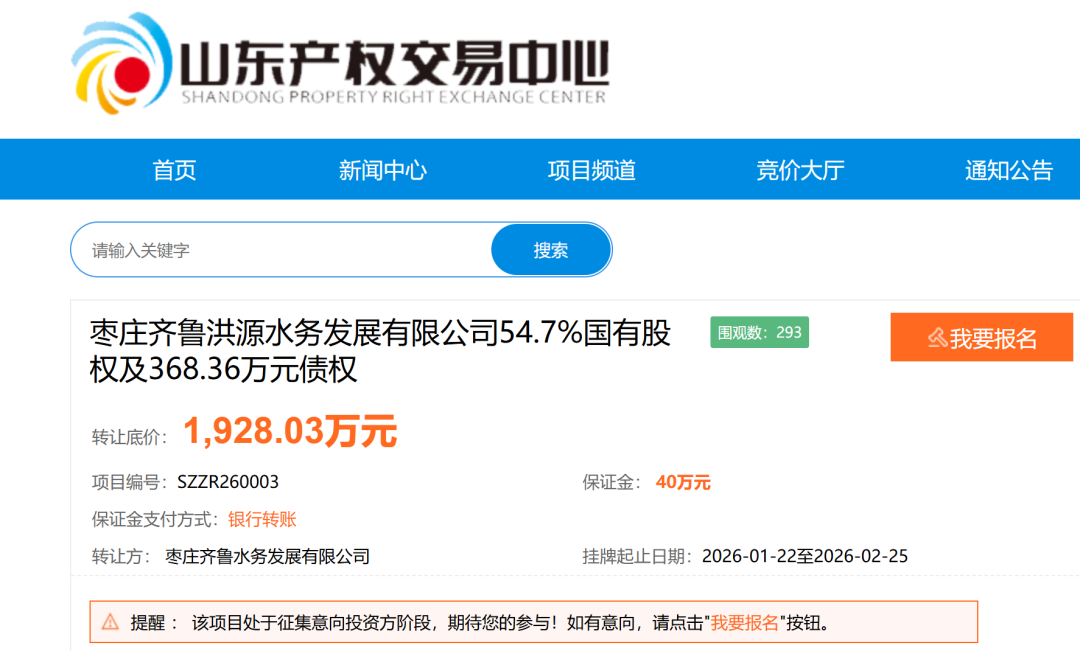
底价1928.03万元,枣庄齐鲁洪源水务54.7%国有股权及债权挂牌转让
Xin Lang Cai Jing· 2026-01-24 00:01
Core Viewpoint - The transfer of 54.7% state-owned equity and a debt of 3.6836 million yuan from Zaozhuang Qilu Water Development Co., Ltd. to Zaozhuang Qilu Hongyuan Water Development Co., Ltd. is currently being listed, with a minimum transfer price of 19.2803 million yuan. The company has not generated any actual business revenue in the past two years [1][3]. Group 1: Company Overview - Zaozhuang Qilu Hongyuan Water Development Co., Ltd. was established on August 28, 2018, with a registered capital of 50 million yuan, focusing on water supply, sewage treatment, and water resource management [3]. - The ownership structure indicates that Zaozhuang Qilu Water Development Co., Ltd. holds 54.7% of the shares, while Zaozhuang Hongyuan Water Supply Co., Ltd. owns 45.3%. The company is currently listed as a dishonest executor, and its legal representative is restricted from high consumption [3]. Group 2: Financial Status - As of 2024, Zaozhuang Qilu Hongyuan Water Development Co., Ltd. reported total assets of 50.8846 million yuan, total liabilities of 11.5 million yuan, with zero operating income and a net loss of 62,600 yuan [3]. - By June 30, 2025, the company's total assets increased to 51.0896 million yuan, total liabilities rose to 11.705 million yuan, with both operating income and net profit remaining at zero. By December 31, 2025, total assets decreased to 45.972 million yuan, total liabilities were 6.4691 million yuan, with no operating income or net profit reported [3]. Group 3: Strategic Focus - Shandong Environmental Development Ecology Co., Ltd., the major shareholder of Zaozhuang Qilu Water Development Co., Ltd., emphasized the need to focus on "integration, revitalization, and clearance" in its 2025 work meeting, aiming to achieve new growth through cost reduction and efficiency improvement [4]. - The "clearance" strategy involves the firm commitment to disposing of non-compliant assets and concentrating on advantageous sectors to foster new efficient development paths [4].