券商合并协同效应

Search documents
国泰海通合并后首份半年报:Q2单季度营收同比下滑 “1+1<2”该当何解?
Xin Lang Zheng Quan· 2025-09-01 07:37
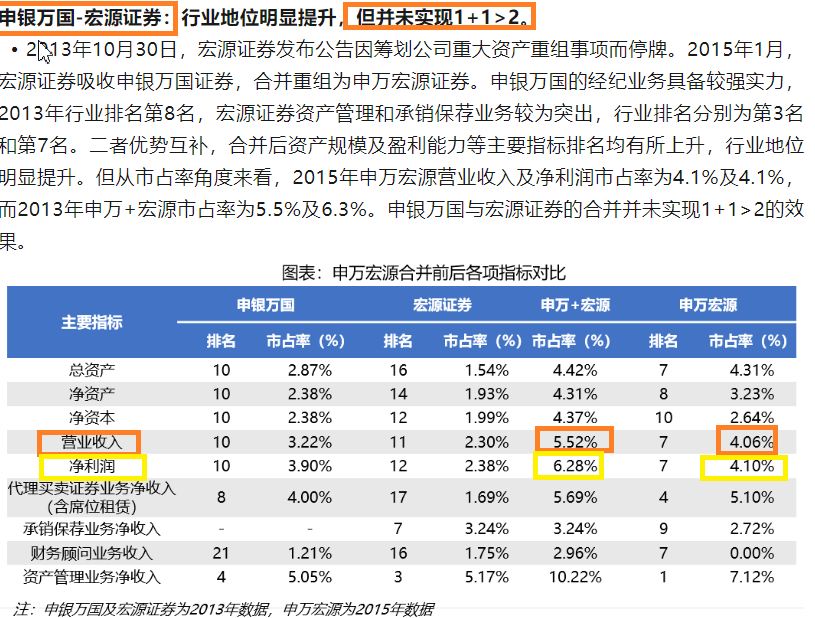
Core Viewpoint - Guotai Junan and Haitong Securities' merger has not yet demonstrated the expected synergies, as evidenced by the second quarter revenue being lower than the combined revenue of the two firms prior to the merger [1][3][7]. Financial Performance - In the first half of the year, Guotai Haitong achieved a total revenue of 238.72 billion yuan, a year-on-year increase of 77.71%, and a net profit attributable to shareholders of 157.37 billion yuan, up 213.74% [2]. - The second quarter revenue was reported at 120.99 billion yuan, which is nearly 11 billion yuan less than the combined revenue of Guotai Junan and Haitong Securities before the merger [1][3]. Profitability Analysis - Guotai Haitong's net profit excluding non-recurring items ranked third in the industry, with a figure of 72.79 billion yuan, reflecting a year-on-year growth of 59.76% [2][3]. - The significant non-recurring profit of approximately 80 billion yuan, primarily from negative goodwill, raises concerns about the sustainability of the reported profits [3][5]. Comparison with Competitors - Major competitors like CITIC Securities, China Galaxy, and Huatai Securities reported substantial growth in both revenue and net profit during the same period, highlighting Guotai Haitong's underperformance [4][3]. - For instance, CITIC Securities achieved a revenue of 152.78 billion yuan in the second quarter, a year-on-year increase of 11.69% [4]. Merger Synergy Concerns - The merger's effectiveness is questioned as the anticipated synergies have not materialized, with the second quarter results indicating a lack of operational efficiency [1][7]. - Historical examples of mergers in the industry suggest that achieving synergies can be challenging, with some firms experiencing prolonged integration issues [11][12]. Derivative Financial Instruments - Guotai Haitong reported a negative fair value change of 35 billion yuan in derivative financial instruments, indicating potential risks in their investment strategies [13][16]. - The company holds significant liabilities in equity derivatives, which could lead to substantial losses if market conditions do not improve [18].