原创

Search documents
杨本芬道歉,为何争议难平?
Xin Lang Cai Jing· 2026-02-28 03:43
Core Viewpoint - The article discusses the controversy surrounding the elderly writer Yang Benfen, who has been accused of plagiarism in her works, despite her late success in literature and the admiration she has garnered from readers [1][2]. Group 1: Plagiarism Controversy - Yang Benfen, an 80-year-old author, faces allegations of plagiarism after a comparison of her texts revealed similarities with other works, leading to public outcry [1]. - The public's sympathy for Yang's late literary success does not excuse the ethical boundaries of writing, which apply to all authors regardless of age or background [2]. Group 2: Apology and Recognition - Yang's apology acknowledges her misunderstanding of writing ethics, as she believed that borrowing phrases was inconsequential until the controversy arose [2]. - The distinction between "borrowing" and "plagiarism" is emphasized, highlighting that while influence is natural in writing, direct copying without attribution crosses a critical line [2][3]. Group 3: Reader Sentiment - Readers express a mix of disappointment and compassion, recognizing Yang's struggles while also maintaining a commitment to literary integrity and originality [3]. - The article stresses that the essence of literature lies in originality and sincerity, and any breach of this principle can damage the relationship between authors and their audience [3].
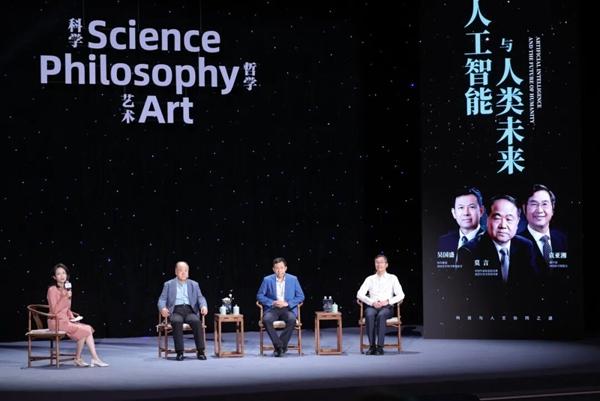
莫言:试过用AI搞创作,文章毫无情感和思想
Zhong Guo Qing Nian Bao· 2025-09-28 23:36
Core Viewpoint - The dialogue emphasizes the importance of human values and creativity in the age of artificial intelligence, asserting that technology should complement rather than replace human intellect and emotion [1][2][4]. Group 1: Event Overview - The dialogue titled "Science, Philosophy, and Art: The Path of Synergy between Technology and Humanities" was held at Renmin University of China on September 23 [3]. - Notable participants included Nobel laureate Mo Yan, mathematician and academician Yuan Yaxiang, and historian of science Wu Guosheng, who discussed the implications of AI on humanity's future [1][3]. Group 2: Perspectives on AI - Mo Yan expressed skepticism about AI's creative capabilities, stating that AI-generated content lacks genuine emotion and thought, relying instead on human originality [1][2]. - Yuan Yaxiang argued that even with the emergence of strong AI, human intelligence remains superior, as AI advancements are fundamentally rooted in human mathematical breakthroughs [1][2]. - Wu Guosheng highlighted that concerns about AI replacing humans are unfounded, suggesting that the real issue lies in the potential for AI to foster laziness and moral decline in society [2]. Group 3: Human Values and Education - The discussion underscored the need to cherish the uniqueness of human civilization to effectively navigate the challenges posed by AI, promoting optimism and confidence in the future [2]. - Zhang Donggang, the Party Secretary of Renmin University, emphasized that in times of rapid technological advancement, it is crucial to uphold a human-centered approach in education and development [4].