取消统考

Search documents
取消统考后,湖南娃们这个期末考试到底咋考?
Xin Lang Cai Jing· 2026-01-18 02:59
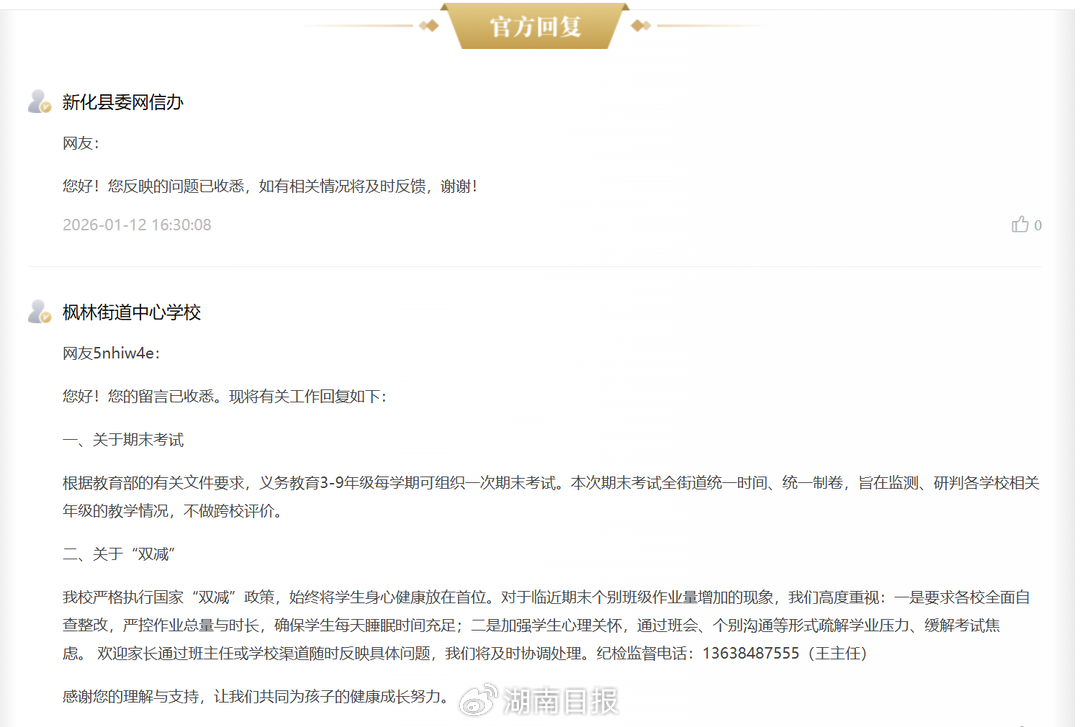
Core Viewpoint - The implementation of the "reduction of exams" policy by the Ministry of Education has led to significant changes in the assessment methods for students in Hunan, with a focus on local adaptations and the elimination of standardized testing for non-graduating grades [1][2]. Group 1: Policy Implementation - The Ministry of Education's directive prohibits regional or inter-school exams for elementary and non-graduating middle and high school grades, effective by the end of 2025 [1]. - Local education authorities in Hunan are developing their own plans, emphasizing "unified timing and autonomous selection of exam papers" [2]. - In Changsha, grades one and two will not have written tests, while grades three to six will have standardized testing for Chinese and mathematics, with other subjects scheduled independently by schools [2]. Group 2: Variability in Implementation - There are noticeable differences in how the policy is applied across various districts, with some schools still conducting unified tests despite the new regulations [2][4]. - For example, a school in Xinhu County initially planned a unified exam for sixth graders but later expanded it to fourth graders, causing increased pressure on students [2]. Group 3: Exam Paper Sourcing - The cancellation of standardized tests raises questions about the sourcing of exam papers, with many districts still providing centralized exam paper services for schools to choose from [5]. - In Changsha's Yuhua District, the education bureau will offer written test papers for grades three to six, allowing schools to decide whether to use them [5]. Group 4: Educational Assessment Philosophy - The shift away from standardized testing is seen as a move towards more tailored assessments that reflect individual student learning conditions, allowing for differentiated teaching approaches [6]. - The education authorities emphasize that the cancellation of standardized tests does not equate to a reduction in assessment quality, as schools are encouraged to adopt evaluation methods suited to their specific contexts [5]. Group 5: Parental Perspectives - Many parents support the cancellation of standardized tests, believing it will reduce pressure on students, while others express concerns about the lack of a unified evaluation standard [7][10]. - The tension between the new assessment methods and the existing high-stakes examination system for college admissions remains a significant concern for families [10].