
合理需求与摸鱼违纪区分

Search documents
男子1月内11次长时间滞留卫生间,单日最长达6小时21分钟,被公司解雇,法院:超出合理生理需求
Xin Lang Cai Jing· 2026-02-01 11:05
Core Viewpoint - Recent court cases in Jiangsu and Beijing highlight the legal distinctions between legitimate employee restroom use and excessive absenteeism, impacting company policies on employee conduct [1] Group 1: Case Summaries - In Jiangsu, an employee named Liu was dismissed after spending excessive time in the restroom, with 11 instances of prolonged absence within a month, the longest being 6 hours and 21 minutes, which the court deemed as exceeding reasonable biological needs and classified as de facto absenteeism, thus validating the company's termination [1] - In contrast, in Beijing, an employee named Li experienced sudden abdominal pain and took a 3-minute restroom break while notifying a colleague to cover for him, which the court ruled as a normal biological occurrence, leading to a judgment against the company for unlawful termination, requiring compensation of over 60,000 yuan [1] Group 2: Legal Insights - Legal experts emphasize the importance of distinguishing between "reasonable needs" and "work evasion," focusing on the employee's intent (whether to avoid work) and the reasonableness of their behavior (duration and frequency of restroom use) in relation to job responsibilities [1] - Companies must exercise their rights regarding employee management within the boundaries of legality and reasonableness, ensuring that policies are compliant with labor laws [1]

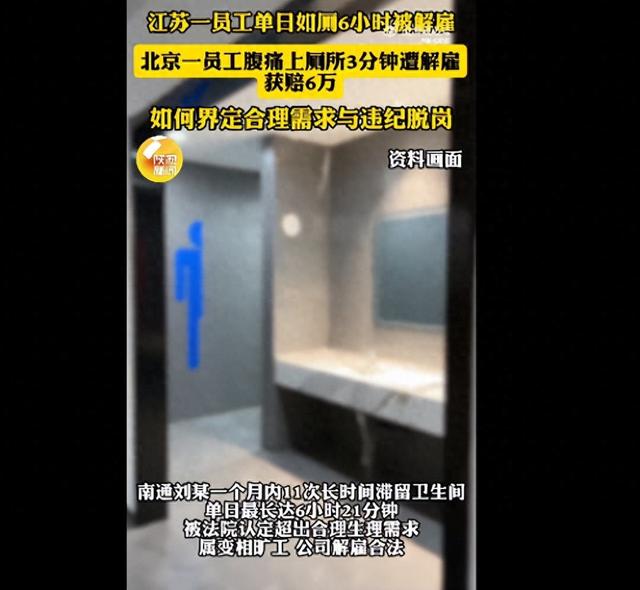
员工腹痛上厕所3分钟遭解雇获赔6万
Xin Lang Cai Jing· 2026-01-31 12:17
Core Viewpoint - The article discusses two labor dispute cases regarding employee restroom usage, highlighting the legal distinctions between reasonable physiological needs and misconduct in the workplace [1] Group 1: Case Summaries - In the first case from Nantong, an employee named Liu was dismissed for spending excessive time in the restroom, totaling 6 hours and 21 minutes in one day, which the court deemed beyond reasonable physiological needs and classified as absenteeism [1] - In the second case from Beijing, an employee named Li was found to have acted reasonably when he took a 3-minute restroom break due to sudden abdominal pain while on duty, leading to a ruling that the company's dismissal was illegal, resulting in compensation of over 60,000 yuan [1] Group 2: Legal Insights - Legal experts emphasize the importance of distinguishing between "reasonable needs" and "misconduct," focusing on the employee's intent (whether they were avoiding work) and the appropriateness of their behavior in terms of duration and frequency [1] - Companies must adhere to legal boundaries when exercising their rights over employee conduct, ensuring that dismissals are justified and compliant with labor laws [1]