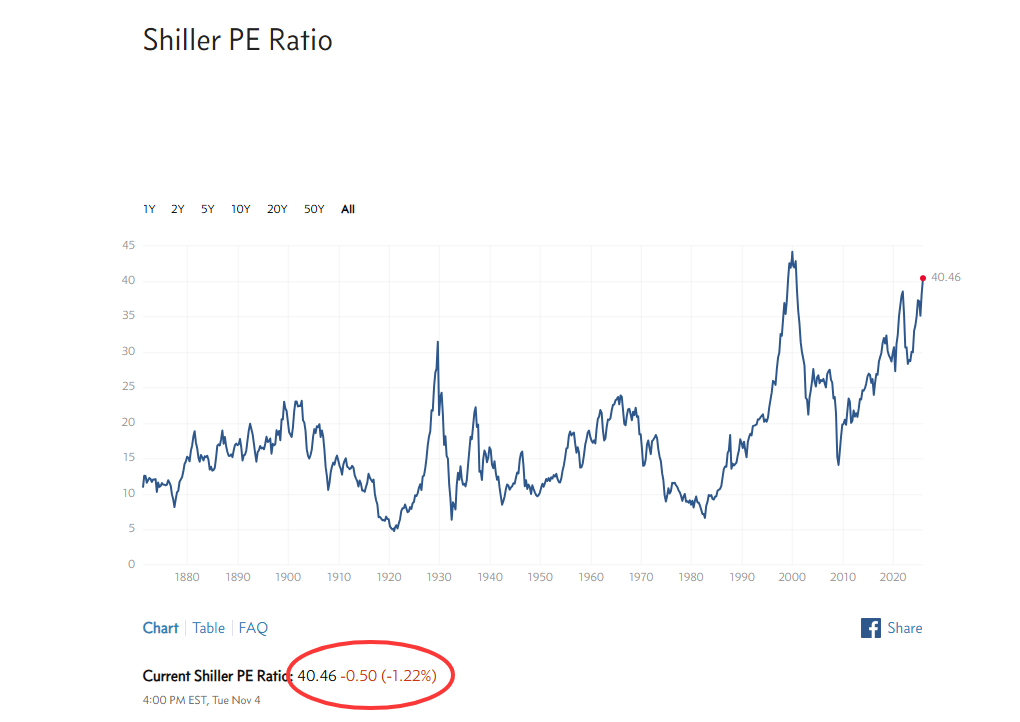
周期性调整市盈率(CAPE或Shiller P/E)

Search documents
敏感时刻,美股警报连连!著名估值指标“史上第二次”突破红线,上一次是1999年
Hua Er Jie Jian Wen· 2025-11-05 00:59
Core Viewpoint - The "Cyclically Adjusted Price-to-Earnings" (CAPE or Shiller P/E) ratio has recently surpassed 40, signaling a warning for the U.S. stock market and suggesting that investors should lower their return expectations for the coming years [1][4]. Valuation Concerns - Historically, peaks in the Shiller P/E ratio have often preceded poor market performance, with negative real returns recorded in the following decade after peaks in 1929, 1966, and 2000 [4]. - The current Shiller P/E level above 40 indicates that stock prices are at a high not seen in 99% of historical time [6]. Historical Context - The long-term average for the Shiller P/E is approximately 17, and even adjusting for modern economic changes, the average since 1990 is only about 27 [5]. - The current valuation is significantly higher than historical averages, raising concerns about sustainability [5]. Market Sentiment and Debate - Some market participants argue that the quality of companies in major indices has improved, with a higher proportion of high-margin, asset-light firms like Microsoft [7]. - Optimism surrounding artificial intelligence (AI) is also noted, but its impact must be transformative and lasting to justify current valuations [7]. Future Return Expectations - The Shiller P/E is not a precise market timing tool, but it serves as an important indicator of long-term risks, suggesting that price corrections are more likely than earnings growth exceeding expectations [8]. - Predictions indicate that the annualized real return for large growth stocks, including the "Tech Seven," is expected to be -1.1%, while large value stocks may achieve a 1.6% positive return [10]. Asset Class Differentiation - Research Affiliates' model based on Shiller P/E forecasts significant divergence in future return expectations across asset classes, with small-cap stocks, European equities, and emerging market stocks projected to have annualized real returns of 4.8%, 5.0%, and 5.4%, respectively [10].