固收类理财产品

Search documents
【笔记20260327— 发行失败】
债券笔记· 2026-03-27 10:00
Core Viewpoint - The article discusses the current market conditions, highlighting the balance in the funding environment, fluctuations in interest rates, and the impact of geopolitical events on the stock and bond markets. Group 1: Market Conditions - The funding environment is described as balanced and slightly loose, with the central bank conducting a 1,462 billion yuan reverse repurchase operation, resulting in a net injection of 1,257 billion yuan after 205 billion yuan matured [3]. - The interbank funding rates are stable, with DR001 around 1.32% and DR007 around 1.44% [3]. Group 2: Interest Rates - The weighted rates for various interbank funding products show slight fluctuations, with R001 at 1.39% (down 0.75 basis points), R007 at 1.51% (down 2 basis points), and R014 at 1.52% (down 1 basis point) [4]. - The total transaction volume for R001 was 65,725.93 million yuan, reflecting a decrease of 1,061.71 million yuan, while R007 had a transaction volume of 8,313.44 million yuan, down by 1,122.50 million yuan [4]. Group 3: Geopolitical Impact - President Trump announced a 10-day pause on attacks against Iranian energy facilities, which contributed to a slight increase in the stock market, while bond market rates experienced volatility [5]. - The 10-year government bond yield fluctuated around 1.8225%, reflecting the market's response to geopolitical tensions [5]. Group 4: Corporate Developments - The article notes significant layoffs planned by major companies, including Google (1,200 employees) and HSBC (20,000 employees), indicating a trend of workforce reductions in the corporate sector [6]. - The commentary suggests a shift in job security, with tech workers feeling the impact of layoffs despite expectations that AI would primarily affect coding jobs [6].

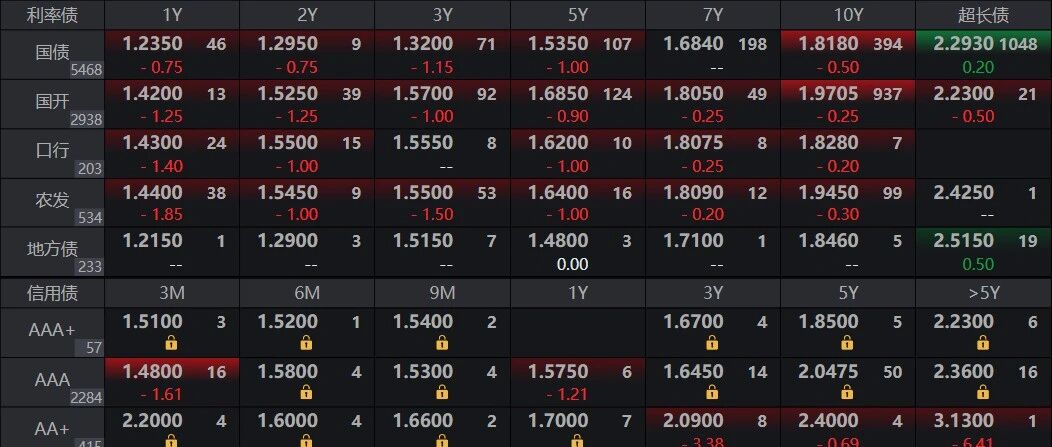
“降费潮”来了!买1万银行理财,年管理费低至1块钱
经济观察报· 2025-06-12 10:15
Core Viewpoint - The recent fee reduction in the banking wealth management sector primarily targets management and sales fees, with some smaller banks implementing more significant reductions compared to state-owned banks [1][5]. Fee Reduction Details - Minsheng Wealth Management has reduced the fixed management fee rate of a pure fixed-income product from 0.5% to 0.05% [2]. - Since the interest rate cut on deposits began on May 20, several banks, including Minsheng Wealth Management, have initiated fee reductions, with some products' fixed management fees dropping to as low as 0.01% [3]. - Agricultural Bank of China announced multiple fee reductions, including a significant drop in management fees for cash management products from 0.3% to 0.01% [4]. - Other banks, such as China Minmetals Bank and Everbright Wealth Management, have also announced fee reductions for various fixed-income products [6][7][8]. Market Dynamics - The average fixed management fee rate across the banking wealth management market has decreased to 0.1865%, down 0.45 basis points from the end of 2023 [11]. - The fee reduction trend is driven by increased competition, regulatory guidance, and a shift from extensive growth to refined operations within the wealth management industry [11][12]. - Smaller wealth management companies are more aggressive in fee reductions to quickly expand their market share, while larger banks focus on enhancing research and service quality [3][11]. Strategic Implications - The fee reductions are seen as a short-term strategy to attract customers and respond to declining interest rates, with the potential for ultra-low fee products to become a norm among leading firms [12]. - Long-term sustainability of such low fees may be challenging for smaller firms due to operational costs and revenue pressures [12]. - The industry may need to shift from a "scale-driven" approach to a "value-driven" strategy, focusing on optimizing asset allocation and improving risk management for sustainable returns [12].