国内生产总值(GDP)

Search documents
2025年中国居民人均可支配收入增长5%
Zhong Guo Xin Wen Wang· 2026-01-19 06:30
Core Insights - In 2025, China's per capita disposable income is projected to reach 43,377 yuan, reflecting a nominal growth of 5.0% and a real growth of 5.0% after adjusting for price factors [1] - Rural residents are expected to experience a faster income growth rate compared to urban residents, with urban per capita disposable income at 56,502 yuan (nominal growth of 4.3%, real growth of 4.2%) and rural per capita disposable income at 24,456 yuan (nominal growth of 5.8%, real growth of 6.0%) [1] - The income growth rate for rural residents exceeds that of urban residents by 1.5 percentage points nominally and 1.8 percentage points in real terms, leading to a reduction in the income disparity between urban and rural areas [1] Economic Context - The growth in residents' income is expected to align with the GDP growth rate, with rural income growth outpacing GDP growth [1] - Achieving these income growth figures amidst domestic and international pressures is considered a significant accomplishment [1]
脱欧公投后决策幽灵再现?英国央行偏信PMI遭经济学家警告
智通财经网· 2025-06-09 07:14
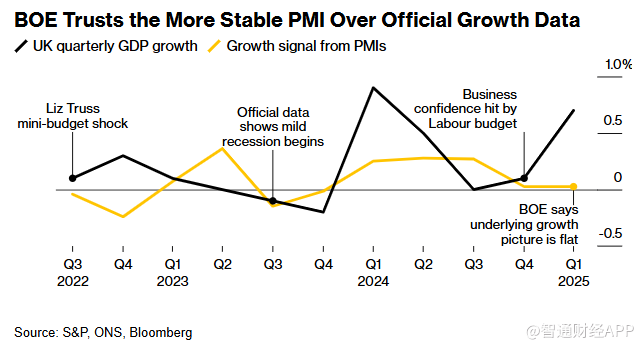
Group 1 - The Bank of England is focusing more on the S&P Global Purchasing Managers' Index (PMI) and has warned of increased volatility in GDP data [1] - The PMI is viewed as a more stable indicator of economic conditions compared to official GDP data, which showed a strong recovery of 0.7% in Q1 [3] - There are concerns that relying on PMI could lead to misleading conclusions about actual economic growth, as it reflects sentiment rather than concrete growth [3][7] Group 2 - The PMI showed almost zero growth in Q1, with a decline into contraction territory in April due to uncertainty surrounding U.S. tariff policies, before rebounding to flat in May [3] - The services sector, which constitutes the largest part of the UK economy, is showing strong performance despite the PMI's mixed signals [7] - Political events have significantly impacted PMI and other business surveys, often leading to sharp declines, while official data like GDP and unemployment rates have remained stable [7] Group 3 - There is a risk that different indicators are sending conflicting signals about demand, necessitating more time for the Bank of England to understand the driving forces behind economic growth [8]