国家治理体系现代化

Search documents
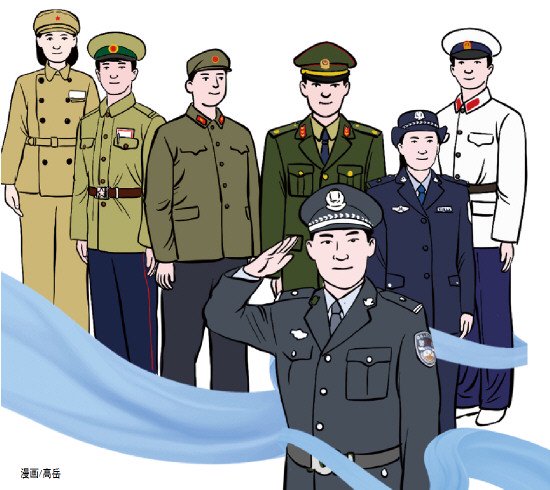
警服变迁:一段具象的法治发展史
Xin Lang Cai Jing· 2026-01-17 18:43
Core Viewpoint - The introduction of the 2025 police uniform marks the first comprehensive change in the attire of the People's Police since the new era, enhancing the seriousness and standardization of law enforcement, while also boosting the sense of honor and belonging among police officers [3]. Historical Evolution of Police Uniforms - The evolution of police uniforms in China has undergone nine significant reforms, reflecting societal changes and the integration of legal spirit with aesthetic design [3]. - The initial police uniforms were similar to military attire, indicating the historical context where police forces were not fully independent from military structures [4]. - The establishment of a formal police uniform system in 1950 introduced a color scheme that conveyed stability, marking a clear distinction between military and police roles [4]. - Subsequent designs, such as the 1955 and 1983 uniforms, incorporated elements that emphasized clarity in law enforcement and a modernized image for female officers [4][6]. Modernization and Technological Upgrades - The 2025 police uniform retains the basic design of the 1999 version but introduces significant improvements in functionality, variety, and materials [7]. - Key enhancements include the introduction of tactical clothing for frontline officers, a reduction in less commonly used uniform types, and the use of advanced domestic materials to improve performance characteristics [7]. - The overall cost of issuing the new uniforms is expected to decrease by approximately 2.36% compared to current standards, reflecting a strategic approach to resource allocation [7]. Cultural Significance - The evolution of police uniforms illustrates the transition from a militarized management style to a service-oriented legal framework, symbolizing the unique charm of the socialist rule of law in China [7]. - The 2025 police uniform serves not only as a functional garment but also as a representation of the country's progress towards legal civilization [7].

学习贯彻党的二十届四中全会精神丨“银发和事佬”激活基层治理末梢神经
He Nan Ri Bao· 2025-12-01 23:39
Core Viewpoint - The establishment of the "Silver-Haired Mediators" volunteer service team in Juqiao Town effectively addresses local conflicts and enhances community harmony through the involvement of respected elderly individuals [1][2]. Group 1: Community Conflict Resolution - Juqiao Town faces challenges in rural governance due to numerous construction projects and land requisitions, leading to potential conflicts [1]. - The "Silver-Haired Mediators" team consists of retired officials, party members, and teachers who are selected based on their political reliability and community respect [1]. - The town implements a "pre-mediation, central petition, judicial guarantee, and platform operation" model to streamline conflict resolution, ensuring that residents only need to visit one location for assistance [1]. Group 2: Mediation Success Stories - Mediators like Xiong Jinxiu share numerous successful mediation stories, including helping dropouts return to school and reconciling family disputes [2]. - The mediators utilize three key skills: "foot power" for community engagement, "eye power" for discernment, and "heart power" for persuasion [2]. - The "Silver-Haired Mediators" have developed a five-step working method to enhance their mediation effectiveness, contributing to improved neighborly relations and a harmonious rural atmosphere [2]. Group 3: Future Governance Initiatives - The local government plans to further implement the spirit of the 20th National Congress, encouraging community participation in social governance to modernize grassroots governance systems [2]. - The ongoing efforts of the "Silver-Haired Mediators" reflect the modernization of the national governance system at the grassroots level, emphasizing the importance of community harmony and conflict resolution [2].
“没有中国共产党,就没有新中国” 巴西学者为何对这句话记忆犹新?丨世界观
Zhong Guo Xin Wen Wang· 2025-07-05 02:40
Core Viewpoint - The achievements of the Communist Party of China (CPC) are highlighted as essential for the establishment and development of New China, emphasizing its role in economic and political reforms since 1949 [2]. Group 1: Achievements of the CPC - The CPC has successfully implemented extensive economic and political reforms that align with the needs of the country and its people [2]. - The leadership of the CPC is credited with extraordinary capabilities in guiding China to its current status through various reforms [2]. Group 2: International Cooperation - Brazil and China, as significant representatives of the Global South, have engaged in extensive cooperation within frameworks like BRICS and G20, focusing on reforming and improving global governance [2]. - Investment and trade have emerged as key highlights in the cooperation agenda between Brazil and China [2]. Group 3: Future Interactions - There is a hope for increased interaction between Brazil and China in areas such as environmental protection, technological innovation, and cultural exchange, promoting mutual visits between the two nations [3].