
国际军事合作

Search documents
特朗普抱怨:盟友不热心
财联社· 2026-03-17 01:09
Core Viewpoint - The ongoing conflict in the Middle East, particularly the war involving Iran, has led to significant geopolitical tensions and economic implications, especially concerning energy prices and supply routes in the Strait of Hormuz. Group 1: U.S. and Allies' Military Involvement - President Trump has called for U.S. allies to send naval vessels to ensure the safety of oil tankers in the Strait of Hormuz, but has faced resistance and lack of enthusiasm from several countries [1][2] - Germany's Chancellor Merz stated that Germany would not participate in military actions to protect oil tankers, emphasizing NATO's defensive nature rather than interventionist roles [3][4] - The UK Prime Minister Starmer indicated that restoring navigation in the Strait is not an easy task and that the UK will not be drawn into a broader Middle Eastern conflict [4][5] Group 2: Responses from Other Countries - Australia has also rejected Trump's proposal, with officials stating that the country is prepared for the economic crisis stemming from the Middle East conflict, citing fuel reserves sufficient for 37 days of gasoline, 30 days of diesel, and 29 days of aviation fuel [6] - Japan is cautious about sending naval vessels to the Middle East, with officials noting that any such decision would face high thresholds due to the ongoing conflict [6] - South Korea is monitoring the situation closely and will communicate with the U.S. before deciding on any military action, while civil groups in South Korea have expressed opposition to involvement in the conflict [7][8] Group 3: European Stance - France has ruled out sending naval vessels to the Strait, maintaining a purely defensive stance and indicating no plans to deploy its aircraft carrier [9] - The EU has expressed a desire to remain uninvolved in the conflict, with officials stating that it is not Europe's war and focusing on maritime security in the Red Sea instead [10]


“这称得上是一场战斗”,在“锋刃”现场直击国际狙击手巅峰对决
Huan Qiu Shi Bao· 2025-07-20 22:57
Core Viewpoint - The "Blade-2025" international sniper shooting competition, held in Urumqi, Xinjiang, showcases elite snipers from over 20 countries, emphasizing practical training and international military cooperation [1][3]. Group 1: Competition Structure and Features - The competition's course design draws from real combat scenarios, enhancing its practical nature by referencing recent successful operations by the Chinese armed forces and global counter-terrorism strategies [3]. - There are 12 competition events categorized into four types: basic precision shooting, typical scenario shooting, comprehensive combat shooting, and extreme challenge shooting, all designed with high realism [3][6]. - The extreme challenge shooting segment aims to set records for the longest sniper shots, with distances reaching up to 2000 meters, integrating advanced technology such as drones for reconnaissance [6]. Group 2: Cultural and Collaborative Aspects - The competition allows participants to use their own sniper equipment or choose Chinese-made rifles, highlighting the appeal of "Made in China" products among international competitors [7]. - Cultural elements are integrated into the competition, with course names and target designs reflecting Chinese heritage, fostering a unique competition atmosphere [8]. - The event serves as a platform for knowledge exchange among top snipers, enhancing their skills and fostering international cooperation in military training [9].
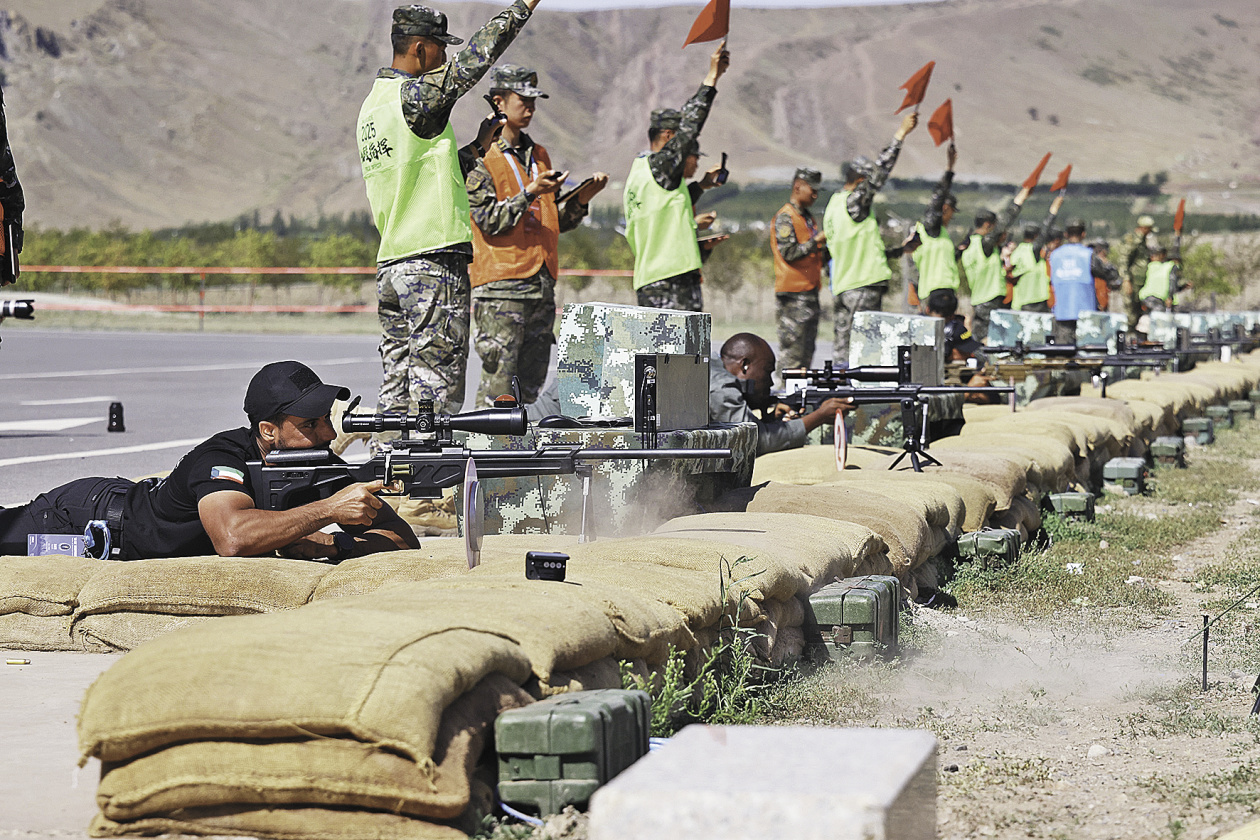
中外神枪手上演“百步穿杨”——“锋刃-2025”国际狙击手射击竞赛侧记
Xin Hua She· 2025-07-19 10:35
Core Viewpoint - The "Fengren-2025" International Sniper Shooting Competition successfully concluded in Urumqi, Xinjiang, showcasing the evolution of international special operations and providing a platform for counter-terrorism forces to exchange and demonstrate their skills [1][5]. Group 1: Competition Overview - The competition featured over 50 sniper teams from more than 20 countries, including Belarus, Kazakhstan, South Africa, Spain, and Cuba, competing in 12 practical scenarios across four categories [1]. - The event emphasized a combination of technology and tactics, upgrading aspects such as shooting distance and human-equipment integration to align with international special operations trends [1]. Group 2: Competition Structure - The "Infiltration Sniping" event was noted as the most complex, requiring teams to perform seven tasks over a distance of 1100 meters, utilizing both handguns and sniper rifles at varying distances [2]. - The "Boat-based Water Sniping" event introduced increased difficulty by transitioning from a land-based platform to a watercraft, enhancing the realism of the shooting scenarios [2]. Group 3: Judging and Technology - The competition's judges had extensive experience in international sniper competitions and were equipped with an upgraded intelligent scoring system that included real-time monitoring and scoring capabilities [3]. - The event featured over 120 high-definition cameras to ensure transparency and fairness in scoring, with live broadcasts of the competition [3]. Group 4: Cultural Integration - The competition incorporated elements of Chinese culture into its events, such as the "Dark Arrow Blade" and "Hundred Steps to Hit the Target," enhancing the uniqueness of the competition [4]. - Participants engaged in discussions on practical skills and techniques, fostering professional dialogue that transcended language barriers [4]. Group 5: Strategic Importance - The "Fengren" competition serves as a significant platform for practical training and international military cooperation, allowing sniper teams to share tactical wisdom that can enhance their operational capabilities against international terrorism [5].
法国、德国、意大利、波兰、西班牙、英国和欧盟外交部长联合声明:同意与乌克兰合作,推动加强乌克兰武装部队、补充弹药和装备的各项举措。
news flash· 2025-05-12 13:57
Core Viewpoint - The foreign ministers of France, Germany, Italy, Poland, Spain, the UK, and the EU have agreed to collaborate with Ukraine to enhance its armed forces and to supplement ammunition and equipment [1] Group 1 - The joint statement emphasizes the commitment of these countries to support Ukraine in strengthening its military capabilities [1] - The collaboration aims to address the urgent need for ammunition and equipment for the Ukrainian armed forces [1]