士绅化

Search documents
周德宇:从羊吃人到房子吃人到AI吃人,资本主义从来不缺物吃人
Xin Lang Cai Jing· 2025-12-21 04:12
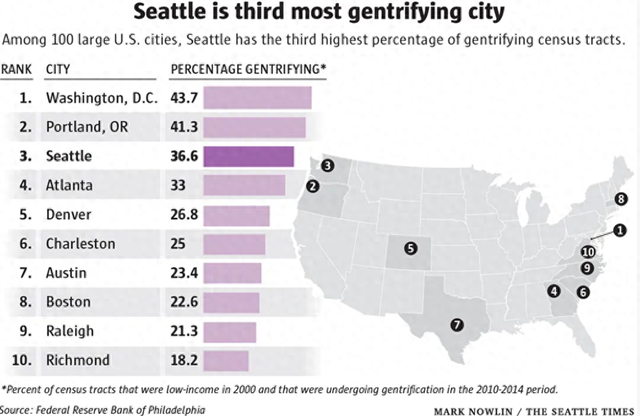
Core Viewpoint - The article discusses the severe gentrification issue in Seattle, highlighting the negative consequences for lower-income residents as the city becomes more affluent and attractive to capital and talent [1][4]. Group 1: Gentrification Definition and Impact - Gentrification is described as a process where neighborhoods attract more capital and talent, leading to reduced crime and increased convenience, but it often results in the displacement of original residents due to rising living costs [4][6]. - Seattle ranks third among the top 100 U.S. cities in terms of gentrification severity, indicating a significant transformation in its socio-economic landscape [4]. Group 2: Consequences of Gentrification - The article emphasizes that gentrification is often accompanied by violence, both visible and invisible, as lower-income residents struggle to cope with rising rents and living costs [6][9]. - Historical examples are provided, such as the phenomenon of landlords potentially committing arson to clear out tenants and redevelop properties for wealthier residents, illustrating the brutal realities of gentrification [9][10]. Group 3: Broader Implications of Capitalism - The narrative connects gentrification to broader capitalist dynamics, suggesting that the system inherently leads to the exploitation of vulnerable populations, as seen throughout history [19][20]. - The rise of AI and data centers in the U.S. is presented as a continuation of this trend, where technological advancements may exacerbate existing inequalities, particularly through rising electricity costs in areas hosting these facilities [20][24].