大模型出海

Search documents
反差强烈!美股AI惨遭抛售,中国AI疯涨超四倍,市值碾压京东快手
Sou Hu Cai Jing· 2026-02-25 07:54
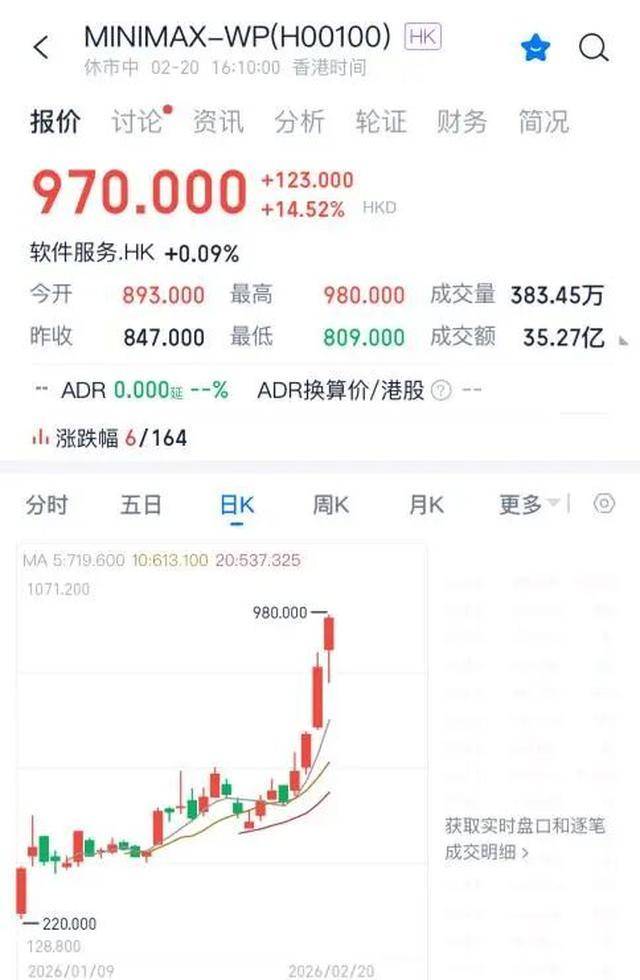
Group 1 - The US AI sector has faced significant institutional sell-offs since 2026, with the "Magnificent Seven" tech giants dragging down the S&P 500 index, while OpenAI's financial sustainability is questioned by Wall Street [1][6] - In contrast, Chinese AI companies like Zhiyu Technology and MiniMax have seen substantial stock price increases, with Zhiyu rising 42.72% to HKD 725 and MiniMax increasing 14.52% to HKD 970, both reaching new highs since their listings [1][4] - Both companies have achieved market capitalizations exceeding HKD 300 billion, comparable to established mid-to-large tech firms, surpassing the valuations of companies like JD.com and Kuaishou [1] Group 2 - Investors are drawn to Zhiyu and MiniMax due to their perceived scarcity and growth potential, with Zhiyu focusing on B2B solutions and MiniMax leveraging multi-modal technology for C-end products, with over 70% of its revenue coming from overseas [2] - The limited float of shares for both companies (1.7 million for MiniMax and 1.17 million for Zhiyu) suggests a potential for price volatility as lock-up periods expire [2] - The contrasting narratives of the US and Chinese AI markets highlight a significant difference in operational costs, with China's lower electricity costs providing a competitive edge [8] Group 3 - OpenAI, despite having around 1 billion users and generating nearly USD 10 billion in subscription revenue in 2025, faces substantial losses, with projected losses nearing USD 40 billion for 2026 [7] - The success of Zhiyu and MiniMax's IPOs marks a pivotal moment for the Chinese AI industry, shifting focus from mere technological aspirations to financial sustainability and profitability [18] - The commercial viability of both companies remains under scrutiny, with Zhiyu's revenue growth expected to slow and MiniMax's revenue projections indicating a potential increase to USD 209 million by 2026 [19][20] Group 4 - MiniMax's business model focuses on a combination of C-end cash flow and B-end growth, with a significant portion of its revenue derived from overseas markets [11] - The rapid pace of AI IPOs mirrors the internet bubble of 2000, with companies like MiniMax and Zhiyu being exceptions in terms of their short time to market [12][14] - The competitive landscape for AI models is intensifying, with both companies needing to navigate challenges such as user retention and potential copyright litigation [10][11]


阿里CEO吴泳铭:加速大模型出海!
第一财经· 2025-05-22 03:24
Core Viewpoint - Alibaba Cloud aims to accelerate the creation of a global cloud computing network with strategic investments, emphasizing its long-term goal of building a competitive AI-enabled cloud infrastructure [1][2]. Group 1: Global Cloud Network Development - Alibaba Cloud plans to invest over 380 billion yuan in cloud and AI infrastructure over the next three years [1]. - The company will enhance its global cloud computing network, with new data centers opening in Malaysia, UAE, Thailand, South Korea, Japan, Mexico, and the Philippines this year [1]. - Currently, Alibaba Cloud operates 87 available zones across 29 regions worldwide [1]. Group 2: AI Product Internationalization - Alibaba Cloud is accelerating the internationalization of its AI products, with over 200 models open-sourced and more than 100,000 derivative models created [2]. - The Qianwen 3 model currently supports 119 languages, including many minority languages and dialects, gaining popularity in Japan, Southeast Asia, and Middle Eastern countries [2]. - The company is also enhancing its consulting, technical, and service teams to support Chinese enterprises in their international expansion [2].


挑战海外云巨头?阿里CEO吴泳铭最新发声:加速大模型出海
Di Yi Cai Jing· 2025-05-22 02:46
Group 1 - The core strategy of Alibaba Cloud is to build a global cloud computing network, emphasizing that its primary product is this network itself [1] - Alibaba Group plans to invest over 380 billion yuan in cloud and AI infrastructure over the next three years, with a focus on expanding its global cloud network [1] - Alibaba Cloud will open seven new data centers this year in Malaysia, UAE, Thailand, South Korea, Japan, Mexico, and the Philippines, increasing its operational regions to 29 with 87 available zones [1] Group 2 - Alibaba Cloud is accelerating the internationalization of its AI products, with over 200 models open-sourced and more than 100,000 derivative models created [3] - The "Qianwen 3" model currently supports 119 languages, including many minority languages and dialects, and has gained popularity in Japan, Southeast Asia, and Middle Eastern countries [3] - The company aims to provide top-notch infrastructure, technology, and services for Chinese enterprises going global, enhancing its consulting, technical, and service teams [3]