定制剧

Search documents
上市公司集体撤离电视剧,主投主控成过去时
3 6 Ke· 2025-11-18 01:09
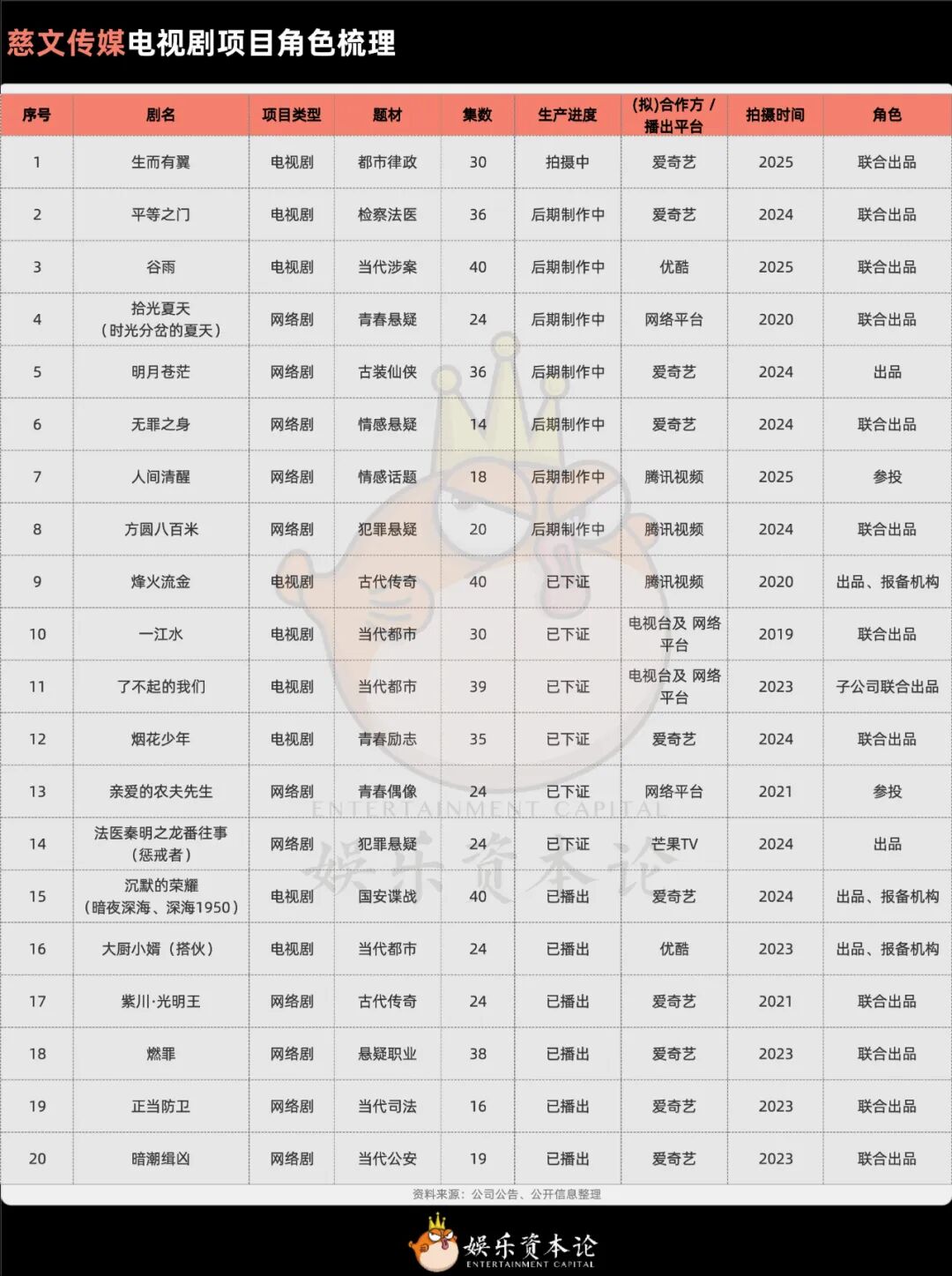
Core Viewpoint - The trend in the television industry indicates that listed companies are shifting from a "main investment and control" role to a model that emphasizes external project investment, often utilizing a "funding" approach to mitigate risks associated with project development [1][4]. Group 1: Industry Trends - The phenomenon of listed companies reducing their project development and focusing on external investments can be traced back to 2020, with a notable increase in such projects starting from 2023 [2]. - Companies like Ciwen Media are increasingly participating in projects as co-producers or investors rather than as primary producers, especially for projects starting in 2025 [2][4]. - The rise of the "funding" model is linked to the shift from copyright dramas to customized dramas, which are becoming the focal point for development in the industry [4][14]. Group 2: Financial Implications - The funding model allows companies to enhance their liquidity and financial security while still obtaining the title of "co-producer" [4]. - Companies are experiencing a significant increase in asset turnover rates, with examples like Zhongguang Tianze showing a rise from 0.49 in 2024 to 0.65 in 2025 H1 [11]. - The financial performance of companies like Zhongguang Tianze has improved, with reported investment income from "capital-preserving" film and television projects reaching 980,000 yuan in 2024 and 1.94 million yuan in the first half of 2025 [10]. Group 3: Project Development Models - The development of television dramas is categorized into three models: copyright dramas, self-produced dramas, and customized dramas, with the latter gaining prominence [4][5]. - The funding model operates by securing a customized contract, allowing the main team to negotiate funding with external investors after project approval [5][6]. - The typical funding share ranges from 20% to 40%, with the first phase of settlement usually paying 50% of the agreed price, allowing external funds to gradually exit [6][9]. Group 4: Market Dynamics - The decline in the share of copyright dramas has led to a concentration of resources among a few major productions, pushing smaller companies to adopt safer customized drama strategies [18]. - The profit margins for customized dramas are significantly lower, ranging from 10% to 15%, compared to 30% to 50% for copyright dramas, leading to a withdrawal of purely financial investors from the market [18][24]. - The industry is collectively seeking stability and certainty, with companies prioritizing risk control and maintaining influence through funding investments [24].