家族企业控制权之争

Search documents
84岁知名鞋企创始人与儿子儿媳断绝关系:不能让美国身份的人接班
21世纪经济报道· 2026-01-05 08:26
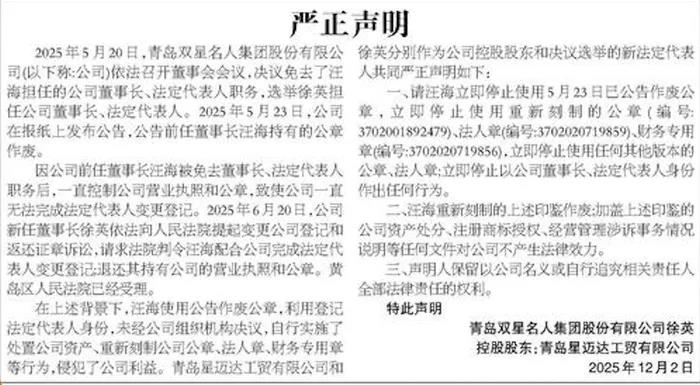
Group 1 - The control struggle within the century-old shoe company, Double Star Celebrity Group, has intensified, with founder Wang Hai publicly severing ties with his son Wang Jun and daughter-in-law Xu Ying, accusing them of betrayal and misconduct [1][3][10] - The root of the conflict dates back to a 2022 equity change, where Xu Ying's company acquired 56.96% of Double Star Celebrity, making her the largest shareholder and leading to Wang Hai losing absolute control [3][6] - In December 2025, Xu Ying announced the removal of Wang Hai from his positions, claiming a board resolution had been passed without his consent, which Wang Hai later contested as illegal [6][10] Group 2 - Wang Hai's recent statement emphasized that both Wang Jun and Xu Ying hold U.S. citizenship, arguing that a national brand like Double Star should not be led by foreign nationals [10] - The company is facing operational challenges, with reports indicating that the domestic sales segment of a competitor, Peak, has incurred losses exceeding 130 million yuan from January to July 2025, highlighting the difficult market conditions [11] - Amidst the internal conflict, Double Star Celebrity's leadership is making strategic decisions, such as terminating the agency rights of its Nanyang company due to poor performance and operational issues [10][11]


列出九大理由 与儿子断绝关系 84岁双星创始人发声:不能让“美国身份的人”接班!其儿媳此前发声明 双方矛盾持续升级
Mei Ri Jing Ji Xin Wen· 2026-01-04 17:24
Core Viewpoint - The control dispute within the century-old shoe company, Double Star Celebrity Group, has escalated, with founder Wang Hai publicly severing ties with his son Wang Jun and daughter-in-law Xu Ying, accusing them of betrayal and power grabs [1][6]. Group 1: Background of the Dispute - The conflict traces back to a 2022 equity change where Xu Ying, through her company Qingdao Xingmaida, acquired 56.96% of Double Star Celebrity's shares, becoming the largest shareholder, which led to Wang Hai losing absolute control [1]. - The company was established in 2002 and is located in Qingdao, Shandong Province, with Wang Hai holding 21.88% of the shares, Wang Jun 6.53%, and Xu Ying as the beneficial owner [1]. Group 2: Public Escalation of the Conflict - In May 2025, Wang Hai publicly accused Wang Jun and Xu Ying of attempting to seize control and making unauthorized decisions regarding company operations [2]. - On December 2, 2025, Xu Ying announced that the board had removed Wang Hai from his positions and claimed he was unlawfully retaining company seals [2][4]. Group 3: Recent Developments - On December 8, 2025, Wang Hai countered Xu Ying's claims, asserting that the board's decision was illegal and that he was safeguarding the original company seal [4]. - The conflict shifted from legal disputes to personal grievances, with Wang Hai citing the nationality of the successors as a primary concern, emphasizing that foreign nationals should not lead a Chinese brand [6][7]. Group 4: Future Plans - Wang Hai announced plans to establish a "Double Star Celebrity Brand Successor Committee" to promote a new succession model based on merit and professional management rather than familial ties [8]. Group 5: Company Background and Market Position - Double Star Celebrity Group, founded in 1921, is one of China's earliest shoe manufacturing enterprises, originally a state-owned entity [11]. - The company has faced declining growth and market share due to competition from emerging brands, despite attempts to revitalize its brand through e-commerce and collaborations [15]. - The brand value is reported at 49.2 billion yuan, with Wang Hai recognized for his contributions to management and entrepreneurship [15].
列出九大理由,与儿子断绝关系,84岁双星创始人发声:不能让“美国身份的人”接班!其儿媳此前发声明,双方矛盾持续升级
Mei Ri Jing Ji Xin Wen· 2026-01-04 16:42
Core Viewpoint - The control dispute within the century-old shoe company, Double Star Celebrity Group, has escalated, with founder Wang Hai publicly severing ties with his son Wang Jun and daughter-in-law Xu Ying, accusing them of betrayal and power grabs [1][8]. Group 1: Background of the Dispute - The conflict traces back to a 2022 equity change where Xu Ying, through her company Qingdao Xingmaida, acquired 56.96% of Double Star Celebrity's shares, becoming the largest shareholder, which led to Wang Hai losing absolute control [1][3]. - The first public indication of the conflict occurred in May 2025 when Wang Hai accused his son and daughter-in-law of attempting to seize control and making unauthorized decisions regarding company operations [3][5]. Group 2: Legal and Corporate Maneuvering - On December 2, 2025, Xu Ying announced Wang Hai's removal from his positions and claimed he was illegally retaining company seals and documents, which she stated were invalid [3][5]. - Wang Hai countered on December 8, asserting that the board's decision to remove him was unlawful and that he would seek legal recourse to annul the decision [5]. Group 3: Personal and National Identity Issues - In his January 3 statement, Wang Hai emphasized that both Wang Jun and Xu Ying hold American citizenship, arguing that a Chinese national brand should not be led by foreign nationals, marking a significant shift from business to personal and national identity concerns [8]. - Wang Hai accused them of attempting to erase his legacy and announced plans to establish a "Double Star Celebrity Brand Succession Committee" to promote a new succession model based on merit rather than bloodline [8][9]. Group 4: Company Overview and Market Position - Double Star Celebrity Group, founded in 1921, is one of China's earliest shoe manufacturing enterprises, originally part of the state-owned Qingdao No. 9 Rubber Factory [11]. - The company has diversified into various sectors, including footwear, clothing, real estate, and logistics, with a sales network across China and exports to over 100 countries [14]. - Despite its historical prominence, with annual shoe sales exceeding 30 million pairs in the 1980s and 1990s, the company has faced market share challenges from emerging brands and has struggled to regain its former influence [14].