常态化退市制度

Search documents
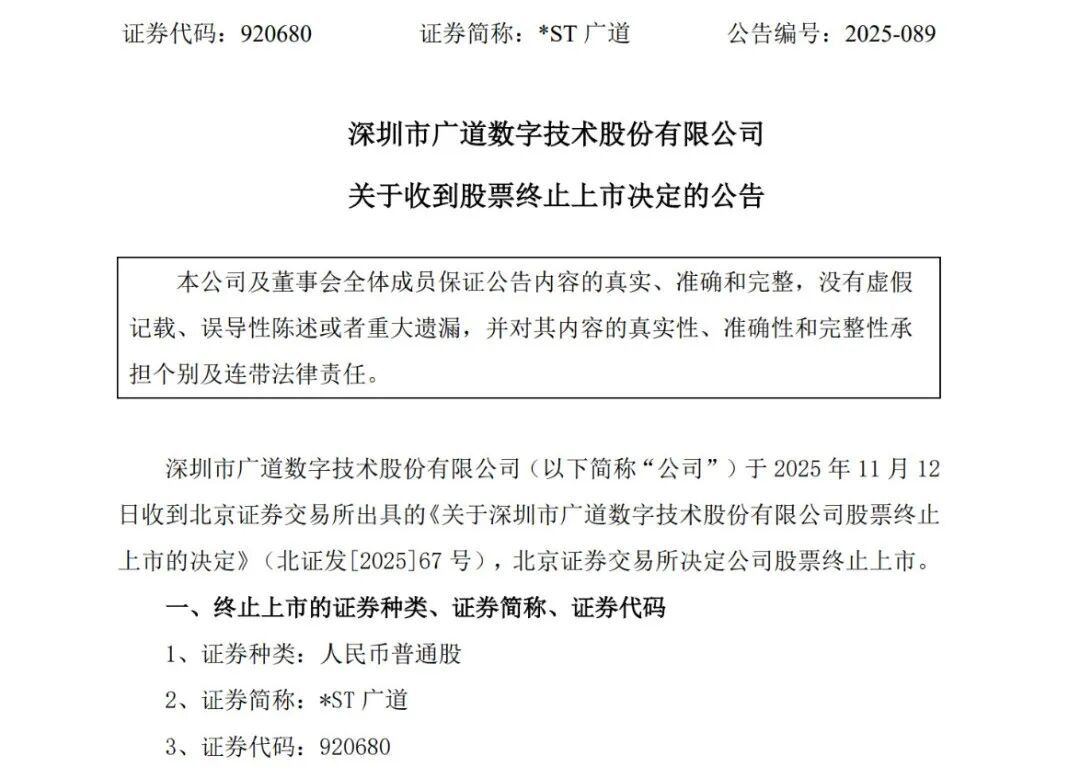
920680,ST广道重大违法强制退市
Jing Ji Ri Bao· 2025-11-13 12:59
Core Viewpoint - The Beijing Stock Exchange has decided to terminate the listing of *ST Guangdao due to long-term and systematic financial fraud, as confirmed by the China Securities Regulatory Commission [3][4]. Company Summary - *ST Guangdao, officially known as Shenzhen Guangdao Digital Technology Co., Ltd., was primarily engaged in the development and sales of software products aimed at data applications. The company was listed on the Beijing Stock Exchange on November 15, 2021, after being listed on the New Third Board in November 2016 [7]. - The company has been found to have fabricated sales and procurement activities through false contracts, invoices, bank receipts, and other documents, leading to significant inflation of reported revenue and costs [4][7]. Financial Misconduct Details - From 2018 to 2023, *ST Guangdao inflated its reported revenue by the following percentages: 87.34% (2018), 95.39% (2019), 98.96% (2020), 85.87% (2021), 99.39% (2022), 98.14% (2023), and 88.11% (2024 H1) [4]. - The inflated operating costs during the same periods were: 84.53% (2018), 91.17% (2019), 98.41% (2020), 83.30% (2021), 99.13% (2022), 92.26% (2023), and 83.81% (2024 H1) [4]. Regulatory Actions - The China Securities Regulatory Commission has imposed a fine of 10 million yuan on *ST Guangdao and has mandated corrective actions. Key executives, including the chairman and financial officer, have faced severe administrative penalties and market bans [7]. - Following the announcement of the termination of its listing, *ST Guangdao has indicated that its sponsor, Wukuang Securities, is leading efforts to establish a compensation fund for eligible investors affected by the company's financial misconduct [7]. Industry Context - The A-share market is witnessing a diversification in delisting practices, with a notable increase in the enforcement of mandatory delisting due to severe violations such as financial fraud. This reflects a commitment from regulatory bodies to protect investors' rights and maintain market integrity [9]. - The principle of "delisting does not exempt liability" has gained traction, emphasizing that companies cannot evade accountability for past misconduct even after being delisted [9].