开放学术生态

Search documents
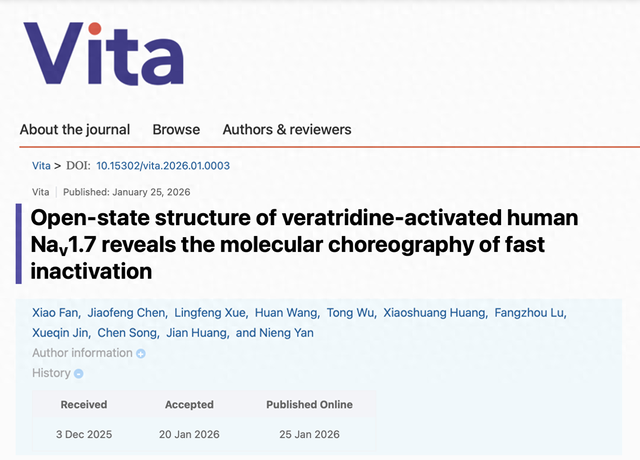
浪淘沙预印本平台首篇论文,作者为颜宁团队
Xin Lang Cai Jing· 2026-01-26 15:53
Core Viewpoint - The research team from Shenzhen Medical Academy and Peking University published a significant paper in the inaugural issue of the journal Vita, highlighting advancements in understanding the fast inactivation of human Nav1.7 channels [1][3]. Group 1: Research Publication - The study was first published on the "Langtaosha Preprint Platform" on November 18, 2025, becoming the first paper on the platform, with nearly 8,000 views and over 2,000 downloads [3]. - The paper underwent rigorous peer review before being officially published in the high-level international journal Vita, which is part of the Life Sciences Open Alliance [3][5]. Group 2: Journal and Platform Development - Vita journal emphasizes a "zero OA fee" policy and aims to return to academic roots, promoting immediate open sharing of research results through the Langtaosha platform [5][6]. - The collaboration between the journal and the preprint platform provides a rapid sharing channel for scientists in the life sciences and biomedical fields, enhancing academic communication [7]. - The establishment of Vita responds to the need for top-tier journals in China's life sciences sector, which has seen significant advancements in research capabilities over the past decade [7][8]. Group 3: Future Plans and Structure - Vita plans to create a professional editorial team to ensure high academic standards and will not charge authors any OA or publication fees [8]. - The journal's first batch of original papers is in the final review stage and is expected to launch in the first quarter of this year, with the print edition scheduled for June 2026 [8].

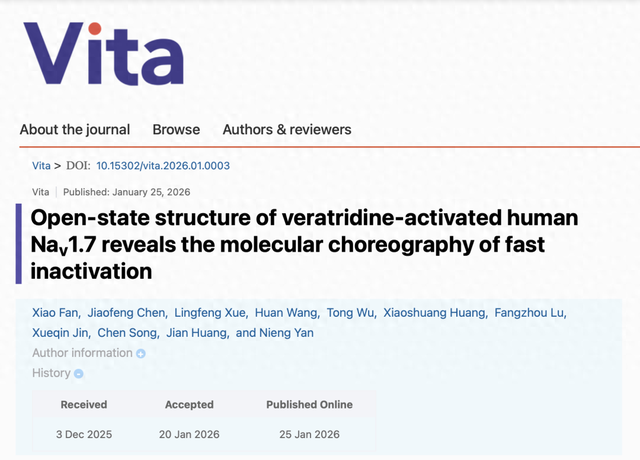
浪淘沙预印本平台首篇论文正式发于施一公任共同主编的Vita首期,作者为颜宁团队
Xin Lang Cai Jing· 2026-01-26 12:48
Core Viewpoint - The research article titled "Open-state structure of veratridine-activated human Nav1.7 reveals the molecular choreography of fast inactivation" was published by a collaborative team from Shenzhen Medical Academy and Peking University in the inaugural issue of the journal Vita, highlighting advancements in the field of life sciences and biomedical research [1][3]. Group 1: Research Publication - The study was first published on the "Langtaosha Preprint Platform" on November 18, 2025, becoming the first paper on the platform, with nearly 8,000 views and over 2,000 downloads [3]. - The article underwent rigorous peer review before being officially published in the high-level international journal Vita, which is part of the Life Sciences Open Alliance [3][5]. Group 2: Journal and Platform Development - The Vita journal promotes a "zero OA fee" policy and emphasizes the return to academic fundamentals, facilitating immediate open sharing of research results through the Langtaosha platform [5][6]. - The collaboration between the journal and the preprint platform aims to provide a rapid sharing channel for scientific results and establish a core platform for academic exchange in life sciences and biomedicine [7]. - The establishment of Vita responds to the need for top-tier journals in China's life sciences sector, which has seen significant advancements in research capabilities over the past decade [7][8]. Group 3: Editorial and Publication Strategy - Vita aims to build a professional editorial team to ensure the innovation and authority of published results, while maintaining an open-access model without charging authors any fees [8]. - The journal's first batch of original papers is in the final review stage and is expected to launch in the first quarter of this year, with the print edition scheduled for June 2026 [8].