浪淘沙预印本平台

Search documents
浪淘沙预印本平台首篇论文,作者为颜宁团队
Xin Lang Cai Jing· 2026-01-26 15:53
Core Viewpoint - The research team from Shenzhen Medical Academy and Peking University published a significant paper in the inaugural issue of the journal Vita, highlighting advancements in understanding the fast inactivation of human Nav1.7 channels [1][3]. Group 1: Research Publication - The study was first published on the "Langtaosha Preprint Platform" on November 18, 2025, becoming the first paper on the platform, with nearly 8,000 views and over 2,000 downloads [3]. - The paper underwent rigorous peer review before being officially published in the high-level international journal Vita, which is part of the Life Sciences Open Alliance [3][5]. Group 2: Journal and Platform Development - Vita journal emphasizes a "zero OA fee" policy and aims to return to academic roots, promoting immediate open sharing of research results through the Langtaosha platform [5][6]. - The collaboration between the journal and the preprint platform provides a rapid sharing channel for scientists in the life sciences and biomedical fields, enhancing academic communication [7]. - The establishment of Vita responds to the need for top-tier journals in China's life sciences sector, which has seen significant advancements in research capabilities over the past decade [7][8]. Group 3: Future Plans and Structure - Vita plans to create a professional editorial team to ensure high academic standards and will not charge authors any OA or publication fees [8]. - The journal's first batch of original papers is in the final review stage and is expected to launch in the first quarter of this year, with the print edition scheduled for June 2026 [8].

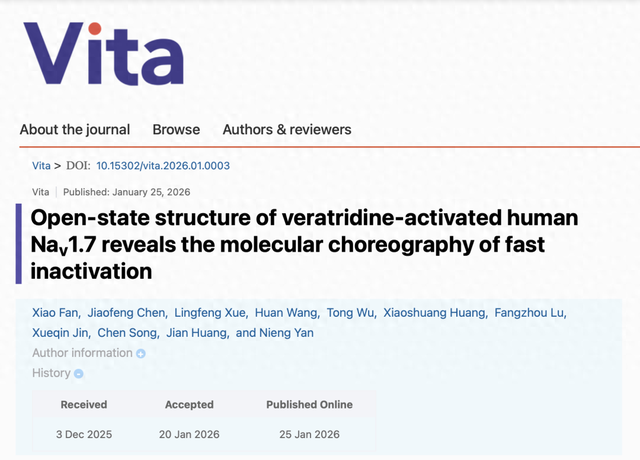
浪淘沙预印本平台首篇论文正式发于施一公任共同主编的Vita首期,作者为颜宁团队
Xin Lang Cai Jing· 2026-01-26 12:48
Core Viewpoint - The research article titled "Open-state structure of veratridine-activated human Nav1.7 reveals the molecular choreography of fast inactivation" was published by a collaborative team from Shenzhen Medical Academy and Peking University in the inaugural issue of the journal Vita, highlighting advancements in the field of life sciences and biomedical research [1][3]. Group 1: Research Publication - The study was first published on the "Langtaosha Preprint Platform" on November 18, 2025, becoming the first paper on the platform, with nearly 8,000 views and over 2,000 downloads [3]. - The article underwent rigorous peer review before being officially published in the high-level international journal Vita, which is part of the Life Sciences Open Alliance [3][5]. Group 2: Journal and Platform Development - The Vita journal promotes a "zero OA fee" policy and emphasizes the return to academic fundamentals, facilitating immediate open sharing of research results through the Langtaosha platform [5][6]. - The collaboration between the journal and the preprint platform aims to provide a rapid sharing channel for scientific results and establish a core platform for academic exchange in life sciences and biomedicine [7]. - The establishment of Vita responds to the need for top-tier journals in China's life sciences sector, which has seen significant advancements in research capabilities over the past decade [7][8]. Group 3: Editorial and Publication Strategy - Vita aims to build a professional editorial team to ensure the innovation and authority of published results, while maintaining an open-access model without charging authors any fees [8]. - The journal's first batch of original papers is in the final review stage and is expected to launch in the first quarter of this year, with the print edition scheduled for June 2026 [8].
瞭望 | 自主预印本平台增强学术话语权
Xin Hua She· 2026-01-19 08:21
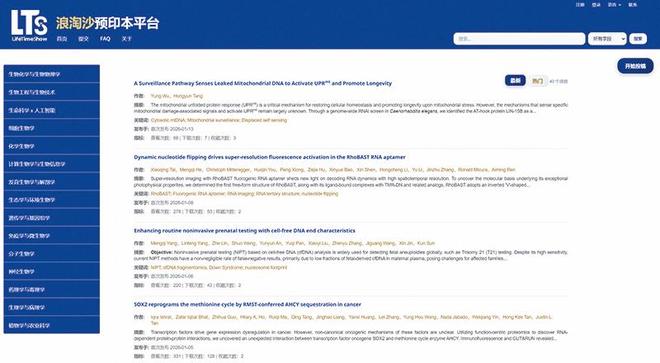
Core Viewpoint - The launch of the domestic preprint platform "Langtaosha" marks a significant step for China's life sciences sector, enabling independent and secure management of research data and academic dissemination, while addressing the challenges posed by international publication systems [1][2]. Group 1: Platform Overview - "Langtaosha" is a preprint platform developed collaboratively by Shenzhen Medical Academy, Shenzhen Bay Laboratory, Tsinghua University, and Westlake University, aimed at enhancing the efficiency and safety of academic communication in China [1][2]. - The platform allows researchers to publish their findings without incurring publication fees, contrasting with the traditional Open Access (OA) model that often requires authors to pay article processing charges (APC) [2][3]. Group 2: Market Context - The global academic publishing market is predominantly controlled by developed countries, with major players like Elsevier and Springer dominating the landscape, leading to over 90% of SCIE papers from Chinese scientists being published in foreign journals [2][3]. - In 2023, Chinese authors paid a total of $750 million in APCs, reflecting a 23% annual growth rate, which highlights the financial burden on researchers and the need for alternative publishing avenues [3]. Group 3: Benefits of Preprint Platforms - Preprint platforms like "Langtaosha" facilitate rapid dissemination of research findings, allowing for immediate feedback and collaboration across disciplines, thus enhancing the overall quality and impact of research [4][5]. - The introduction of blockchain technology in "Langtaosha" ensures transparency and traceability of research records, which is crucial for maintaining academic integrity and prioritizing original contributions [4]. Group 4: Future Development and Recommendations - Experts suggest that the development of preprint platforms in China is still in its exploratory phase and requires improved top-level design, institutional norms, and academic evaluation systems to support high-level scientific independence [6][7]. - Recommendations include establishing a national certification system for preprint platforms, defining qualification criteria, and integrating preprints into existing research management frameworks to enhance their credibility and acceptance [6][7].
中国主导顶级国际期刊《Vita》即将上线,不收版面费
仪器信息网· 2026-01-14 09:02
Core Viewpoint - The newly launched journal "Vita" aims to alleviate the financial burden of high publication fees faced by researchers globally, particularly in China, by adopting an open-access model without charging authors any publication or processing fees [1][2]. Group 1: Journal Overview - "Vita" is set to officially launch in Spring 2026, led by Westlake University and published by Higher Education Press, with Li Dangsheng as the editor-in-chief and Shi Yigong as the co-editor [2]. - The journal's name "Vita," meaning "life" in Latin, reflects its commitment to fostering a global academic community [2]. - The journal has received its international standard serial number and has established an expert advisory committee comprising nearly 100 top scientists from both domestic and international backgrounds [2]. Group 2: Financial Context - In 2024, Chinese scholars are projected to pay approximately $909 million in international publication fees, highlighting the significant financial burden on researchers [2]. - "Vita" directly addresses this issue by ensuring no fees are charged to authors, which is a significant shift in the current publishing landscape [2]. Group 3: Related Initiatives - The "Langtaosha Preprint Platform" has been launched in conjunction with "Vita" to provide a rapid sharing channel for research outcomes [3]. - The establishment of "Vita" is a response to the growing need for a high-quality, internationally recognized scientific journal led by China, as the country’s research capabilities in life sciences have reached a world-class level [3].

颜宁团队推出全新预印本平台,并上线自己的两篇论文,助力生命科学发现得以如实记录及高效分享
生物世界· 2025-11-24 04:28
Core Insights - The article discusses the launch of the LangTaoSha Preprint Server, a collaborative open science platform aimed at enhancing academic communication in the life sciences field [3][4]. - The platform is established by Shenzhen Medical Academy, Shenzhen Bay Laboratory, Tsinghua University, Westlake University, and other leading institutions, focusing on rapid dissemination of research findings prior to formal peer review [3]. - The introduction of blockchain technology ensures the integrity and traceability of scientific records by generating unique, immutable timestamps and encrypted certificates for each published paper [3]. Group 1: Platform Overview - The LangTaoSha Preprint Server officially launched in November 2025, providing a reliable and efficient environment for researchers [3]. - The platform has already published 11 research papers, including two from the team led by Academician Yan Ning [4]. - The platform aims to integrate AI-driven tools to streamline manuscript screening processes and improve manuscript quality [3]. Group 2: Research Highlights - The paper titled "Open-state structure of veratridine-activated human Nav1.7 reveals the molecular choreography of fast inactivation" focuses on capturing the open-state structure of the sodium channel Nav1.7 using veratridine [5][8]. - The research team identified two complexes of Nav1.7 with veratridine, revealing insights into the dual-mode regulatory mechanism of veratridine on sodium channels [9][11]. - Another paper, "High-throughput cryo-EM characterization and automated model building of glycofibrils via CryoSeek," introduces a new strategy combining cryo-electron microscopy with AI for discovering novel biological entities [12][13]. Group 3: Methodologies and Innovations - The CryoSeek methodology allows for high-throughput processing of cryo-EM data and automated modeling of glycan structures, establishing a workflow for reconstructing three-dimensional electron microscopy maps [14]. - The research team proposed a unified naming scheme for the fibers discovered through CryoSeek, which will aid in understanding glycan folding principles [14]. - A CryoSeek database has been created for data archiving and sharing, accommodating the large volume of structures obtained through this strategy [14].