彩陶文化

Search documents
文旅新探·博物馆之约|彩陶之路 一脉相承向西行-每日动态
Xin Hua Wang· 2026-01-30 03:37
Core Viewpoint - The exhibition "From the Yellow River to the Tianshan - The Path of Prehistoric Painted Pottery" at the Gansu Provincial Museum showcases the evolution and spread of painted pottery culture originating from the Yellow River region, featuring 175 unique artifacts that illustrate the cultural connections between different regions [1][4]. Group 1: Exhibition Overview - The exhibition is a collaboration between the Gansu Provincial Museum and the Xinjiang Uygur Autonomous Region Museum, along with 13 other cultural institutions, to trace the dissemination of prehistoric painted pottery culture [1]. - The exhibition is divided into four sections: "By the Yellow River," "Crossing the Long Mountains," "West Out of the Qilian," and "At the Foot of the Tianshan," allowing visitors to explore the cultural transmission pathways [1]. Group 2: Cultural Significance - The painted pottery from the Yellow River region, particularly from the Yangshao culture, is characterized by simple yet exquisite patterns, showcasing the early artistic expressions of ancient civilizations [3][4]. - The Maijiawa culture's pottery, dating back approximately 5,000 years, features geometric patterns that dominate the visual landscape, indicating a progression in artistic complexity [3]. - The exhibition highlights the continuous evolution of pottery styles, with influences from various regional cultures, demonstrating a rich tapestry of artistic innovation and cultural exchange [4]. Group 3: Academic Insights - Recent archaeological findings confirm the independent origins and complete developmental sequence of China's painted pottery culture, which emerged in multiple regions, including the lower Yangtze and middle Yellow River areas [4]. - The exhibition illustrates a clear lineage of cultural development, where different regional pottery styles interacted and influenced each other, leading to a diverse yet interconnected cultural heritage [4].


文博日历丨几何纹+小蛮腰 3600年前的“涂鸦款”罐罐超美
Yang Shi Xin Wen· 2025-12-04 01:32
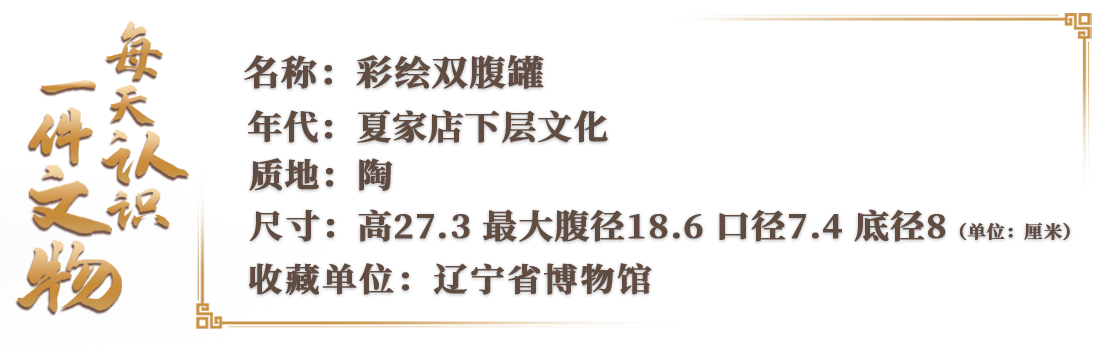
Core Viewpoint - The article introduces the painted double-bellied pot, a significant artifact from prehistoric pottery, showcasing its artistic design and cultural importance [2][4]. Group 1: Design and Aesthetics - The pot features a unique shape that is narrower at the top and wider at the bottom, resembling a small tree or a dancer in a colorful skirt [4]. - The rim of the pot is rolled outward, giving it a charming appearance with a "thick lip," while the neck is adorned with four symmetrical protrusions, resembling a studded necklace [6]. - The elegant circular patterns connect two layers of the pot's "belly," leading to its designation as a "double-bellied pot" or "pagoda bottle" due to its shape [8]. Group 2: Decorative Elements - The pot is decorated with two color patterns, featuring horizontal stripes, diagonal lines, cloud and thunder patterns, and triangular geometric designs, with the lower belly showcasing petal patterns resembling flames [10]. - The abstract lines form continuous patterns that are characteristic of Shang Dynasty painted pottery, highlighting the artistic techniques used in its creation [13]. Group 3: Cultural Significance - The article distinguishes between painted pottery and colored pottery, explaining that colored pottery involves painting images on pre-made pottery before firing, while painted pottery refers to applying color after the pottery has been fired [15]. - The painted pottery culture has a long history, spanning over 5,000 years, with significant archaeological findings from various cultures such as the Yangshao and Majiayao [13][15]. - The double-bellied pot was discovered at the Dadianzi site in Inner Mongolia, dating back to the Xiajiadian Lower Culture, with a total of 420 painted pottery artifacts unearthed from this site [19][20]. Group 4: Artistic Techniques - Research indicates that the decorative patterns were created using a brush, with a technique involving the application of white main patterns followed by red outlines, leaving a uniform black background [20]. - The Dadianzi pottery exhibits strong expressive power, particularly in the swirling cloud patterns, which may reflect the local climate and the natural beauty observed by ancient artisans [23].