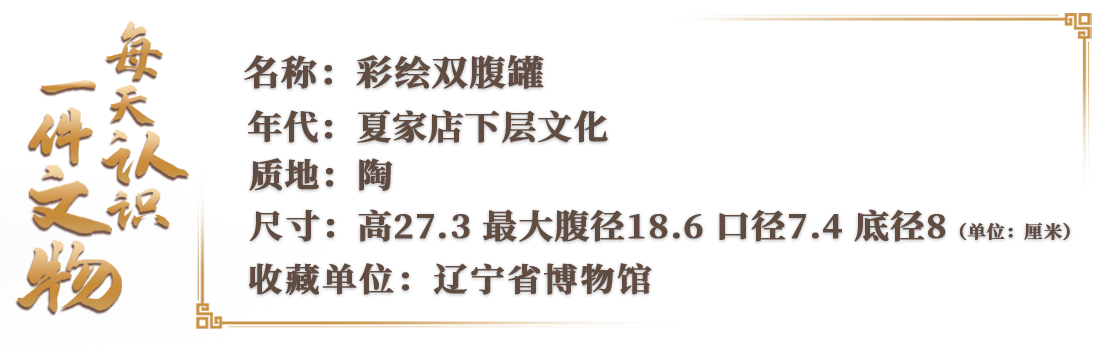
彩绘双腹罐

Search documents
文博日历丨几何纹+小蛮腰 3600年前的“涂鸦款”罐罐超美
Yang Shi Xin Wen· 2025-12-04 01:32
Core Viewpoint - The article introduces the painted double-bellied pot, a significant artifact from prehistoric pottery, showcasing its artistic design and cultural importance [2][4]. Group 1: Design and Aesthetics - The pot features a unique shape that is narrower at the top and wider at the bottom, resembling a small tree or a dancer in a colorful skirt [4]. - The rim of the pot is rolled outward, giving it a charming appearance with a "thick lip," while the neck is adorned with four symmetrical protrusions, resembling a studded necklace [6]. - The elegant circular patterns connect two layers of the pot's "belly," leading to its designation as a "double-bellied pot" or "pagoda bottle" due to its shape [8]. Group 2: Decorative Elements - The pot is decorated with two color patterns, featuring horizontal stripes, diagonal lines, cloud and thunder patterns, and triangular geometric designs, with the lower belly showcasing petal patterns resembling flames [10]. - The abstract lines form continuous patterns that are characteristic of Shang Dynasty painted pottery, highlighting the artistic techniques used in its creation [13]. Group 3: Cultural Significance - The article distinguishes between painted pottery and colored pottery, explaining that colored pottery involves painting images on pre-made pottery before firing, while painted pottery refers to applying color after the pottery has been fired [15]. - The painted pottery culture has a long history, spanning over 5,000 years, with significant archaeological findings from various cultures such as the Yangshao and Majiayao [13][15]. - The double-bellied pot was discovered at the Dadianzi site in Inner Mongolia, dating back to the Xiajiadian Lower Culture, with a total of 420 painted pottery artifacts unearthed from this site [19][20]. Group 4: Artistic Techniques - Research indicates that the decorative patterns were created using a brush, with a technique involving the application of white main patterns followed by red outlines, leaving a uniform black background [20]. - The Dadianzi pottery exhibits strong expressive power, particularly in the swirling cloud patterns, which may reflect the local climate and the natural beauty observed by ancient artisans [23].