慈善+资本

Search documents
又一A股实控人股份捐赠,近年已近20例,背后有一套税务逻辑
Xin Lang Cai Jing· 2026-02-27 04:34
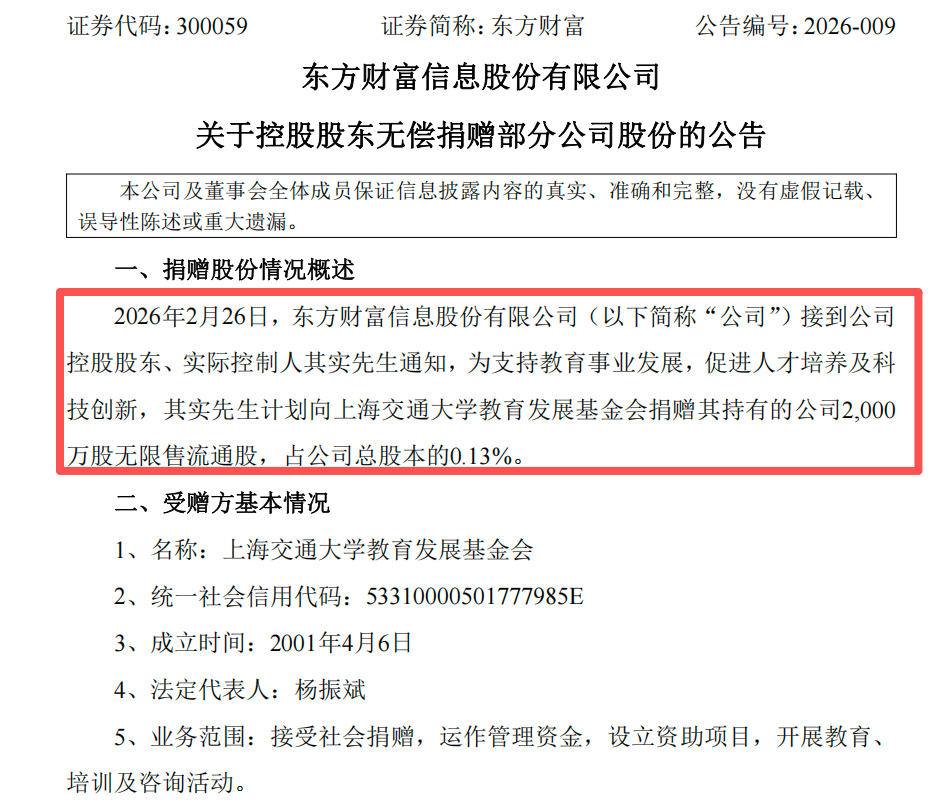
Core Viewpoint - The trend of listed company controlling shareholders donating shares or cash to support educational institutions has become increasingly common, reflecting a normalization of such philanthropic activities in the capital market [6][9][10]. Group 1: Recent Donations - On February 26, Dongfang Caifu announced that its controlling shareholder plans to donate 20 million shares, representing 0.13% of the company's total equity, to Shanghai Jiao Tong University, with a market value of 450 million yuan [1][8]. - On the same day, Ji Qi, founder of Huazhu Group and an alumnus of Shanghai Jiao Tong University, donated 100 million yuan to support the university's development [4]. - A total of at least 18 A-share listed companies' controlling shareholders or major shareholders have donated, with total donations amounting to 41.139 billion yuan, with 2025 being a particularly active year for such donations [4][10]. Group 2: Donation Statistics - Historical data indicates that there have been over 24 instances of donations from controlling shareholders or major shareholders of A-share companies, totaling 41.139 billion yuan [10]. - Share donations are the predominant form, accounting for 87.5% of total donations, with a total market value of approximately 40.539 billion yuan [11]. - The majority of donations have been directed to educational foundations, with 79.2% of donations going to such institutions [12]. Group 3: Motivations Behind Donations - These donations reflect not only the social responsibility and philanthropic intentions of entrepreneurs but also provide benefits such as tax optimization, improvement of shareholding structure, and stabilization of market expectations [7][14]. - Tax policies incentivize these donations, allowing for significant tax deductions and exemptions, which enhances the willingness of controlling shareholders to donate [15][16]. - From a corporate governance perspective, donations can help optimize shareholding structures while signaling confidence in the company's long-term value, thus stabilizing stock prices [17]. Group 4: Future Implications - The integration of "capital + charity + education" is expected to deepen, with more controlling shareholders likely to engage in share donations to support educational and technological advancements [18].