手机镜头膜的利弊

Search documents
都2026年了,为何还有人在用手机镜头膜
3 6 Ke· 2026-01-28 12:02
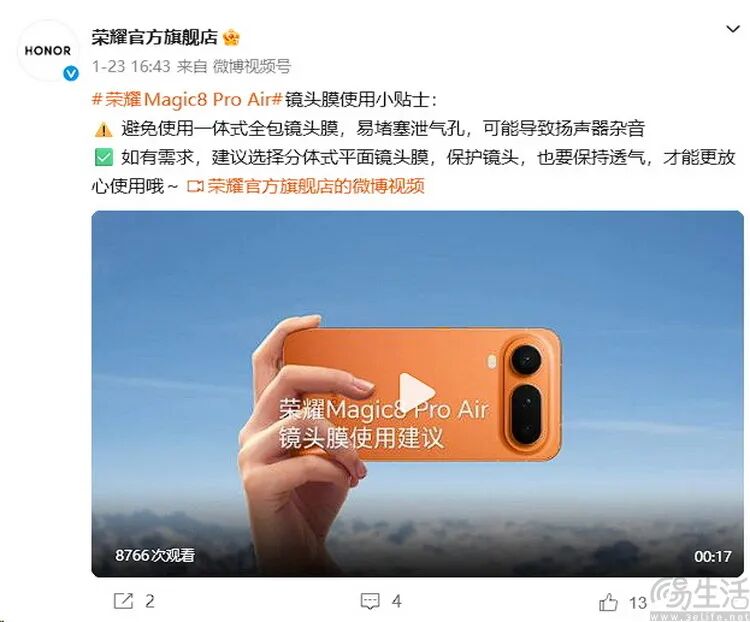
Core Viewpoint - Honor has repeatedly advised users against using lens protectors, citing potential negative impacts on camera performance and speaker functionality, indicating a persistent user belief in the necessity of such protectors despite the drawbacks [1][3][6]. Group 1: Company Statements - On the launch day of Honor Magic8 RSR and Magic8 Pro Air, Honor's official store warned users to avoid using full-cover lens protectors due to the risk of blocking vent holes, which could lead to speaker noise [1]. - Honor's imaging system expert previously emphasized that lens protectors severely degrade image clarity and contrast, reinforcing the company's stance against their use [3]. - The chief imaging engineer at Honor also recommended against lens protectors, stating that modern smartphones use high-strength glass that does not require additional protection, and that such protectors can negatively affect photo quality and cause speaker noise [6]. Group 2: Technical Explanation - Lens protectors can degrade photo quality due to their thickness and inability to achieve 100% light transmission, resulting in reflections and reduced clarity, akin to shooting through a dirty thick glass [8][10]. - The interference with speaker functionality is attributed to lens protectors potentially blocking vent holes necessary for maintaining pressure balance in the speaker, which can lead to abnormal operation and noise [13]. Group 3: User Segmentation - Users of lens protectors can be categorized into three groups: practical users who prioritize device protection over photo quality, psychological comfort users who seek to avoid scratches and damage, and aesthetic users who desire a personalized look for their devices [15][17][18]. - Practical users, such as delivery personnel and outdoor workers, often accept the trade-off of reduced photo quality for enhanced device protection [15]. - Psychological comfort users are typically concerned with maintaining the appearance of their devices, while aesthetic users seek to customize their phones, often leading to a conflict between protection and functionality [17][18].