投顾行业合规

Search documents
3·15调查|监管重拳整治投顾行业,合规是竞争力而非“紧箍咒”
券商中国· 2026-03-16 03:32
Core Viewpoint - The securities investment advisory industry is undergoing a significant regulatory overhaul, with a focus on addressing long-standing issues and ensuring compliance to protect investors' rights [1][2]. Group 1: Regulatory Environment - Since the beginning of 2026, nine regulatory fines have been issued, and five institutions have been suspended from acquiring new clients, indicating a severe shake-up in the industry [2]. - The number of advisory firms has decreased from 83 in 2021 to 76 currently, with seven firms exiting the market over four years, highlighting the impact of regulatory scrutiny on the industry [2][8]. Group 2: Industry Challenges - The industry faces persistent issues such as exaggerated marketing, a focus on short-term performance over compliance, and a lack of adequate internal controls [4][5]. - In 2025, 46 advisory firms were penalized 56 times, a 36.59% increase year-on-year, with two firms losing their licenses due to severe violations [4]. Group 3: Shift in Business Model - There is a call for a transition from "sell-side sales" to "buy-side advisory," but regulatory constraints on full delegation of authority pose challenges to aligning with client interests [12][14]. - Suggestions for improvement include changing service philosophies, optimizing service delivery methods, and ensuring transparent fee structures to enhance client retention and long-term relationships [12][14]. Group 4: Future Outlook - The ongoing industry cleansing is seen as a necessary evolution towards a more mature and compliant market, with a focus on high-quality development [8][9]. - Institutions that prioritize compliance and professional capabilities are expected to build competitive advantages and capture more market resources in the long run [9][10].


涉虚假报送等,证监会撤销老牌投顾中方信富牌照,时任董事长遭6年市场禁入
Mei Ri Jing Ji Xin Wen· 2025-11-24 13:48
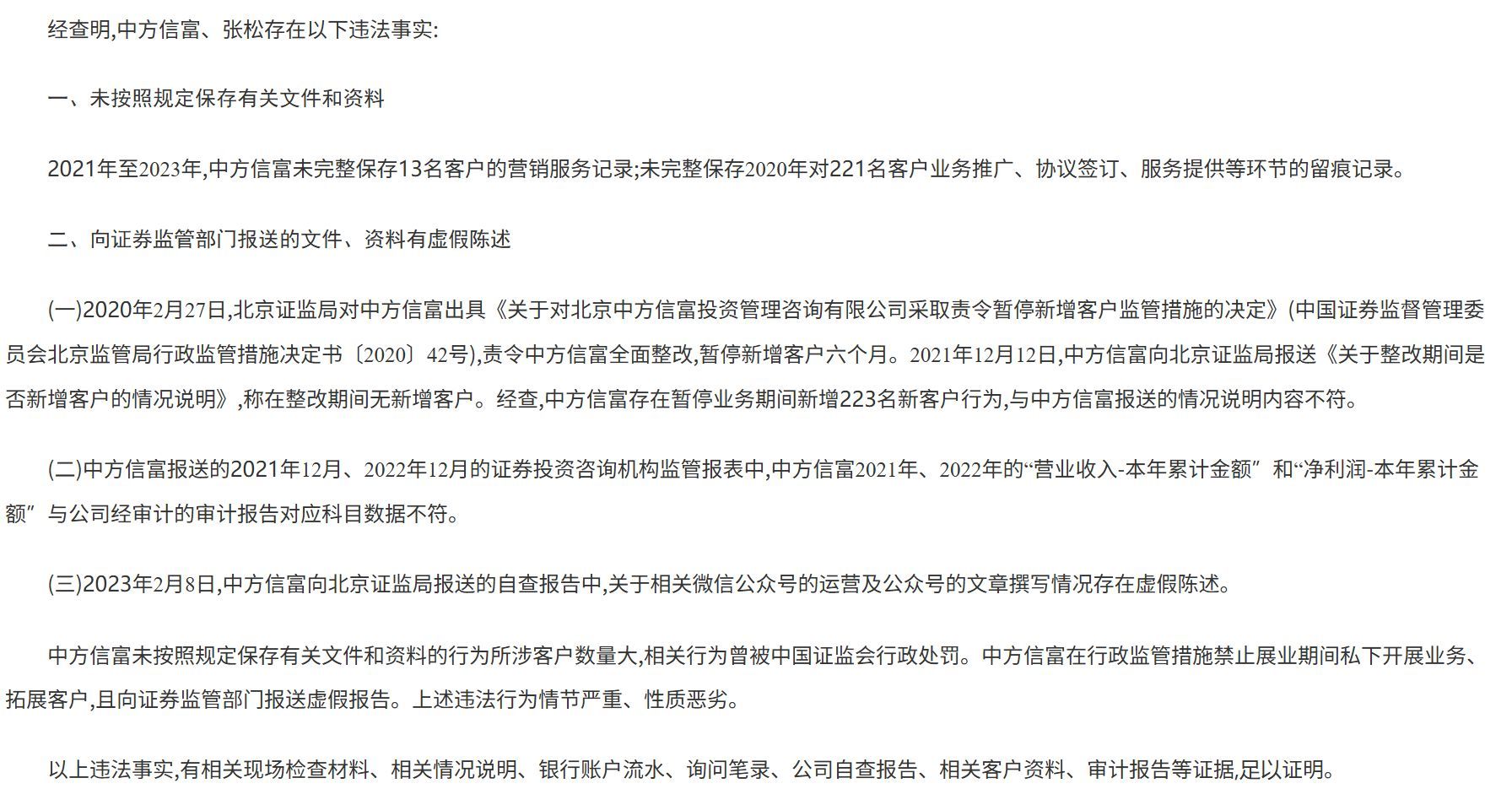
Core Viewpoint - The China Securities Regulatory Commission (CSRC) has imposed significant penalties on Beijing Zhongfang Xinfeng Investment Management Consulting Co., Ltd. (Zhongfang Xinfeng) and its chairman Zhang Song for serious violations, including failure to maintain required documentation and submitting false materials to regulators, highlighting the regulatory body's zero-tolerance approach to compliance in the securities investment consulting industry [1][2][3]. Summary by Sections Regulatory Actions - Zhongfang Xinfeng was fined 3 million yuan, and its securities investment consulting license was revoked, marking a significant enforcement action against a long-established firm [1][4]. - Chairman Zhang Song received a warning, a fine of 600,000 yuan, and a six-year ban from the securities market, reflecting the regulatory emphasis on holding management accountable for compliance failures [4][5]. Violations and Findings - The CSRC's investigation revealed systematic violations, including the failure to properly maintain marketing service records for 13 clients from 2021 to 2023 and missing records for 221 clients in 2020 [2][3]. - Zhongfang Xinfeng submitted false statements regarding client acquisition during a regulatory suspension, claiming no new clients were added while actually onboarding 223 clients [3]. - The company also falsified financial data in regulatory reports for 2021 and 2022, with discrepancies between reported revenues and audited figures [3]. Historical Context - Zhongfang Xinfeng has a history of compliance issues, having received multiple penalties over the past five years for various violations, including misleading information and inadequate compliance management [5][6][7][8][9][10][11]. - Other firms in the industry have faced similar fates, with notable cases of license revocation for severe violations, indicating a trend of increasing regulatory scrutiny [11][12]. Industry Implications - The case of Zhongfang Xinfeng serves as a warning to the securities investment consulting industry, signaling the end of lax compliance practices and the necessity for robust internal controls and professional investment capabilities to survive in a stricter regulatory environment [12].