折叠屏手机技术创新

Search documents
从“猎奇”到“信赖”:折叠屏手机用户发展洞察报告
艾瑞咨询· 2025-12-19 00:06
Core Insights - The global foldable smartphone market is experiencing continuous growth, particularly in China, driven by technological advancements and an improved supply chain, leading to product diversification [1] - China has emerged as a major growth engine for the global foldable smartphone market, with Huawei maintaining a significant market share and leading the industry [1][18] - User willingness to purchase foldable smartphones is increasing, with higher expectations for product functionality and experience [1] - The transition from niche to mainstream market for foldable smartphones is anticipated, with sustained demand growth and a focus on hardware optimization, software ecosystem development, and enhanced user interaction experiences [1] Market Overview - The global smartphone market has entered a phase of stock competition since 2017, with annual shipment volumes declining by approximately 2.52%, projected to reach 1.22 billion units by 2024 [2] - The flat smartphone market has become saturated, prompting manufacturers to innovate product forms to explore the high-end market [5] Competitive Landscape - The foldable smartphone industry chain includes upstream raw material supply, midstream design and manufacturing, and downstream sales [7] - Chinese foldable smartphone manufacturers, such as Huawei and Samsung, are leading the industry chain with strong technological capabilities and market influence [7][8] User Behavior and Preferences - The majority of foldable smartphone users are male and female, with a higher preference among first-tier and new first-tier city users [20] - Users with higher education levels, particularly those with a bachelor's degree or above, show a greater preference for foldable smartphones [20] - The price range for most users' foldable smartphones is between 5,000 to 9,000 yuan, with Huawei being the most used brand at 62.3% [22] Purchase Motivations - The key reason for purchasing foldable smartphones is the stronger sense of technology and futurism, accounting for 44.7% of users [24] - Users have a substantial budget for purchasing foldable smartphones, with 28.4% willing to spend between 8,000 to 10,000 yuan [24] Brand Recognition and Image - Huawei leads in brand recognition across various dimensions, including high-end perception, business style, technological innovation, and reputation [26][28] - Users express high satisfaction with Huawei products, indicating strong user recognition and loyalty [30] User Experience and Pain Points - Current user satisfaction is highest for Huawei, followed by Xiaomi and Samsung, with a notable willingness to recommend these brands [30][31] - Users report pain points related to hardware durability, such as screen wear and tear, and software issues like poor visual effects [39] Future Outlook - Over 90% of consumers are considering purchasing a foldable smartphone for their next device, focusing on reliability, battery life, and hardware specifications [41] - The foldable smartphone market is transitioning from a niche to a mainstream product, with 95.5% of consumers willing to switch to a foldable device in the future [47]


众多玩家“暗中”加码研发 折叠屏手机市场加速多元化
Zheng Quan Ri Bao· 2025-09-05 00:57
Core Viewpoint - Huawei's launch of the second-generation tri-fold screen smartphone, Mate XTs, marks a significant advancement in the foldable smartphone market, driving technological innovation and supply chain upgrades across the industry [1][2]. Group 1: Product Launch and Features - Huawei officially launched the Mate XTs tri-fold screen smartphone on September 4, featuring the Kirin 9020 chip and the new Harmony operating system, resulting in a 36% performance improvement [1]. - The new smartphone will be available for the first time through Meituan's flash purchase platform, indicating a shift towards instant retail channels for product launches [1]. Group 2: Market Trends and Projections - The global foldable smartphone shipment increased by 45% year-on-year in Q2, driven by strong demand in the Chinese market, with Huawei being a key player [2]. - By the first half of 2025, China's foldable smartphone shipments are expected to reach 4.98 million units, with Huawei holding a 75% market share [2]. - The foldable smartphone market is anticipated to evolve from a niche "novelty" to a mainstream category, with prices expected to drop below 10,000 yuan by 2026 [2]. Group 3: Industry Dynamics and Competition - The introduction of tri-fold screen smartphones is prompting competitors like Samsung and Apple to accelerate their own development efforts in this segment [1]. - The complexity of tri-fold structures is driving upgrades in core components such as hinges and screens, with domestic suppliers entering Huawei's supply chain [4]. - The launch of the new tri-fold smartphone is seen as a reset of industry standards, pushing the market into a new competitive cycle focused on form, ecosystem, and supply chain integration [4].
Counterpoint:到2028年书本式折叠屏手机销量预计将超过欧洲智能手机总销量的2%
智通财经网· 2025-08-28 02:45
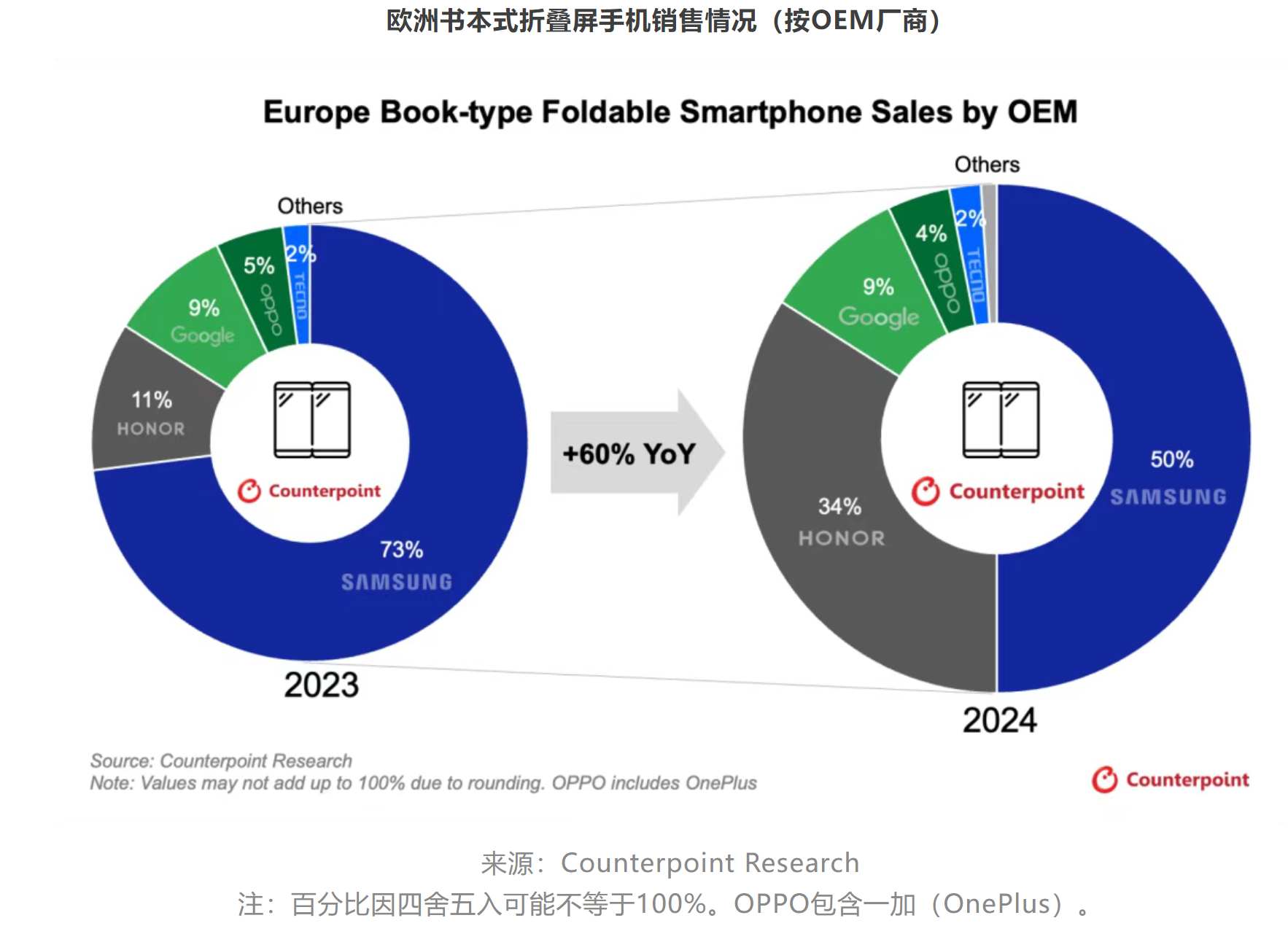
Core Insights - By 2028, book-style foldable smartphone sales are expected to approach 4 million units, accounting for over 2% of total smartphone sales, with a nearly 10% market share in the high-end segment in Europe [1][9] - 2024 is a pivotal year for the European foldable smartphone market, with a projected 37% year-on-year growth in sales, driven primarily by book-style foldable models, which are expected to see a 60% increase [1][9] - The competitive landscape is intensifying, with Samsung's market share dropping from 98% in 2022 to 73% by the end of 2023 due to new entrants like Honor, Google, and others [2][3] Market Dynamics - Honor's Magic V2 has captured 27% of the European book-style foldable smartphone market, and the upcoming Magic V3 is anticipated to further enhance its position [3][6] - Samsung is set to launch the Galaxy Z Fold7 in July 2025, which is its thinnest and lightest foldable smartphone to date, potentially regaining market competitiveness [6][8] - Google and other manufacturers are also ramping up their efforts in the European foldable smartphone market, indicating a new phase of industry growth [7][9] Future Projections - Apple is expected to enter the foldable smartphone market in 2026, which will further intensify competition and potentially accelerate market growth [9] - Despite a projected decline in foldable smartphone sales in the first half of 2025 due to a lack of technological innovation and macroeconomic factors, a rebound is anticipated in the latter half of the year [9][10]