折叠屏手机市场竞争

Search documents
打破双雄垄断!摩托罗拉 Razr 系列领跑西欧折叠屏市场
Ge Long Hui· 2025-11-07 05:55
Group 1 - Motorola's Razr 60 leads the Western European foldable smartphone market with a 15% share, and combined with Razr 50, the total share reaches approximately 27%, comparable to last year's leading model [1] - Google Pixel 9 Pro Fold follows with just over 10% market share, indicating a more balanced competitive landscape [1] - The foldable smartphone market in Western Europe, traditionally dominated by Samsung's Galaxy Z series and Honor's Magic V series, is experiencing a shift with Motorola and Google gaining ground [1] Group 2 - Google's Pixel 10 Pro Fold launched in early October in major European channels, supported by promotional activities, leading to a strong start in markets like the UK [2] - Motorola's Razr 50 and 60 series are expanding distribution and are expected to surpass Honor, becoming the second-largest brand in the European foldable market [2] - The Western European market is transitioning from a dual-brand to a four-brand competition, with increased activity expected during the holiday season [2] Group 3 - Apple is anticipated to enter the foldable smartphone market in the second half of next year, which may reshape resource allocation among carriers and high-end price segments [2] - Brands that secure core carrier partnerships, maintain stable software updates, and demonstrate the practicality of large screens in daily use are likely to succeed in the foldable market [2] - Brands that are slow to act or have limited product lines may find their growth space further squeezed between high-end Apple models and cost-effective alternatives [2]

从万元折叠屏到消费心理学:华为阔屏战略如何撬动高净值人群?
Sou Hu Cai Jing· 2025-10-16 14:48
Core Insights - The launch of Huawei's PuraX, which features a wider screen and a higher price point, contrasts with competitors like Honor and Samsung, indicating a strategic focus on the high-end consumer market [1][7] - The global foldable smartphone market is projected to grow by 67% in 2024, with over 80% of sales in the premium segment, where Huawei holds a 47% market share [1][5] Market Dynamics - The average selling price of foldable smartphones is expected to exceed 10,000 yuan in 2024, with profit margins more than three times that of traditional smartphones [5] - The consumer base for foldable phones is predominantly high-income, with 70% of buyers earning over 1 million yuan annually, leading to higher brand loyalty compared to average consumers [5][11] Competitive Landscape - The market is polarizing, with brands like Honor and Xiaomi pushing foldable prices down to 7,000 yuan, while Huawei maintains a premium strategy with products like the Mate XT priced at 19,999 yuan and PuraX starting at 7,499 yuan [7] - Huawei's strategy is driven by a harsh reality: the traditional smartphone market is shrinking by 12% in Q4 2024, while the premium foldable segment is growing by 41% [7] Product Innovation - The PuraX's 16:10 aspect ratio significantly enhances user experience, reducing black borders by 42% and allowing for more data display in Excel, which increases productivity for business users [8] - Huawei's foldable product line is strategically layered, with the Mate XT serving high-end business needs and the PuraX addressing document processing challenges, supported by a strong patent portfolio [9] User Engagement - The Mate XT's multi-application display capabilities enhance user engagement, increasing user stickiness by three times compared to traditional models [10] - Huawei's ecosystem is designed to facilitate seamless transitions between devices, with a 78% activation rate for cross-device functionality [10] Branding and Market Positioning - The branding of Huawei's PuraX incorporates luxury elements, transforming technical specifications into social currency, appealing to high-net-worth individuals [11] - The competition in the high-end market has shifted from product features to fulfilling users' self-actualization needs, with Huawei's strategy focusing on creating aspirational products rather than just affordable options [11]


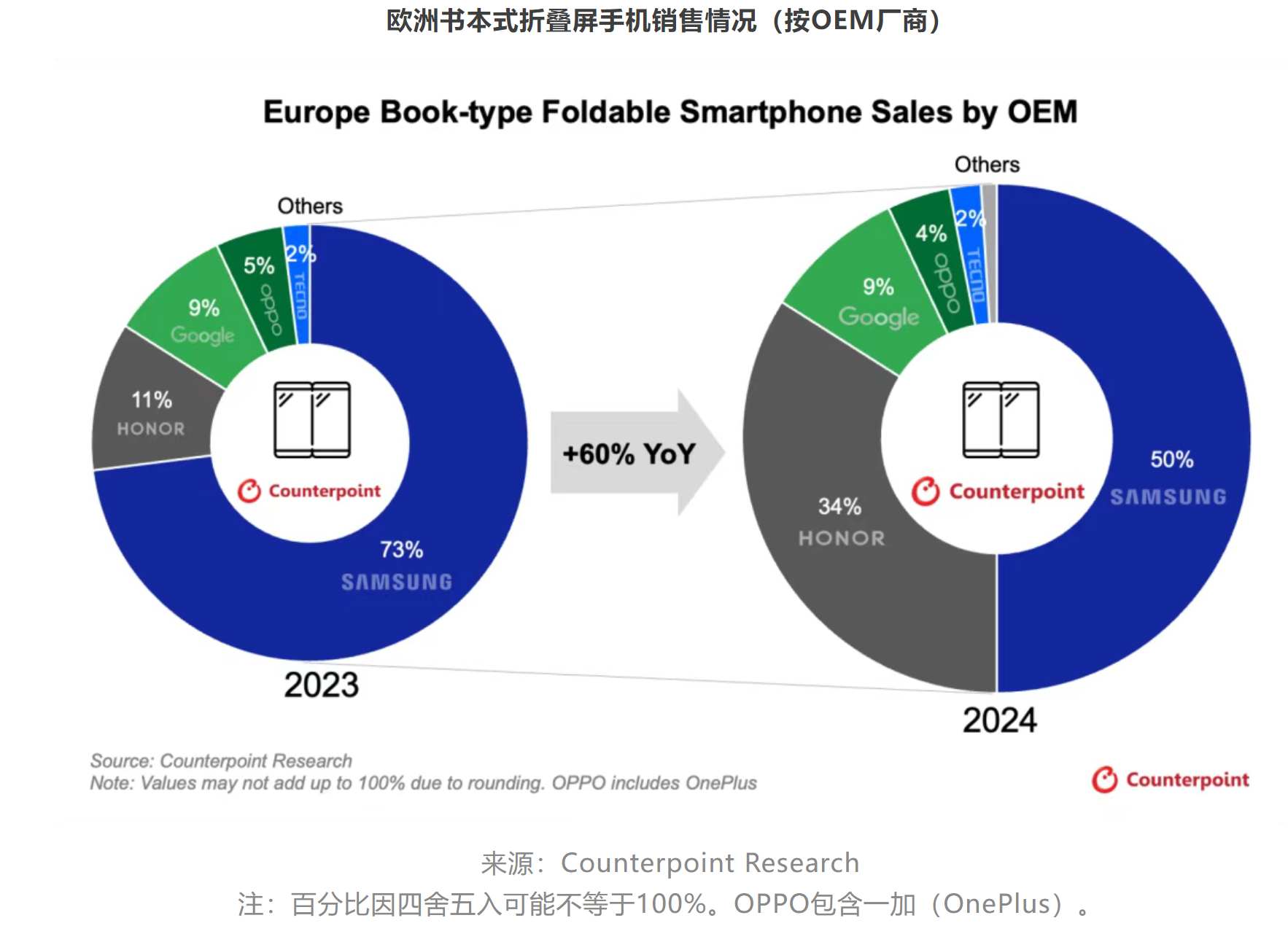
Counterpoint:到2028年书本式折叠屏手机销量预计将超过欧洲智能手机总销量的2%
智通财经网· 2025-08-28 02:45
Core Insights - By 2028, book-style foldable smartphone sales are expected to approach 4 million units, accounting for over 2% of total smartphone sales, with a nearly 10% market share in the high-end segment in Europe [1][9] - 2024 is a pivotal year for the European foldable smartphone market, with a projected 37% year-on-year growth in sales, driven primarily by book-style foldable models, which are expected to see a 60% increase [1][9] - The competitive landscape is intensifying, with Samsung's market share dropping from 98% in 2022 to 73% by the end of 2023 due to new entrants like Honor, Google, and others [2][3] Market Dynamics - Honor's Magic V2 has captured 27% of the European book-style foldable smartphone market, and the upcoming Magic V3 is anticipated to further enhance its position [3][6] - Samsung is set to launch the Galaxy Z Fold7 in July 2025, which is its thinnest and lightest foldable smartphone to date, potentially regaining market competitiveness [6][8] - Google and other manufacturers are also ramping up their efforts in the European foldable smartphone market, indicating a new phase of industry growth [7][9] Future Projections - Apple is expected to enter the foldable smartphone market in 2026, which will further intensify competition and potentially accelerate market growth [9] - Despite a projected decline in foldable smartphone sales in the first half of 2025 due to a lack of technological innovation and macroeconomic factors, a rebound is anticipated in the latter half of the year [9][10]