
捍卫国家主权和领土完整

Search documents
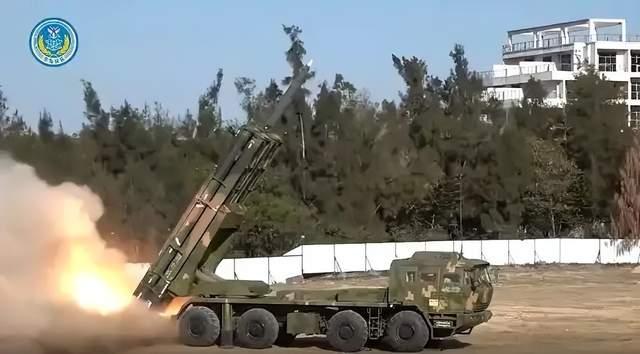
“越海杀器”,震撼出鞘
Xin Lang Cai Jing· 2025-12-31 04:31
Core Viewpoint - The Chinese People's Liberation Army (PLA) Eastern Theater Command conducted military exercises around Taiwan, simulating land and sea strikes, as a response to "Taiwan independence" forces, emphasizing the necessity of safeguarding national sovereignty and territorial integrity [1][6][12]. Group 1: Military Exercises - On December 30, the PLA Eastern Theater Command organized joint firepower strikes involving the army, navy, air force, and rocket forces against southern waters near Taiwan, achieving expected results [3][4]. - The Eastern Theater Command released videos of live-fire exercises, showcasing the army's capabilities in conducting long-range strikes with precision [3][4]. - The exercises included rapid deployment of multiple fire units to predetermined positions, demonstrating effective coordination and operational readiness [4][8]. Group 2: Weaponry and Capabilities - The "Yuanxianghuo" (远箱火) artillery system, praised as a "cross-sea killer," features long-range capabilities, precision targeting, and the ability to launch multiple munitions simultaneously, making it a significant asset in modern warfare [4][13]. - The system can cover the entire territory of Taiwan with a range of several hundred kilometers and has a high accuracy rate, capable of hitting targets within meters [4][14]. - The PLA's new long-range firepower has been integrated into joint operational frameworks, allowing for precise strikes on high-value targets [4][14]. Group 3: Strategic Messaging - The PLA released a series of thematic posters during the exercises, including titles like "Justice Hammer: Blockade and Cut Off," indicating strategic intentions to disrupt key ports and supply lines around Taiwan [5][6]. - Military experts interpret these messages as a warning to Taiwan, highlighting the potential chaos that could ensue if critical maritime routes are severed [5][6]. - The thematic posters also reflect the PLA's capabilities in joint operations and cross-domain maneuvering, showcasing a unified military front [5][6]. Group 4: Law Enforcement Actions - The Chinese Coast Guard conducted comprehensive law enforcement operations around Taiwan, focusing on controlling maritime routes and preventing external forces from aiding "Taiwan independence" elements [6][12]. - The Coast Guard's operations included inspections and interceptions of vessels, reinforcing China's maritime sovereignty and law enforcement capabilities [6][12]. - The thematic posters released by the Coast Guard emphasized the importance of maintaining control over critical sea routes and preventing the escape of "Taiwan independence" supporters [12][18].

军事专家谈“正义使命-2025”演习:围岛链条越收越紧
Xin Lang Cai Jing· 2025-12-30 13:58
Core Viewpoint - The military exercise "Mission of Justice-2025" organized by the Eastern Theater Command of the People's Liberation Army (PLA) is a response to increasing military cooperation between the U.S. and Taiwan, emphasizing China's commitment to safeguarding its core interests and territorial integrity [2][3]. Summary by Sections Legitimacy of the Exercise - The military exercise is deemed legitimate and justified as it occurs in response to provocative actions from the U.S. and Taiwan, including significant arms purchases totaling $40 billion and over $11 billion in U.S. military sales to Taiwan [2]. - Experts assert that the exercise is a necessary measure to maintain peace and stability in the Taiwan Strait and to advance the process of national reunification [2]. Military Strategy and Capabilities - The exercise focuses on various military objectives, including maritime and aerial combat readiness, comprehensive control of key areas, and deterrence against external interference [3]. - The PLA demonstrated its capability to conduct real-time military operations, including live-fire exercises, indicating a strong resolve to counter any separatist attempts [3][4]. Encirclement Strategy - The exercise has established a strategic encirclement around Taiwan, signaling that any attempts at independence will be met with significant military pressure [4]. - The PLA's ability to restrict external escape routes and resources for separatist forces is highlighted, reinforcing the message that reliance on foreign support is futile [4]. Readiness and Commitment - The PLA maintains a state of readiness, emphasizing its commitment to national defense and the protection of Taiwan's stability and the well-being of its people [6]. - The military's advancements in technology and strategic capabilities are showcased as essential for ensuring peace in the Taiwan Strait [6].
从“联合利剑”到“海峡雷霆”到“正义使命” 三次演习有一个共同点
Xin Lang Cai Jing· 2025-12-29 00:37
Core Viewpoint - The Chinese military's Eastern Theater Command has initiated the "Justice Mission-2025" exercise, emphasizing its readiness to act against Taiwan independence and external interference, showcasing the military's operational capabilities and commitment to national sovereignty [1][4]. Group 1: Military Exercises - The "Justice Mission-2025" exercise involves multiple branches of the military, including the Army, Navy, Air Force, and Rocket Force, focusing on combat readiness, control of key areas, and deterrence against external forces [1][3]. - This exercise follows a series of previous drills, indicating a consistent military strategy aimed at reinforcing China's stance on Taiwan [3][4]. Group 2: Political Context - The exercise is a direct response to recent U.S. arms sales to Taiwan, which amounted to over $11.1 billion, marking a historical high in U.S. military support for Taiwan [2]. - The Chinese government views the Taiwan issue as a core interest and has warned that any provocation will be met with strong countermeasures [2][4]. Group 3: Implications for Taiwan - Taiwan's defense authorities have been criticized for their lack of preparedness in the face of increased military activity from the Chinese side, with reports indicating a record number of Chinese military aircraft circling Taiwan [3]. - The Chinese military's actions are framed as necessary to safeguard national sovereignty and counteract Taiwan's perceived moves towards independence [4][5].