数字城市竞争力

Search documents
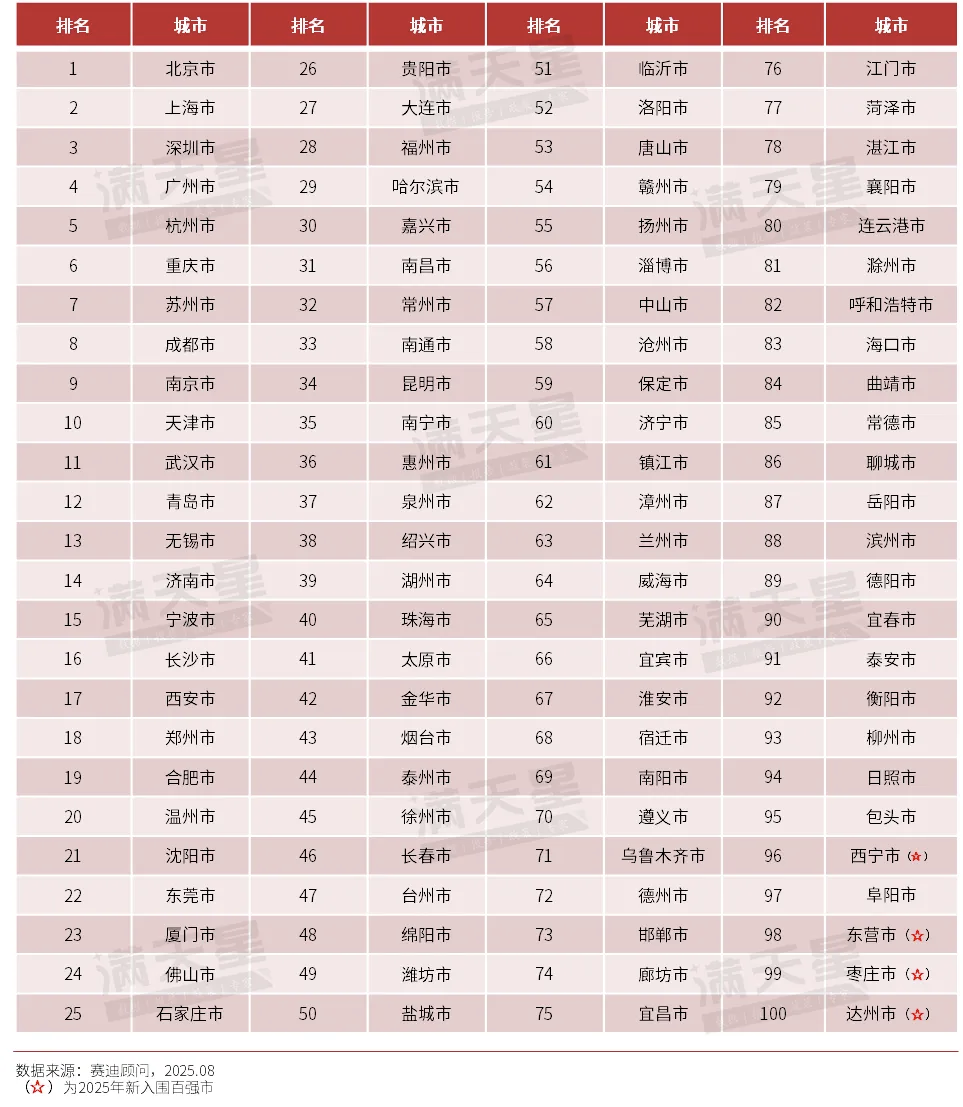
中国城市数字经济呈现“极核引领,梯队分化”特征
Zhong Guo Fa Zhan Wang· 2025-09-30 08:54
Core Insights - The construction of digital cities in China has entered a new phase characterized by large-scale promotion and deep empowerment, driven by advanced information technologies such as artificial intelligence and data elements [1] Group 1: Digital Economy Development - The "2025 China Digital City Competitiveness Research Report" indicates a significant feature of China's urban digital economy, showing a "core leading, tiered differentiation" pattern [1] - The top cities in the digital economy rankings are Beijing, Shanghai, and Guangzhou, while cities like Shenzhen, Hangzhou, and Chengdu remain stable [1] - Emerging cities such as Heze and Dongying have entered the top 100 digital economy cities, with notable advancements in cities like Hengyang and Binzhou [2] Group 2: Competitive Landscape - The report highlights that 40 cities have improved their rankings, while 31 cities have seen a decline, indicating intense competition among mid-tier and emerging cities [2] - Hohhot is leveraging the "East Data West Calculation" initiative to enhance its digital economy, projecting a core industry value of 17.2 billion yuan by 2024 [2] - Yibin is fostering a digital economy ecosystem with 53 new digital enterprises expected in 2024, and has been recognized as a pilot city for small and medium-sized enterprise digital transformation [2] Group 3: Regional Distribution - All provinces except Hainan, Ningxia, Qinghai, and Tibet have cities listed in the top 100 digital economy rankings, with all four direct-controlled municipalities included [3] - Jiangsu has maintained a leading position with its cities consistently ranking in the top 100 for five consecutive years [3] - The overall distribution of cities in the rankings shows relative stability with minor adjustments, as Shandong has gained two cities while Guangdong and Anhui have lost one each [3] Group 4: Evaluation Methodology - The report evaluates over 200 cities using six dimensions, 22 secondary indicators, and 54 tertiary indicators to determine the top 100 digital cities [3] - The integration of previous reports into a dual-list system aims to provide a clearer and more comprehensive view of urban digital development in China [3]

赛迪顾问2025数字百强市发布,山东16市全部入列数字百强市
Qi Lu Wan Bao· 2025-09-25 09:17
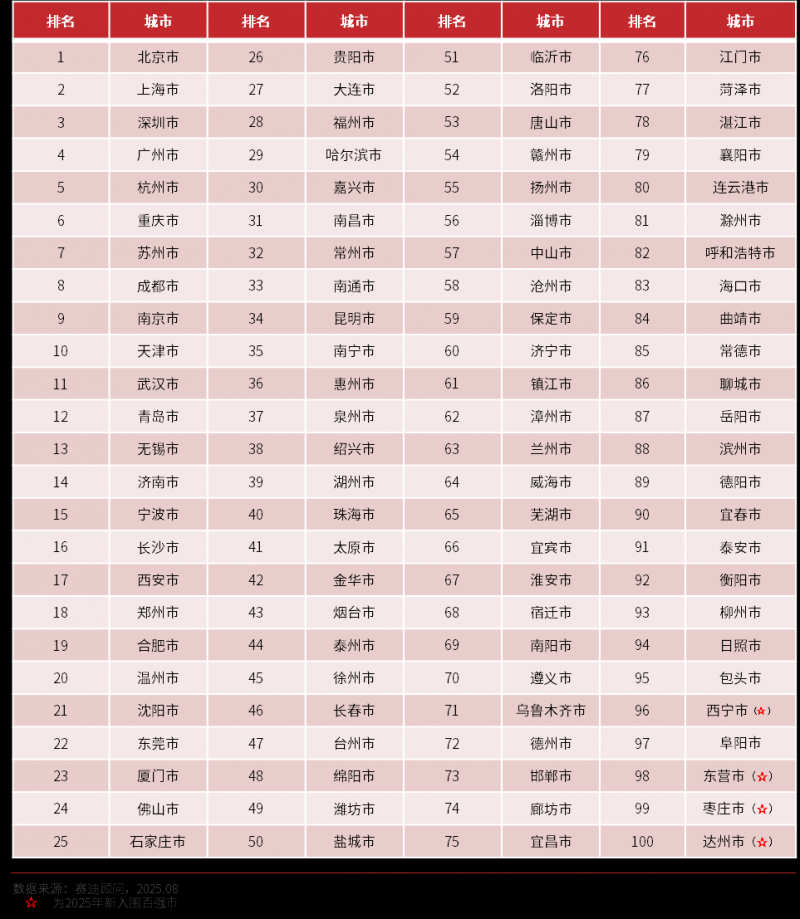
Core Insights - The digital transformation is entering a critical phase, leading to a new competitive landscape among cities focused on data elements, intelligent computing power, and scenario innovation [1][4] - The "2025 China Digital City Competitiveness Research Report" by CCID Consulting indicates significant changes in the rankings of the top 100 digital cities, with 48 cities rising, 18 remaining stable, and 38 declining [1][4] - Four new cities have entered the top 100, including Dongying and Zaozhuang, making Shandong the only province with all 16 cities listed in the 2025 digital top 100 [1][3] Digital City Rankings - The report evaluates over 200 cities based on six dimensions and 54 indicators, reflecting comprehensive capabilities in digital infrastructure, economic vitality, innovation capacity, governance efficiency, green transformation, and cultural soft power [1][4] - The top 10 cities in the 2025 digital rankings include Beijing, Shanghai, Shenzhen, Guangzhou, Hangzhou, Chongqing, Suzhou, Chengdu, Nanjing, and Tianjin [2] Shandong Province Insights - Shandong's 16 cities rank as follows: Qingdao (12), Jinan (14), Yantai (43), Weifang (49), Linyi (51), Zibo (56), Jining (60), Weihai (64), Dezhou (72), Heze (77), Liaocheng (86), Binzhou (88), Tai'an (91), Rizhao (94), Dongying (98), and Zaozhuang (99) [3] - The rankings of Shandong cities align with their economic output, with cities like Weihai leading in high-tech industry output, giving it an advantage in digital transformation [3] Competitive Dynamics - The competition among major cities has disrupted previous GDP rankings, with Shandong's Qingdao and Jinan outperforming cities like Ningbo, Changsha, Xi'an, Zhengzhou, and Hefei [4] - The number of cities in the "efficiency-driven" category has increased from 40 in 2024 to 48 in 2025, indicating a shift from basic infrastructure to data empowerment and scenario innovation [4] Policy and Future Outlook - The recent approval of pilot reforms for market-oriented allocation of factors, including data marketization, is expected to reshape the competitive landscape among cities [5] - Shandong's ability to maintain its competitive edge will depend on continuous efforts in data empowerment, scenario innovation, and value release [5]