数据驱动型文化公司

Search documents
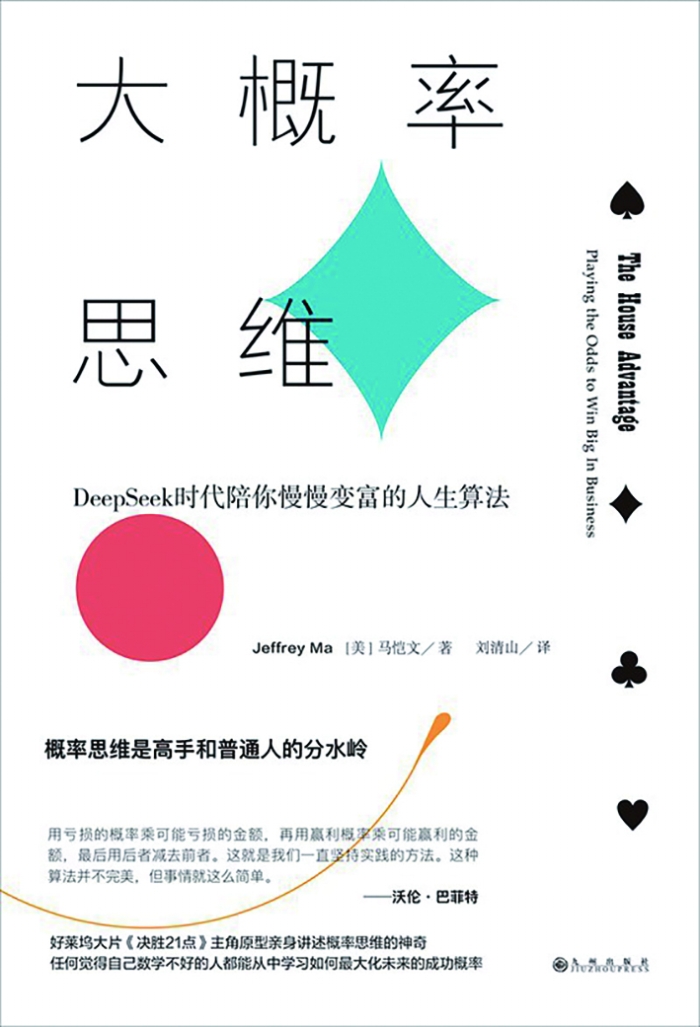
大数据时代的理性胜利法则———读《大概率思维》
Shang Hai Zheng Quan Bao· 2026-02-23 18:37
Core Insights - The essence of probability thinking is a belief that relies on analytical and statistical methods to find certainty [3] - The author emphasizes the importance of understanding volatility and maintaining a long-term perspective in decision-making [4] - The book provides a framework for decision-making that includes setting goals, defining scope, and determining perspective [8] Group 1: Probability Thinking - Probability thinking is a distinguishing factor between experts and ordinary individuals, focusing on maximizing future success probabilities [1] - The author shares personal experiences from the blackjack table, illustrating the universal applicability of probability thinking in business [3] - The success in blackjack is attributed to a solid mathematical foundation, where past events influence future outcomes [3] Group 2: Long-term Perspective - The second principle of "big probability thinking" is to value and maintain a long-term perspective, requiring multiple attempts and patience [4] - The author stresses that true belief in strategies and models is essential, based on an understanding of underlying system logic [4] Group 3: Cognitive Biases - The book highlights cognitive traps that hinder rational decision-making, such as confirmation bias and selective bias [5] - It is crucial to ensure that all relevant data is considered to maintain sample integrity and representativeness [6] - Distinguishing correlation from causation is key to understanding the predictive value of data [6] Group 4: Data Utilization - Collecting data is just the first step; the focus should be on obtaining trustworthy, unbiased information [7] - Organizations should foster a culture of inquiry, encouraging collaboration between those who ask important questions and those skilled in statistical analysis [8] Group 5: Decision Framework - A complete decision framework consists of three elements: goals, scope, and perspective [8] - The author advocates for a "data-driven culture" in organizations, where decisions are based on solid data and thorough examination [8] Group 6: Quality of Decisions - Decision quality should not be judged solely by outcomes; the logic and information used in decision-making are the true standards [9] - The author warns against the dangers of inaction and groupthink, which can stifle innovation [9] - A clear strategy for navigating uncertainty involves seeking certainty in data and maintaining patience through volatility [9]