数据驱动检测

Search documents
Mistras (MG) - 2025 Q4 - Earnings Call Transcript
2026-03-05 15:02
Financial Data and Key Metrics Changes - Consolidated revenue growth of 5.1% in Q4 2025 compared to the prior year, with full-year revenue at $724 million, slightly up year-over-year [4][9] - GAAP net income of $3.9 million and EPS of $0.12 for Q4, with non-GAAP net income of $7.9 million and EPS of $0.20 [8][23] - Adjusted EBITDA of $24.8 million for Q4, up 18.2% year-over-year, representing a 13.7% margin, the highest ever for Q4 [8][10] - Full-year Adjusted EBITDA of $91.1 million with a margin of 12.6%, exceeding previous outlook [10] Business Line Data and Key Metrics Changes - Aerospace and defense business grew by $4.5 million in Q4, a 21.9% increase year-over-year [5] - Power generation revenue increased by $3.3 million, representing 33.2% growth [5] - Laboratory business grew by 61% in Q4 compared to the prior year [7] - Industrial and infrastructure verticals saw increases of 6.7% and 26.8% respectively [5] Market Data and Key Metrics Changes - International segment delivered nearly 6% revenue growth for the year, driven by strong performance in industrials and aerospace and defense markets [9] - Oil and gas revenue anticipated to decline due to project timing and lab closures, but other sectors are expected to grow [5][9] Company Strategy and Development Direction - Focus on expanding share wallet and transforming services into integrated solutions, with significant growth in data solutions business [11][12] - Strategic plan includes increasing capital expenditures to 4.5% of revenue to expand capacity, particularly in aerospace and defense [32] - Emphasis on operational leverage through efficiency and productivity gains, with investments in proprietary technology for digitalization [18] Management's Comments on Operating Environment and Future Outlook - Management views 2026 as an opportunistic year for executing strategic plans and unlocking inherent value [32] - Anticipated full-year revenue for 2026 is between $730 million and $750 million, with Adjusted EBITDA between $91 million and $93 million [34] - Management remains cautious about the oil and gas market but confident in growth from aerospace, infrastructure, and power generation [34][70] Other Important Information - Increased restructuring charges of $12.6 million for the year, with no negative revenue implications from restructuring actions [22][86] - Total accounts receivable increased to $154.7 million as of December 31, 2025, due to working capital timing [26] Q&A Session Summary Question: Insights on Aerospace and Defense backlog and capacity - Management has good visibility into customer demand and is expanding capacity to meet it, with a hub and spoke model in place [41][42] Question: Plans for tuck-in acquisitions in Aerospace and Defense - Current focus is on organic expansion rather than acquisitions due to high costs, with significant growth achieved through internal investments [44] Question: Impact of geopolitical events on operations - Limited direct impact from geopolitical events, but management is monitoring the situation closely [47] Question: Customer wins and bid activity in growth segments - New contracts are being won in infrastructure and power generation, with a focus on expanding existing customer relationships [49] Question: Clarification on revenue guidance range - Revenue performance is heavily dependent on oil and gas market conditions, with confidence in growth from other sectors [54] Question: Improvement in international profitability - Structural improvements in international operations are expected to sustain profitability in 2026 [77] Question: Long-term organic revenue growth and EBITDA margins - Long-term organic revenue growth is projected at a CAGR of about 5%, with aspirations for EBITDA margins to reach 15% [89]

Mistras (MG) - 2025 Q4 - Earnings Call Transcript
2026-03-05 15:02
Financial Data and Key Metrics Changes - Consolidated revenue growth of 5.1% in Q4 2025 compared to the prior year, with full-year revenue at $724 million, slightly up year-over-year [4][9] - GAAP net income of $3.9 million and EPS of $0.12 for Q4, with non-GAAP net income of $7.9 million and EPS of $0.20 [8][23] - Adjusted EBITDA of $24.8 million in Q4, up 18.2% year-over-year, representing a 13.7% margin, the highest ever for Q4 [8][10] - Full-year Adjusted EBITDA of $91.1 million with a margin of 12.6%, exceeding previous outlook [10] Business Line Data and Key Metrics Changes - Aerospace and defense revenue increased by $4.5 million, a growth of 21.9% year-over-year [5] - Power generation revenue rose by $3.3 million, representing a 33.2% increase [5] - Industrial and infrastructure verticals grew by 6.7% and 26.8% respectively [5][7] - Laboratory business grew by 61% in Q4 compared to the prior year [7] Market Data and Key Metrics Changes - International segment revenue grew nearly 6% for the year, driven by strong performance in industrials and aerospace and defense markets [9] - Oil and gas revenue anticipated to decline due to project timing and lab closures, but other sectors showed strong growth [5][9] Company Strategy and Development Direction - Focus on expanding share wallet and transforming services into integrated solutions, with significant growth in data solutions business [11][12] - Strategic plan includes increasing capital expenditures to 4.5% of revenue to expand capacity, particularly in aerospace and defense [32] - Emphasis on operational leverage through efficiency and productivity gains, with investments in proprietary technology for digitalization [18] Management's Comments on Operating Environment and Future Outlook - Management views 2026 as an opportunistic year for executing strategic plans and unlocking inherent value [32] - Anticipated revenue for 2026 is between $730 million and $750 million, with Adjusted EBITDA between $91 million and $93 million [34] - Cautious outlook on oil and gas market, with expectations of flat or slightly down CapEx from customers [67] Other Important Information - Increased restructuring charges of $12.6 million for the year, with no negative revenue implications from restructuring actions [22][86] - Total accounts receivable balance increased to $154.7 million as of December 31, 2025, due to working capital timing [26] Q&A Session Questions and Answers Question: Insights on Aerospace and Defense backlog and capacity - Management has good visibility into customer demand and is expanding capacity to meet it, with a hub and spoke model in place [41][42] Question: Plans for tuck-in acquisitions in Aerospace and Defense - Current focus is on organic expansion rather than acquisitions, with significant internal investments to build capabilities [44] Question: Impact of geopolitical events on operations - Limited direct impact from geopolitical events, but potential for increased upstream activities if oil prices rise [47] Question: Trends in oil and gas customer spending and margin profiles - Customers are maintaining maintenance budgets, which could favorably impact the company, with higher margins expected in growing sectors [49][50] Question: Clarification on revenue guidance range - Revenue performance largely depends on oil and gas market conditions, with confidence in growth from aerospace and defense [54]
趋势研判!2025年中国建筑材料检测行业流程、产业链、发展规模、市场价格、竞争格局及行业发展趋势分析:规模逐渐壮大,市场规模有望增长至426.14亿元[图]
Chan Ye Xin Xi Wang· 2025-08-18 01:28
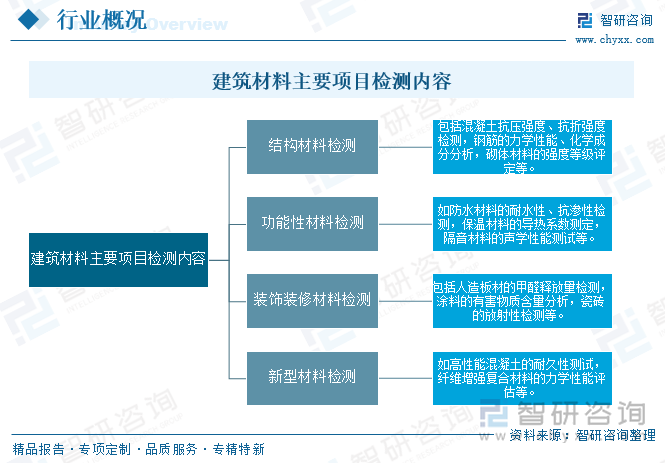
Core Insights - The construction materials testing industry is crucial for ensuring engineering safety, with 35% of construction accidents attributed to material issues [10][12]. - The market for construction materials testing in China is projected to grow significantly, with an expected report issuance of 62.21 million in 2025 and a market size of 42.614 billion yuan [10][12]. - The average price for construction materials testing is on a downward trend, decreasing from 745 yuan per report in 2019 to an estimated 685 yuan in 2025 [12]. Industry Definition and Main Content - Construction materials are defined as materials used in civil engineering, including cement, sand, stone, metals, asphalt, synthetic resins, and plastics [8]. - Testing is essential for quality control, ensuring materials meet design requirements, construction standards, and national regulations [8][10]. Current Development Status - The construction materials testing industry has evolved from simple physical and chemical tests to high-precision non-destructive testing technologies [10]. - The number of reports issued in the construction materials testing sector has increased from 25.51 million in 2016 to 58.74 million in 2024, with a market size growth from 18.241 billion yuan to 40.881 billion yuan during the same period [10][12]. Industry Chain - The upstream of the construction materials testing industry includes instruments, consumables, standard substances, data and software, and talent [14]. - The midstream consists of testing service providers, including third-party testing agencies, government laboratories, and internal company labs [14]. - The downstream serves construction companies, building material manufacturers, regulatory bodies, and ultimately property owners [14]. Competitive Landscape - The competitive landscape includes state-owned leaders, private third-party testing institutions, and international testing giants, each leveraging their strengths for differentiated positioning [17]. - Major players include the state-owned National Inspection Group, private firms like Huace Testing and Puni Testing, and international entities such as SGS and BV [17][19]. Development Trends - The industry is expected to focus on technological innovation, with an emphasis on developing intelligent and automated testing equipment to meet increasing testing demands [27]. - There is a need for a standardized database system to analyze material performance data, utilizing data analysis tools for intelligent predictions and anomaly detection [27][28]. - The construction materials testing sector is also moving towards sustainability, requiring materials that are efficient, lightweight, green, and multifunctional [29].