文本到3D生成

Search documents
RL加持的3D生成时代来了!首个「R1 式」文本到3D推理大模型AR3D-R1登场
机器之心· 2025-12-22 08:17
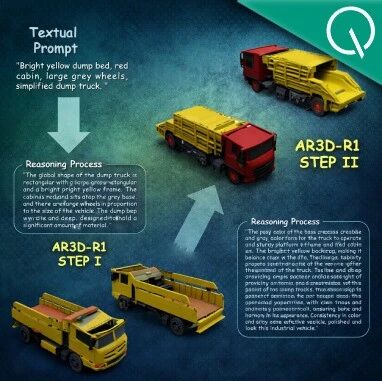
Core Insights - The article discusses the successful application of Reinforcement Learning (RL) in the text-to-3D generation domain, marking a systematic breakthrough in this area [2][32] - The AR3D-R1 model, developed by researchers from various institutions, is the first RL-enhanced autoregressive model for text-to-3D generation [2][32] Group 1: Challenges in Applying RL to 3D Generation - 3D generation faces unique challenges such as higher spatial complexity, global geometric consistency, and local texture refinement compared to 2D images [12][9] - Previous works primarily utilized a "pre-training + fine-tuning" framework for 3D models, with no systematic integration of RL into 3D generation until now [9][12] Group 2: AR3D-R1 Framework - AR3D-R1 is built on the discrete 3D generation model ShapeLLM-Omni and introduces a reasoning-driven 3D generation process [11][14] - The model first generates high-level semantic reasoning based on text prompts, which guides the rough shape generation [11][27] Group 3: Reward Design and RL Algorithms - The research emphasizes the importance of aligning reward signals with human aesthetic preferences to significantly enhance generation quality [17][20] - Various RL algorithm variants were analyzed, providing systematic guidance for RL applications in 3D generation [20][22] Group 4: Hi-GRPO Hierarchical RL Paradigm - Hi-GRPO is introduced as a hierarchical RL paradigm that optimizes 3D generation by separating global structure reasoning from local texture refinement [24][25] - This approach allows for progressive 3D generation, ensuring global geometric consistency while fine-tuning local details [25][22] Group 5: MME-3DR Benchmark - The new MME-3DR benchmark is proposed to evaluate the implicit reasoning capabilities of 3D generation models, focusing on five challenging categories [26][30] - AR3D-R1 shows significant improvements in performance across various benchmarks, surpassing models like Trellis in implicit 3D reasoning capabilities [30][26] Group 6: Quantitative Results - AR3D-R1 achieved a Kernel Distance of 0.156 and a CLIP Score of 29.3, indicating a high alignment with real data distributions and improved semantic quality [30][31] - The model demonstrates superior performance on existing datasets and the newly introduced MME-3DR benchmark, showcasing advancements in geometric consistency and texture quality [30][31]


首个文本到3D生成RL范式诞生,攻克几何与物理合理性
量子位· 2025-12-20 04:20
Core Insights - Reinforcement Learning (RL) has become a key method for enhancing the reasoning chain and generation quality in large language models and text-to-image generation [1] - A recent study by several universities explores the applicability of RL in the more complex domain of text-to-3D generation [2][3] Group 1: Research Focus - The study investigates whether RL can strengthen the stepwise reasoning and generation process of 3D autoregressive models [3] - It identifies challenges in the text-to-3D domain, including the need for reward design that captures semantic alignment, geometric consistency, and visual quality [6] Group 2: Reward Design and Findings - The research team found that aligning with human preference signals is crucial for improving overall 3D quality, while other reward dimensions provide limited benefits when used alone [7] - Specialized reward models generally outperform large multimodal models (LMMs) in robustness, although a general multimodal model (Qwen-VL) showed unexpected robustness in 3D-related attributes [7] Group 3: Training Techniques - In 3D autoregressive generation, RL prefers token-level strategies over sequence-level operations, leading to significant improvements [8] - Techniques like Dynamic Sampling can stabilize training, while excessive KL penalty removal can degrade performance [9] Group 4: Benchmarking and Evaluation - The study introduces the MME-3DR benchmark, focusing on spatial and structural geometry, mechanical affordance, physical plausibility, organic forms, and rare entities [10] - MME-3DR aims to assess consistency, reasonability, and interpretability under challenging constraints rather than just diversity [11] Group 5: Key Discoveries - RL training significantly enhances implicit 3D reasoning capabilities across various dimensions, including spatial geometry and physical feasibility [15] - The hierarchical structure design (Hi-GRPO) that respects the sequence of geometry followed by texture is more effective than simple scoring on final images [16] - The balance between performance and stability is critical, as sparse rewards or excessive RL iterations can lead to instability and mode collapse [17] Group 6: Limitations and Future Directions - Current models still struggle with complex geometries, long-tail concepts, and highly stylized scenes, indicating the limitations of scalable 3D RL due to computational and reward acquisition costs [18]