新能源材料开发

Search documents
我国发现新矿物,正式命名
中国能源报· 2025-12-18 03:49
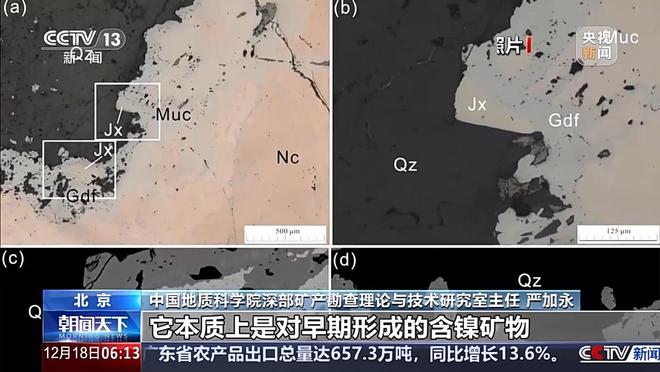
Core Viewpoint - The discovery of a new mineral named Jinxiuite in China represents a significant scientific breakthrough, enhancing the understanding of mineral resources and potentially leading to new material applications [1][8]. Group 1: Discovery and Characteristics - Jinxiuite, a nickel-bismuth-antimony-arsenic sulfide, was officially approved by the International Mineralogical Association and discovered in the Longhua nickel-cobalt deposit in Guangxi, China [1][3]. - The Longhua deposit is rich in nickel and cobalt, with concentrations of approximately 17.5% nickel and 1.5% cobalt, significantly higher than conventional standards [1]. - The mineral's formation involved the replacement of earlier nickel-containing minerals, resulting in a new stable crystal structure [3]. Group 2: Economic and Research Implications - The discovery of Jinxiuite is crucial as nickel-cobalt deposits are scarce, particularly cobalt, which has been heavily reliant on imports [5]. - The presence of valuable metals like nickel and cobalt in Jinxiuite necessitates further research on their extraction, impacting the economic viability of resource utilization [7]. - Establishing theoretical models for Jinxiuite as a marker mineral could aid in identifying economically valuable nickel-cobalt mineralization in future geological explorations [7]. Group 3: Scientific Significance - The discovery of new minerals like Jinxiuite expands human understanding of the material world and may lead to the synthesis of new materials with unique properties [8][10]. - Jinxiuite serves as a "time capsule" for geological history, revealing the evolution of elements under extreme geological conditions [12][14]. - The mineral acts as a natural sensor for deep Earth processes, providing valuable data for understanding the Earth's past, present, and future [14]. Group 4: Discovery Process - The process of discovering and approving a new mineral involves extensive sampling and data analysis from known deposits [15]. - Key methods for confirming a new mineral include electronic probe analysis and X-ray diffraction to determine elemental composition and atomic arrangement [19][20]. - The naming of new minerals can be based on their structure or geographical location, as seen with Jinxiuite, named after its discovery site in Guangxi [21].

地球矿物家族添新成员!我国发现的新矿物正式命名为金秀矿
Huan Qiu Wang Zi Xun· 2025-12-17 23:49
Core Viewpoint - The discovery of a new mineral named "Jinxiuite" (金秀矿) by researchers from the Chinese Academy of Geological Sciences represents a significant advancement in geological research and adds a new member to the mineral family, with implications for material science and resource extraction [1][8][10]. Group 1: Mineral Discovery - The new mineral Jinxiuite, composed of nickel, bismuth, antimony, arsenic, and sulfur, was discovered in the Longhua nickel-cobalt deposit in Jinxiu Yao Autonomous County, Guangxi, China [1][3]. - The Longhua nickel-cobalt deposit is rich in nickel and cobalt, with concentrations of approximately 17.5% nickel and 1.5% cobalt, significantly higher than conventional standards [1][5]. Group 2: Implications for Resource Utilization - The discovery of Jinxiuite is crucial for understanding the genesis of hydrothermal nickel-cobalt deposits and may guide future exploration efforts [5]. - The mineral contains valuable metals such as nickel, cobalt, and bismuth, prompting further research into the extraction feasibility and economic benefits of these resources [7]. Group 3: Scientific Significance - The identification of new minerals enhances the understanding of Earth's geological history and can reveal the evolution of elements under extreme geological conditions [10][12]. - Jinxiuite serves as a natural sensor for probing deep Earth processes, providing valuable data for understanding the planet's past, present, and future [12]. Group 4: Discovery Process - The process of discovering and obtaining approval for a new mineral involves extensive sampling, data analysis, and comparison with previously identified minerals, culminating in a proposal submitted to the International Mineralogical Association [18][20]. - The naming of the mineral, in this case, Jinxiuite, is based on its geographic origin, reflecting the location of its discovery [20].