
日本众议院选举

Search documents
日本政府决定召集特别国会 预计将进行首相指名选举
Yang Shi Xin Wen· 2026-02-10 03:45
Core Viewpoint - The Japanese government and ruling party have decided to convene a special Diet session on February 18, during which a prime ministerial election is expected to take place [1] Group 1 - The Japanese House of Representatives was officially dissolved on January 23, marking the shortest interval of 16 days from dissolution to voting since the end of World War II [1] - In the House of Representatives election held on February 8, the ruling coalition formed by the Liberal Democratic Party and the Japan Innovation Party secured a majority of seats [1]
日本执政联盟获过半数议席
Xin Lang Cai Jing· 2026-02-09 05:51
Core Points - The ruling coalition of the Liberal Democratic Party (LDP) and Japan Innovation Party secured a majority in the recent Japanese House of Representatives election [1] - The LDP won 316 seats, while the Japan Innovation Party obtained 36 seats [1] - The opposition parties, including the Constitutional Democratic Party and Komeito, formed a new party called "Center Reform Union," which gained 49 seats [1] Election System - The Japanese House of Representatives election employs a mixed electoral system combining single-member districts and proportional representation [1] - Out of 465 total seats, 289 are from single-member districts and 176 from proportional representation [1] - Voting took place on the 8th, with 1,284 candidates participating [1]
日本众议院选举结果公布,日经225指数上涨超5%
第一财经· 2026-02-09 00:55
Group 1 - The ruling coalition formed by the Liberal Democratic Party (LDP) and the Japan Innovation Party secured a majority in the recent Japanese House of Representatives election, with the LDP winning 316 seats and the Japan Innovation Party winning 36 seats [2] - The opposition parties, including the Constitutional Democratic Party and Komeito, formed a new party called the "Center Reform Coalition," which won 49 seats, while the Democratic Party for the People secured 28 seats [2] - Other parties and independent candidates received a total of 15 seats for the Participating Party, 11 seats for the emerging party "Future Team," 4 seats for the Japanese Communist Party, 1 seat for the Reiwa Shinsengumi, and 1 seat for the "Tax Reduction Japan and Concerned Citizens Union," with 4 seats for independents and others [2] Group 2 - The Nikkei 225 index experienced a significant increase of 5.1%, reaching 56,999.60 points [3]


日本众议院选举结果出炉:自民党单独获超三分之二席位
Zhong Guo Xin Wen Wang· 2026-02-09 00:15
Group 1 - The core viewpoint of the article is that the Liberal Democratic Party (LDP) of Japan has secured over two-thirds of the seats in the recent House of Representatives election, indicating a strong political position [1] - The LDP won a total of 316 seats in the election, which is a significant majority [1] - The election saw the Constitutional Democratic Party and Komeito's "Center Reform Coalition" lose over 100 seats, ending up with only 49 seats [2] Group 2 - The National Democratic Party obtained 28 seats, while other parties such as the emerging "Future Team" secured 11 seats and the Japanese Communist Party received 4 seats [2] - The election involved 1,284 candidates competing for 465 seats, which included 289 single-member district seats and 176 proportional representation seats [2] - The electoral system in Japan combines single-member district voting and proportional representation, allowing voters to cast votes for individual candidates and parties [2]
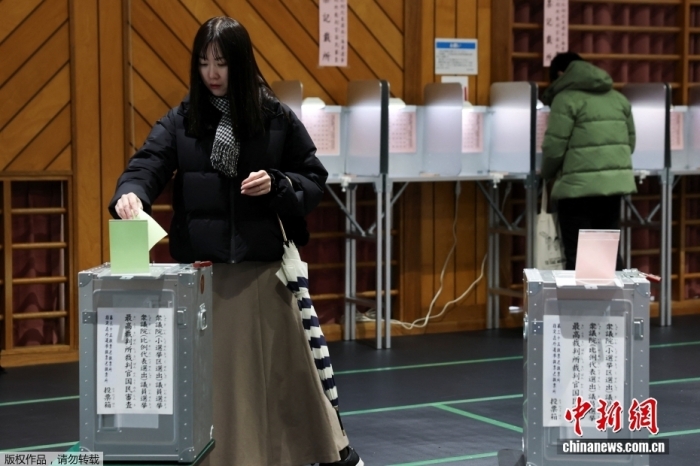
日本众议院选举结果公布
21世纪经济报道· 2026-02-09 00:08
Group 1 - The ruling coalition formed by the Liberal Democratic Party (LDP) and the Japan Innovation Party secured a majority in the recent Japanese House of Representatives election, with the LDP winning 316 seats and the Japan Innovation Party winning 36 seats [1] - The opposition parties, including the Constitutional Democratic Party and the Komeito Party, formed a new party called the "Center Reform Coalition," which won 49 seats, while the Democratic Party for the People secured 28 seats [1] - The election utilized a mixed electoral system combining single-member districts and proportional representation, with a total of 465 seats available, including 289 from single-member districts and 176 from proportional representation [1] Group 2 - The election took place on January 8, with voting starting at 7 AM local time and ending at 8 PM, involving 1,284 candidates [1] - The interval between the dissolution of the House of Representatives on January 23 and the election was only 16 days, marking the shortest period since World War II [1]

日本众议院选举结果公布
财联社· 2026-02-08 23:40
Group 1 - The ruling coalition formed by the Liberal Democratic Party (LDP) and the Japan Innovation Party secured a majority in the recent House of Representatives election, winning 316 and 36 seats respectively [1] - The opposition parties, including the Constitutional Democratic Party and Komeito, formed a new party called the "Center Reform Coalition," which won 49 seats, while the Democratic Party for the People secured 28 seats [1] - The election utilized a mixed electoral system combining single-member districts and proportional representation, with a total of 465 seats available [1][2] Group 2 - The House of Representatives was officially dissolved on January 23, and the time from dissolution to voting was only 16 days, marking the shortest interval since World War II [2]

日本众议院选举遇创纪录降雪:多个投票站提前关闭
Xin Jing Bao· 2026-02-08 10:27
Core Viewpoint - The record snowfall in parts of Japan on February 8 has significantly impacted the House of Representatives election, leading to lower voter turnout and operational challenges at polling stations [1] Group 1: Weather Impact - Aomori City recorded a snow depth of 133 centimeters, approximately double the average depth for this time of year [1] - Tottori Prefecture observed 30 centimeters of snowfall within a 6-hour period, causing multiple polling stations to close 2 hours early [1] Group 2: Voter Turnout - As of 2 PM on February 8, the voter turnout was 16.05%, which is a decrease of 3.07 percentage points compared to the previous House of Representatives election [1]
日本众议院选举共有哪几“关”?
Xin Lang Cai Jing· 2026-01-27 17:52
Group 1 - The core point of the article is that Japanese Prime Minister Sanna Takichi has stated she will resign if the ruling coalition fails to secure a majority in the upcoming House of Representatives election [1][5] - The announcement of the 51st House of Representatives election was made on January 27, with voting scheduled for February 8, marking the official start of the election campaign [1][5] - The election will involve a total of 465 seats, including 289 from single-member districts and 176 from proportional representation [1] Group 2 - As of January 26, over 1,200 individuals have expressed their intention to run for election [1] - The election campaign activities, including street speeches and debates, are expected to continue until February 7, the day before voting [1][5] - The legal term for the House of Representatives is four years, but this election comes just over a year after the last one, leading to criticism regarding the necessity of this early election [5]
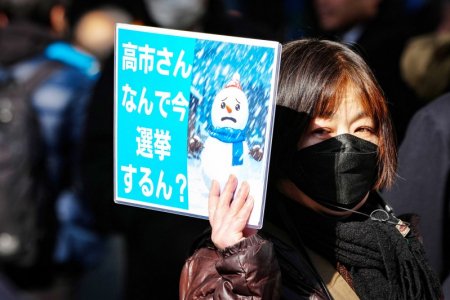
高市最新表态:如若不成,将辞相位
Xin Lang Cai Jing· 2026-01-27 12:40
Core Viewpoint - The 51st House of Representatives election in Japan is officially announced, with voting and counting scheduled for February 8, marking the start of a 12-day campaign period [1] Group 1: Election Details - The election will involve a total of 465 seats, comprising 289 single-member district seats and 176 proportional representation seats [1] - As of the 26th, over 1,200 individuals have expressed their intention to run for election [1] Group 2: Political Implications - Prime Minister Sanna Takashi stated that if the Liberal Democratic Party and the Japan Innovation Party fail to secure a majority of seats, he will resign from his position [1]
日本众议院选举公告发布 选战正式拉开序幕
Yang Shi Xin Wen· 2026-01-27 02:52
Core Points - The 51st House of Representatives election in Japan has been officially announced, with voting and counting scheduled for February 8, marking the start of a 12-day election campaign [1] - The election will involve a total of 465 seats, which includes 289 seats from single-member districts and 176 seats from proportional representation districts [1] - As of the 26th, over 1,200 individuals have expressed their intention to run for election [1]