早期融资

Search documents
创业者要把融资当作一份全职工作
Sou Hu Cai Jing· 2025-12-30 00:55
Group 1 - The core message emphasizes that fundraising is a critical task that requires full commitment and should not be treated as a secondary process [1][2] - Founders often make the mistake of trying to manage multiple responsibilities while fundraising, which can lead to stalled progress and missed opportunities [2][4] - Before starting the fundraising process, it is essential to clear other responsibilities, delegate tasks, and automate repetitive processes to focus entirely on fundraising [3] Group 2 - To achieve a higher valuation, it is crucial to generate interest from multiple investors simultaneously rather than relying on a single investor [5][6] - The fundraising process is likened to an auction, where having more interested investors increases the potential for a higher valuation due to supply and demand dynamics [5] - Early-stage companies are encouraged to adopt a phased approach to fundraising, allowing them to secure initial funds and build momentum for subsequent rounds [7] Group 3 - Founders should actively seek introductions to potential investors from their network, as many people are willing to help if asked [8][10] - The fundraising process requires a systematic approach, including clear time management, reaching out to a sufficient number of investors, and maintaining follow-up [10] - It is important for founders to treat fundraising as a full-time job, as this mindset can significantly influence the outcome of their efforts [10]

直击融资实战,这场活动干货满满!| 活动回顾
Sou Hu Cai Jing· 2025-10-11 09:39
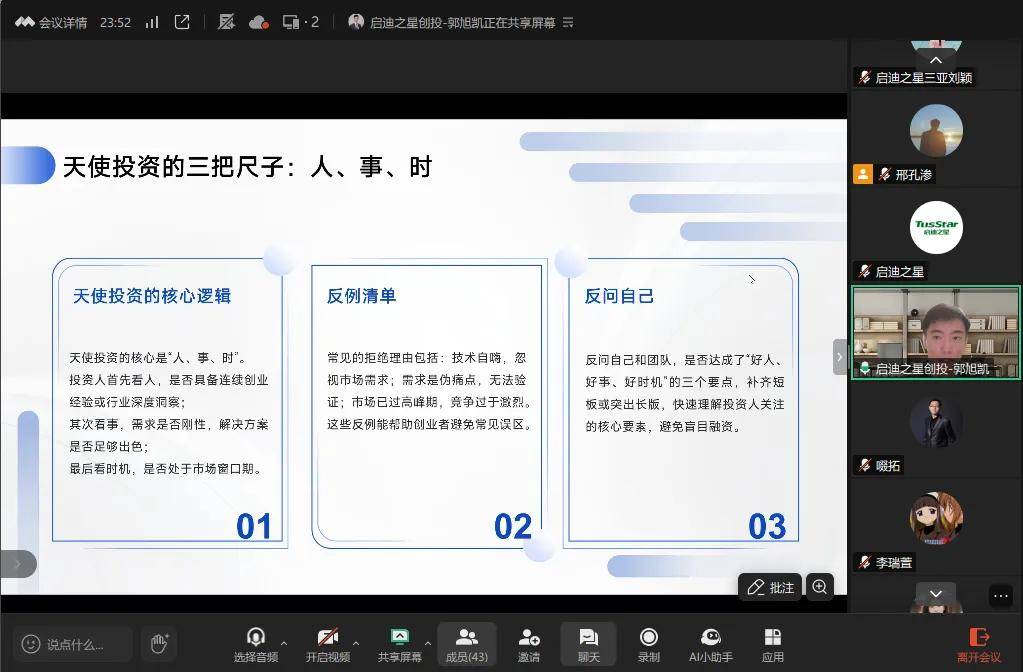
Group 1 - The core activity organized by Qidi Star focuses on addressing the practical needs of early-stage entrepreneurs in financing awareness, pacing, and material preparation [1] - The training aims to provide entrepreneurs with actionable financing methodologies through systematic practical content [1][2] Group 2 - The training features four core modules designed to build a practical financing system [2] - Expert Guo Xukai shares insights on common pitfalls in the financing process and offers specific, actionable solutions [2] Group 3 - The training addresses four key concerns of entrepreneurs: decoding investor thinking, financing rhythm planning, practical skills for writing business plans, and financial forecasting and valuation [4][5][6][7] - The session on investor thinking helps entrepreneurs understand the three major investment criteria: "people, events, timing," enabling them to think from the investor's perspective [4] - Financing rhythm planning provides practical advice on equity design and financing strategies tailored to different stages of business development [5] - The business plan writing segment covers essential elements and offers specific guidance on creating effective presentations [6] - Financial forecasting and valuation are taught through case studies, highlighting key points in valuation negotiations to help avoid common pitfalls [7] Group 4 - The training includes case studies and interactive sessions to address real issues faced by entrepreneurs [8] - During the interactive segment, entrepreneurs engage in discussions about validating demand authenticity and concerns over high valuations affecting future financing [10] - Guo Xukai provides personalized financing strategy suggestions for specific projects, utilizing a teaching approach that combines case studies, formulas, and pitfalls lists to simplify complex financing logic [10]