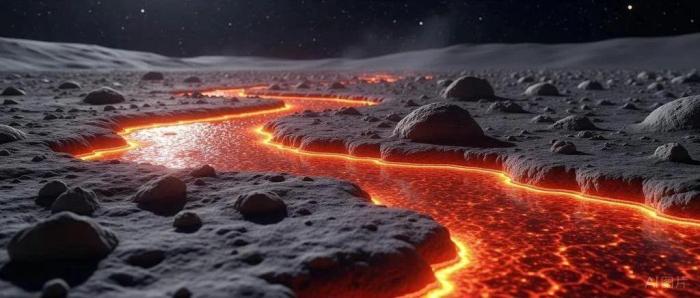
月球年轻火山活动机制

Search documents
【中国新闻网】月球“晚年”为何还有火山喷发?中国科学家研究嫦娥六号样品揭秘
Zhong Guo Xin Wen Wang· 2025-08-23 00:37
Core Insights - The research reveals that the Moon experienced volcanic activity much later than previously believed, with evidence of eruptions occurring as recently as 2.8 billion years ago, challenging the notion that the Moon has been geologically inactive for the last 3 billion years [1][2]. Group 1: Mechanisms of Lunar Volcanism - The study identifies two distinct types of basalt samples from the Chang'e 6 mission, indicating that volcanic activity was driven by different heat sources: "ultra-low titanium basalt" from deep within the Moon's mantle and "low titanium basalt" from shallower depths [1][2]. - A new thermal dynamic mechanism is proposed, suggesting that as the Moon cooled, magma became trapped in the upper mantle, leading to partial melting and subsequent volcanic eruptions [2]. Group 2: Asymmetrical Evolution of the Moon - Analysis of lunar remote sensing data indicates a significant shift in volcanic activity mechanisms around 3 billion years ago, transitioning from diverse heat sources to a dominant upward heat transfer mechanism [3]. - The chemical characteristics of late-stage volcanic rocks on the Moon's near side are found to be similar to those of the Chang'e 5 basalt, while the far side shows a closer resemblance to the ultra-low titanium basalt from Chang'e 6, suggesting compositional differences in the lunar mantle [3]. Group 3: Implications for Lunar Research - The findings from the Chang'e 6 samples not only enhance understanding of the Moon's thermal evolution but also provide insights into volcanic activity mechanisms on other small celestial bodies lacking atmospheres [4]. - The ongoing lunar exploration efforts, particularly through the Chang'e missions, are expected to continue revealing new information about the Moon's geological history and its thermal state [5].
月球“晚年”为何还有火山喷发?中国科学家研究嫦娥六号样品揭秘
Zhong Guo Xin Wen Wang· 2025-08-23 00:33
Core Insights - The research reveals that the Moon has experienced volcanic activity during its "late" period, challenging the long-held belief that it became dormant around 3 billion years ago [1][2] - The study identifies two distinct types of basalt from the Chang'e 6 samples, indicating different sources and depths of formation, which contributes to understanding the Moon's thermal evolution [2][4] Group 1: Volcanic Activity - The study confirms that volcanic eruptions occurred on the Moon even in its later stages, raising questions about the heat dynamics that sustain this activity [1][2] - Two types of basalt were identified: "ultra-low titanium basalt" from deep within the Moon's mantle (approximately 120 km from the surface) and "low titanium basalt" from a shallower depth (60-80 km) [2][4] Group 2: Thermal Mechanisms - The research proposes a new thermal mechanism where magma, trapped in the upper mantle, can transfer heat upward, leading to partial melting and subsequent volcanic eruptions [2][3] - Traditional hypotheses linking volcanic activity to water-rich or radioactive heat sources were disproven, as the identified source regions were found to be dry and lacking radioactive elements [2][4] Group 3: Asymmetrical Evolution - Analysis of lunar remote sensing data indicates a significant shift in volcanic heat sources around 3 billion years ago, transitioning from diverse sources to a dominant upward heat transfer mechanism [3][4] - The chemical characteristics of late-stage volcanic rocks on the Moon's near side are similar to those of the Chang'e 5 basalt, while the far side shows a closer resemblance to the ultra-low titanium basalt from Chang'e 6, suggesting compositional differences in the lunar mantle [4] Group 4: Implications for Lunar Studies - The findings from the Chang'e 6 samples not only enhance the understanding of the Moon's thermal evolution but also provide insights into volcanic mechanisms on other small celestial bodies [5][6] - The ongoing research is expected to uncover more mysteries about the Earth-Moon system, indicating that the Moon's geological history is more complex than previously thought [5][6]