月球演化研究

Search documents
【新华社】改写演化认知史!中国不断破译“月球天书”
Xin Hua She· 2026-02-10 02:58
Core Insights - The Chang'e 6 mission successfully returned with 1935 grams of lunar soil samples, marking the first time humanity has collected samples from the far side of the Moon [1] Group 1: Scientific Discoveries - The Chinese Academy of Sciences identified ancient rock formations in the samples, dating back 4.25 billion years, which serve as a valuable reference point for understanding the Moon's early history [2] - A research team from Jilin University discovered naturally occurring single-walled carbon nanotubes and graphite carbon in the samples, indicating that these materials can form in the Moon's extreme environment [3] - The Shandong University team found micro-sized hematite and magnetite crystals, revealing a new oxidation mechanism on the Moon linked to large impact events [4] Group 2: Geological Insights - Researchers discovered a new type of impact lava from the South Pole-Aitken basin, confirming its formation 4.25 billion years ago, and identified volcanic activity on the far side of the Moon occurring around 4 billion and 2.8 billion years ago [6] - The study revealed that the Moon's magnetic field strength experienced a rebound 2.8 billion years ago, challenging previous assumptions of a monotonous decline [6] - The analysis of basalt samples indicated a significant depletion of incompatible elements, suggesting that giant impact events led to intense volcanic activity and a substantial extraction of magma from the shallow lunar mantle [6] Group 3: Future Research Directions - China aims to promote international sharing of lunar samples, with ongoing research expected to unlock further cosmic mysteries [6]


嫦娥六号月球背面样品研究最新成果发布
Yang Shi Wang· 2025-10-06 12:58
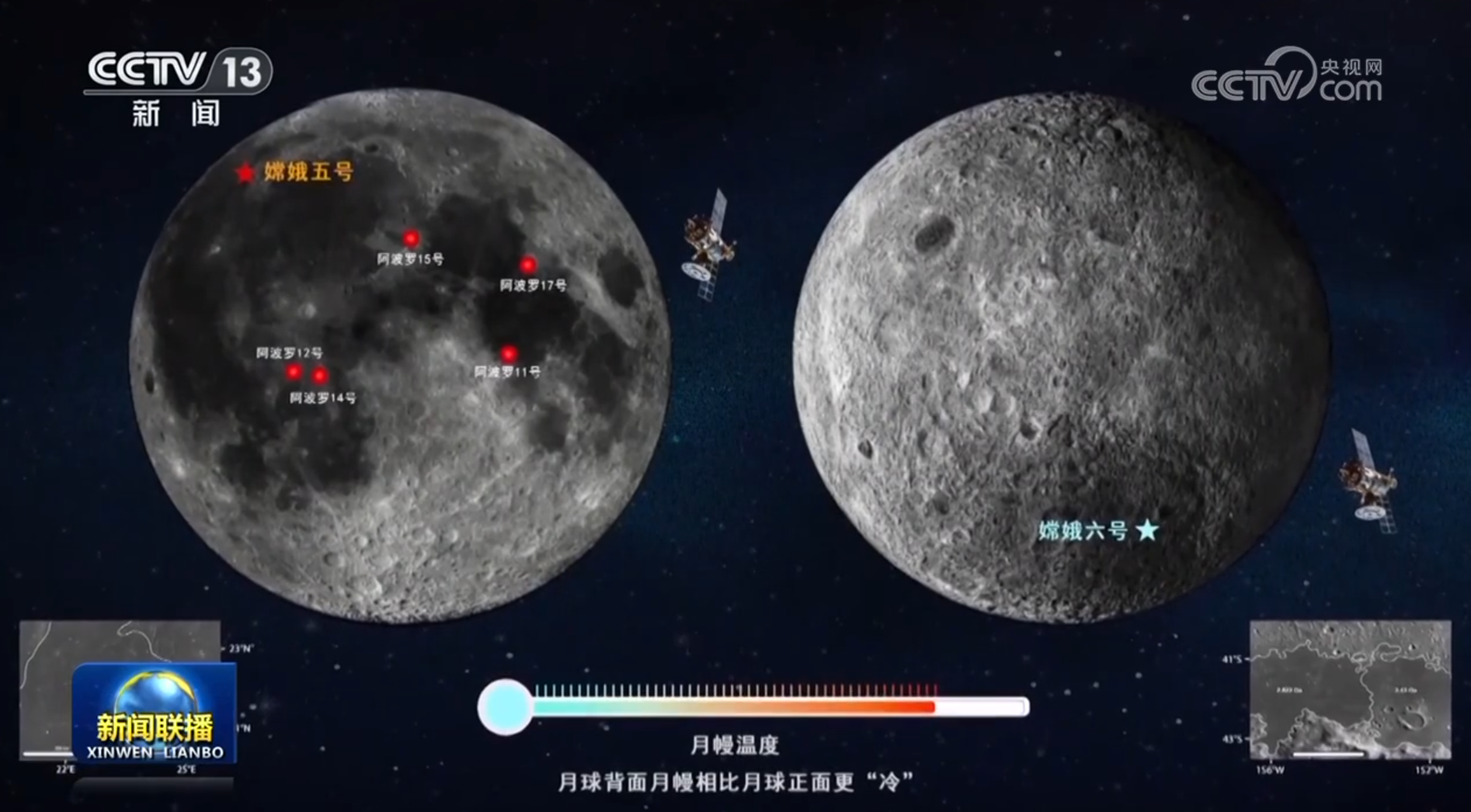
Core Insights - The latest findings from the Chang'e 6 lunar mission reveal that the crystallization temperature of basalt on the far side of the moon, as well as the potential temperature of the lunar mantle, are lower than those on the near side, indicating that the far side's mantle is comparatively "cooler" [1][2] Group 1: Scientific Findings - The research provides geological and geochemical evidence for the temperature differences between the lunar mantle of the near side and the far side [2] - Understanding the internal characteristics of the moon, such as the mantle, is crucial for studying lunar evolution, as ancient volcanic activity on the moon was driven by material from the mantle [1]