月相盈亏

Search documents
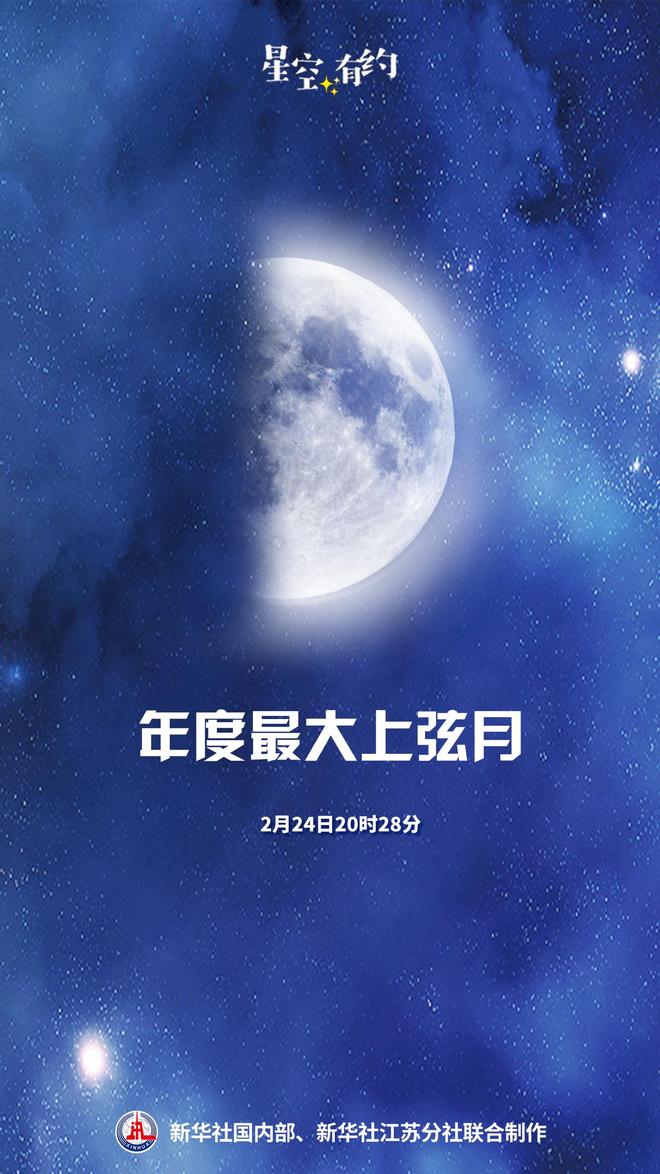
今晚8点28分,抬头看!
Xin Lang Cai Jing· 2026-02-24 12:07
Group 1 - The largest first quarter moon of the year will occur at 20:28 today, with the moon positioned near its perigee, approximately 370,000 kilometers from Earth [1] - This "half-covered" first quarter moon will be a spectacular celestial event that can be enjoyed with the naked eye, without the need for professional equipment [1] - The first quarter moon typically appears around the 7th, 8th, or 9th day of the lunar month, rising around noon and setting before midnight, making it more suitable for public viewing compared to the last quarter moon [8] Group 2 - In 2026, there will be 12 occurrences of the first quarter moon and 13 occurrences of the last quarter moon [11] - The reason this first quarter moon on February 24 is termed the "annual largest first quarter moon" is due to its occurrence near the moon's perigee, making it appear larger and brighter than other first quarter moons [11] - Interestingly, the smallest last quarter moon of the year will appear 15 days later, as the moon takes an average of about 14 days to travel from perigee to apogee [14]


星空有约|24日将迎年度最大上弦月
Xin Hua She· 2026-02-22 03:05
Group 1 - The largest first quarter moon of the year will occur on February 24 at 20:28, with the moon at its perigee, approximately 370,000 kilometers from Earth, making it a spectacular sight visible to the naked eye [1] - The first quarter moon appears when the sun, Earth, and moon form a right angle, with the moon positioned east of the sun, illuminating the western hemisphere of the moon, resembling the letter "D" [4] - The first quarter moon typically occurs around the 7th, 8th, or 9th day of the lunar month, rising around noon and setting around midnight, making it more suitable for public viewing compared to the last quarter moon [7] Group 2 - In 2026, there will be 12 occurrences of the first quarter moon and 13 occurrences of the last quarter moon, with the February 24 event being termed the "annual largest first quarter moon" due to its proximity to the perigee [10] - The moon's elliptical orbit causes varying distances from Earth, ranging from over 400,000 kilometers at its apogee to less than 360,000 kilometers at its perigee, resulting in a larger and brighter appearance during the first quarter moon near perigee [10] - Interestingly, the smallest last quarter moon of the year will appear 15 days later, as the moon takes about 14 days to travel from perigee to apogee, with the average interval between the first and last quarter moons being approximately 15 days [13]