未办税户清税证明开具

Search documents
一问一答|企业职工社保费缴费热点问题问答,请查收!
蓝色柳林财税室· 2025-12-18 01:06
Group 1 - Employers are required to register social insurance for employees within 30 days of employment according to the Social Insurance Law of the People's Republic of China [2][5] - Retired employees and interns are not required to pay basic pension insurance as they are not considered statutory insured employees [3] - Employers cannot avoid paying social insurance contributions even if employees voluntarily waive their participation [4] Group 2 - Employees who have paid social insurance for 15 years are still required to continue contributions as per the law [5] - The contribution base for the five types of employee insurance must be declared together and cannot be adjusted arbitrarily within a social insurance year [6][7] - If an employer discovers an error in the declared contribution salary, they can adjust it through the designated module starting from February 2025, but salary reductions require in-person processing [8] Group 3 - To make up for previously unpaid social insurance contributions, employers must contact the social insurance department for data submission before proceeding with the payment [9] - Late payments incur a penalty of 0.05% per day from the date of the debt [9]

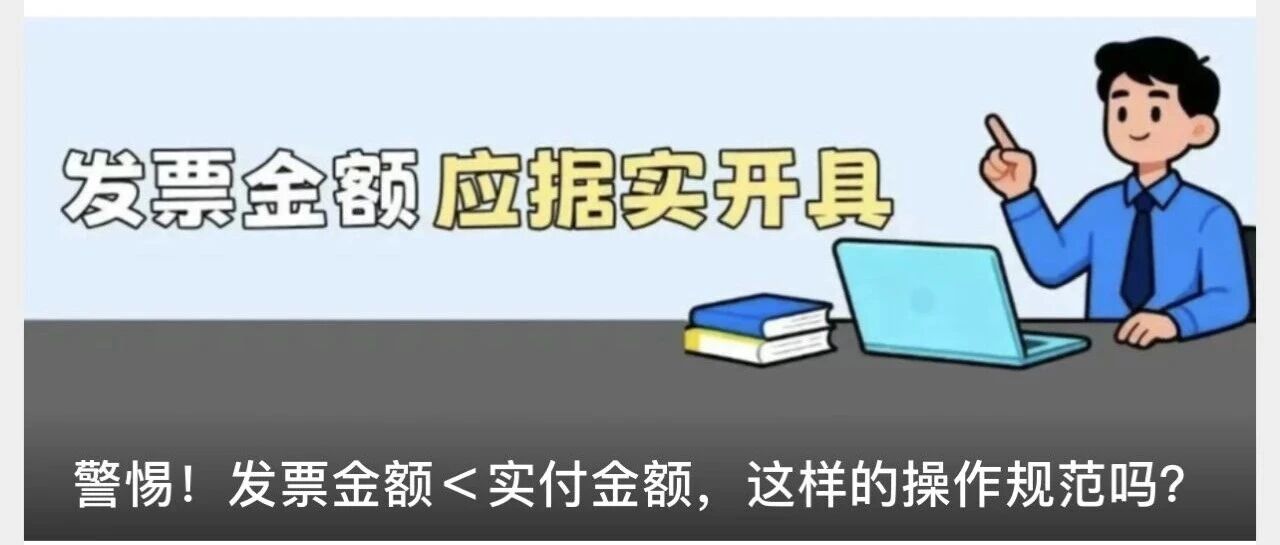
警惕!发票金额<实付金额,这样的操作规范吗?
蓝色柳林财税室· 2025-12-17 12:29
Core Viewpoint - The article emphasizes the importance of issuing invoices accurately and truthfully to avoid legal issues related to tax evasion and to ensure proper cost accounting and reimbursement processes [3]. Invoice Compliance Requirements - Invoices must be issued according to the regulations set forth in the "Invoice Management Measures of the People's Republic of China," which stipulates that all invoices should reflect the true nature of the transaction, including accurate amounts and item descriptions [3]. - Changes to the invoice amount, including unit prices and quantities, are prohibited unless due to legitimate business reasons such as debt restructuring or cash discounts [3]. Common Non-compliance Situations - Common issues with invoice compliance include: 1. Failure to include the full name of the payer on the invoice [3]. 2. Omission of the taxpayer identification number or unified social credit code [3]. 3. Alteration of item names and amounts on the invoice [3]. 4. Discrepancies between the invoice details and the actual transaction [3].