
机动车排放检验监管

Search documents
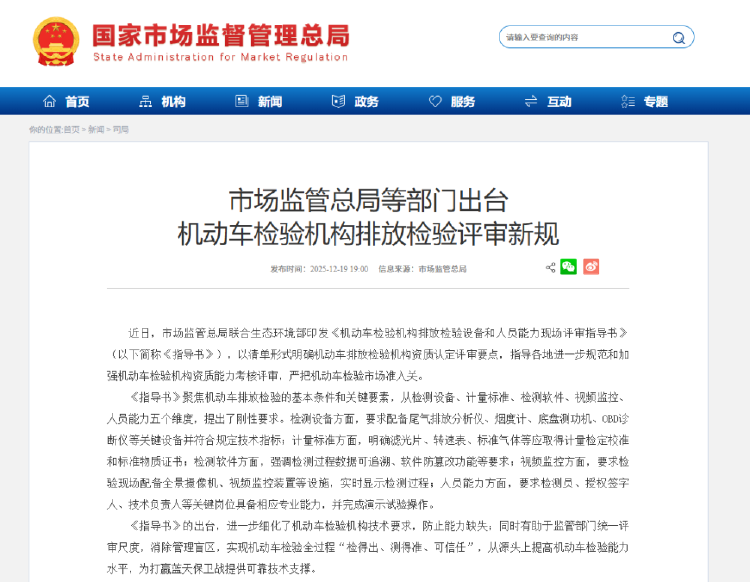
市场监管总局等部门出台机动车检验机构排放检验评审新规
Xin Hua She· 2025-12-19 11:30
Core Viewpoint - The issuance of the "Guidelines for On-Site Review of Emission Inspection Equipment and Personnel Competence of Motor Vehicle Inspection Institutions" aims to standardize and strengthen the qualification assessment of motor vehicle inspection institutions, ensuring strict market entry standards for vehicle emissions testing [1][2]. Group 1: Key Requirements - The guidelines focus on five dimensions: testing equipment, measurement standards, testing software, video monitoring, and personnel competence, establishing rigid requirements for each [1]. - Testing equipment must include essential devices such as exhaust gas analyzers, opacity meters, chassis dynamometers, and OBD diagnostic tools, all meeting specified technical standards [1]. - Measurement standards require that items like filters, tachometers, and standard gases obtain calibration and standard material certificates [1]. - Testing software must ensure data traceability and include anti-tampering features [1]. - Video monitoring mandates the installation of panoramic cameras and monitoring devices at inspection sites to display the testing process in real-time [1]. - Personnel in key positions, such as inspectors and technical leaders, must possess relevant professional qualifications and complete demonstration tests [1]. Group 2: Regulatory Impact - The introduction of the guidelines further refines technical requirements for motor vehicle inspection institutions, preventing capability deficiencies and aiding regulatory bodies in standardizing assessment criteria [2]. - The guidelines aim to enhance the overall capability of vehicle inspections, contributing to the fight against air pollution, as motor vehicle nitrogen oxide emissions account for over 46% of total nitrogen oxide emissions nationwide [2]. - Currently, there are approximately 16,000 motor vehicle inspection institutions in the country, and recent regulatory efforts have included various documents aimed at optimizing environmental supervision and combating fraudulent inspection practices [2]. - In 2025, regulatory authorities plan to inspect 11,000 motor vehicle inspection institutions, with 1,439 cases of violations addressed and 148 institutions having their qualifications revoked due to serious infractions [2].

【西安】三部门联合整治机动车排放检验违法行为
Shan Xi Ri Bao· 2025-12-09 23:07
Core Viewpoint - The joint meeting held by Xi'an's ecological environment, market supervision, and public security departments aims to address fraudulent practices in vehicle emission inspection, with a focus on improving air quality in the city. The special rectification will last until April next year and will strictly investigate illegal activities in vehicle emission inspections [1]. Group 1: Focus Areas of Rectification - The rectification focuses on prominent issues in vehicle emission inspections, particularly targeting heavy-duty trucks that do not properly use pollution control devices, do not add urea correctly, and do not operate the On-Board Diagnostics (OBD) system as required. Unauthorized modifications to pollution control devices and tampering with OBD systems are also key areas of concern [1]. - The approach includes strengthening clue verification, joint law enforcement inspections, and exposing typical cases to achieve comprehensive supervision [1]. Group 2: Organizational Structure and Responsibilities - A special rectification leadership group has been established by the three departments, with work institutions set up in various districts and development zones to clarify responsibility targets and establish work ledgers [1]. - Enhanced collaboration among departments is emphasized to ensure information sharing and joint investigations of cases [1]. Group 3: Regulatory and Enforcement Measures - The ecological environment department will focus on supervising the authenticity of inspection processes and reports, taking legal action against forged inspection results [1]. - The market supervision department will verify the qualifications and technical capabilities of inspection institutions, revoking inspection qualifications for serious violations [1]. - The public security department will assist in law enforcement and intervene in cases suspected of criminal activity to promote the connection between administrative and criminal enforcement [1]. Group 4: Support and Training Initiatives - In addition to strict enforcement, departments will provide support and guidance to vehicle inspection institutions to address issues during the inspection process [2]. - Initiatives such as "scanning into enterprises" will be implemented to standardize administrative inspections related to enterprises [2]. - Training for law enforcement personnel will be conducted to enhance their inspection capabilities [2].