核心科技主线

Search documents
大摩Q4持仓维持核心科技主线 苹果(AAPL.US)荣登榜首、指数ETF仓位下降
智通财经网· 2026-02-15 01:36
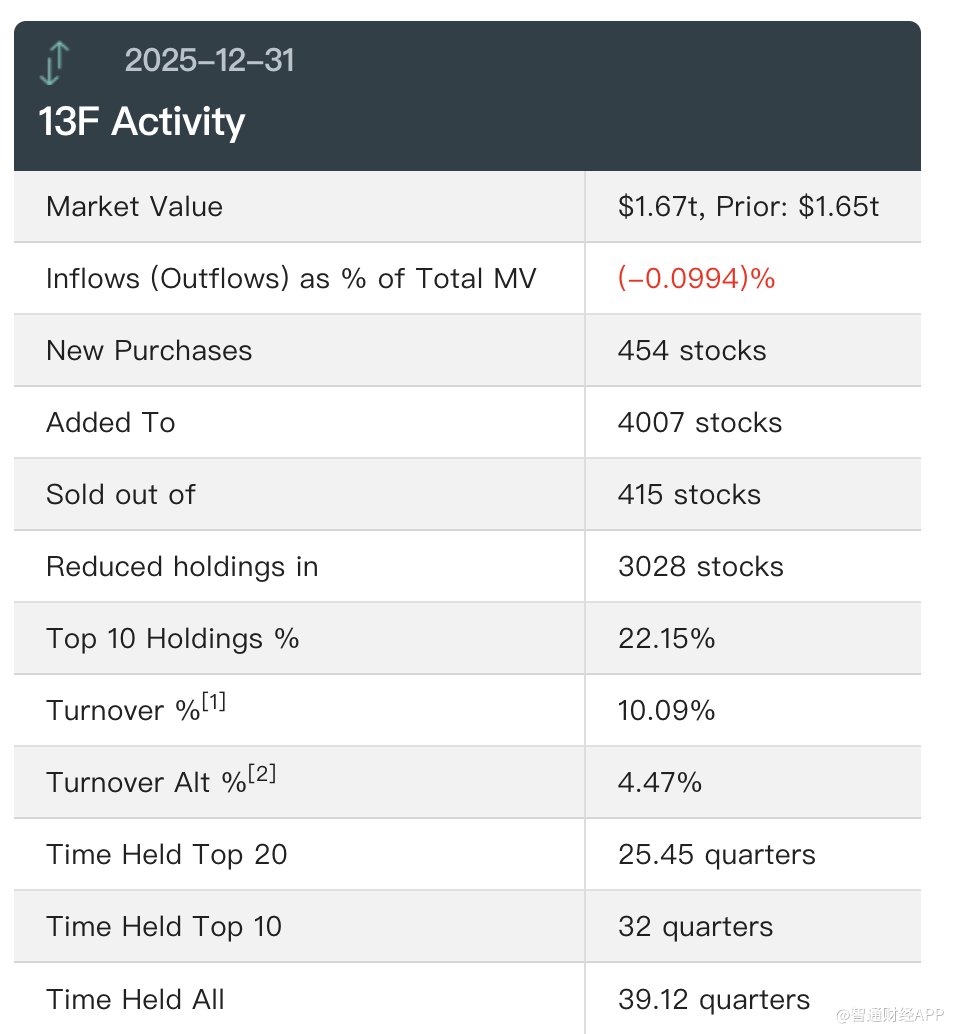
Core Insights - Morgan Stanley's Q4 2025 13F filing indicates a strategy focused on maintaining core technology positions, reducing index exposure, and enhancing active selection capabilities [1][2] Holdings Overview - The total market value of Morgan Stanley's Q4 holdings reached $1.67 trillion, up 1.2% from $1.65 trillion in the previous quarter [1][2] - The portfolio saw the addition of 454 new stocks, an increase in 4,007 stocks, a reduction in 3,028 stocks, and the complete sale of 415 stocks [1][2] - The top ten holdings accounted for 22.15% of the total market value [1][2] Top Holdings - The top five holdings include: - Apple (AAPL.US) - 3.74% of the portfolio, with an increase of approximately 1.38 million shares - NVIDIA (NVDA.US) - 3.6% of the portfolio, with an increase of nearly 780,000 shares - Microsoft (MSFT.US) - 3.5% of the portfolio, with an increase of about 980,000 shares - Alphabet Class A (GOOGL.US) - 2.28% of the portfolio, with a reduction of approximately 150,000 shares - Alphabet Class C (GOOG.US) - increased by 1.13 million shares, holding approximately 71.84 million shares - Amazon (AMZN.US) - 2.23% of the portfolio, with a reduction of about 1.28 million shares [2][3] Sector Adjustments - Morgan Stanley did not significantly reduce its allocation to the technology sector but opted for internal rebalancing, favoring companies with strong profit certainty and stable cash flows [4] - The firm reduced holdings in healthcare stocks such as Johnson & Johnson (JNJ.US), AbbVie (ABBV.US), and Thermo Fisher Scientific (TMO.US), as well as consumer staples like Walmart (WMT.US), Procter & Gamble (PG.US), and Coca-Cola (KO.US) [4] - Energy stocks such as ExxonMobil (XOM.US) and Chevron (CVX.US) were also reduced, indicating a potential decrease in the attractiveness of defensive and high-dividend sectors as interest rate paths become clearer [4] New Positions and Sales - New positions included Medline (MDLN.US), Total (TTE.US), Qnity Electronics (Q.US), Solstice (SOLS.US), and Dreamland (MICC.US) [5] - The top five new purchases were Alphabet Class C, Eli Lilly (LLY.US), Apple, Micron (MU.US), and Vanguard FTSE Developed Markets ETF (VEA.US) [5][6] - The top five sales included SPDR S&P 500 ETF (SPY.US), Invesco QQQ Trust (QQQ.US), Home Depot (HD.US), ServiceNow (NOW.US), and MercadoLibre (MELI.US) [5][6] Investment Strategy - The decrease in ETF positions suggests a preference for individual stock selection to achieve excess returns rather than relying on broad index exposure [5]