气温震荡

Search documents
一场极致的气温震荡即将登场!气温猛冲到“四月春”后将被紧急撤回
Xin Lang Cai Jing· 2026-02-18 14:15
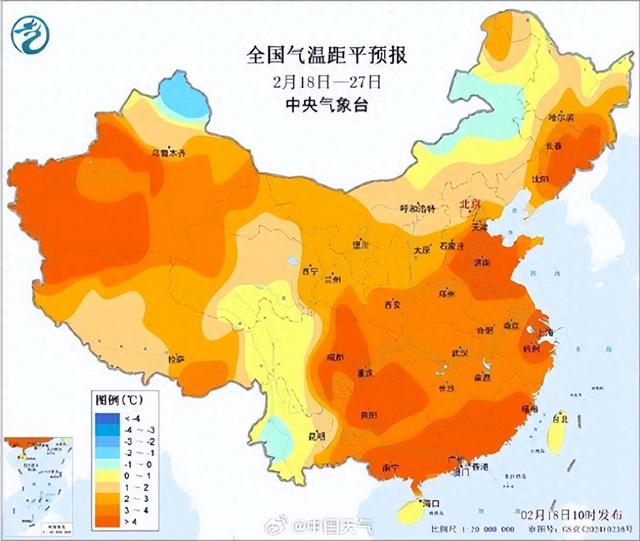
Group 1 - The article discusses a significant warming trend in China during the Spring Festival, with temperatures expected to rise dramatically across most regions before January 21 [1][3] - The warming is particularly notable, with maximum temperatures in many areas expected to exceed the seasonal average by more than 10°C, and in some northern regions by around 15°C [1][5] - Major cities such as Shijiazhuang, Zhengzhou, Jinan, Wuhan, Hefei, Changsha, Nanchang, and Hangzhou are forecasted to reach maximum temperatures close to or at 25°C, which is 12-16°C higher than the typical mid to late February temperatures [5][7] Group 2 - A strong cold front is anticipated to follow the warm spell, beginning to affect Inner Mongolia on January 21, leading to a significant drop in temperatures across much of the country [5][7] - The cold air mass is expected to move east and south from January 22 to 24, causing temperatures in the central and eastern regions to decrease sharply, returning to normal or even below normal levels [5][7] - Cities like Jinan, Zhengzhou, Hefei, and Changsha will experience a temperature drop of over 15°C within a few days, transitioning from spring-like warmth back to winter conditions [7]

大反转!猛降17℃!河南大范围雨雪沙尘要来了
Xin Lang Cai Jing· 2026-02-18 12:10
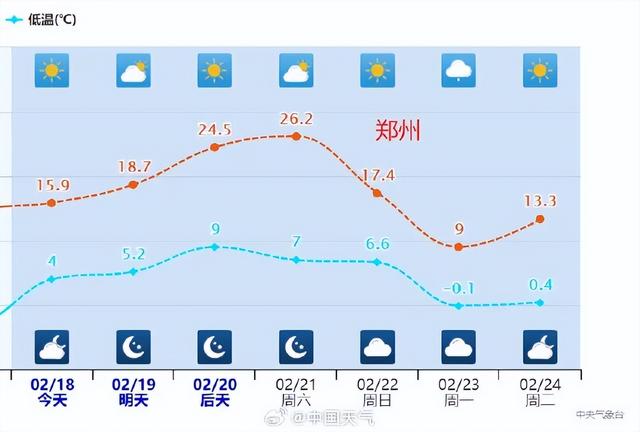
Core Viewpoint - A significant temperature fluctuation is expected in Henan, with a major warming trend followed by a strong cold front bringing rain and snow [1][6]. Group 1: Temperature Changes - A large-scale warming is anticipated across most regions of China, with temperatures rising by 15 to 20 degrees Celsius in areas from Huanghuai to the Yangtze River [1]. - On February 21, temperatures in northern and southwestern parts of Henan may reach around 26 degrees Celsius, while other areas will range from 22 to 24 degrees Celsius [1]. - The highest temperature on February 21 will contrast sharply with the lowest temperature on February 23, which is expected to drop to 9 degrees Celsius, marking a 17-degree difference [8]. Group 2: Weather Conditions - Strong winds are expected from February 19 to 20, with gusts reaching 6 to 7 levels, increasing the risk of forest fires due to dry conditions [4]. - A cold front will begin affecting Henan on the night of February 21, bringing strong winds, temperature drops, and potential sandstorms or dust [6]. - Rain and mixed precipitation are forecasted for February 22 to 23 and again from February 25 to 26, coinciding with the peak travel period for the Spring Festival [10]. Group 3: Daily Weather Forecast - February 19: Sunny with temperatures ranging from 4 to 19 degrees Celsius [11]. - February 20: Partly cloudy with temperatures from 6 to 24 degrees Celsius [11]. - February 21: Partly cloudy with a high of 26 degrees Celsius [11]. - February 22: Cloudy with temperatures dropping to a high of 16 degrees Celsius [11]. - February 23: Overcast with light rain or mixed precipitation, temperatures between 5 and 10 degrees Celsius [11]. - February 24: Partly cloudy with temperatures from 0 to 10 degrees Celsius [11]. - February 25: Partly cloudy with temperatures from 2 to 12 degrees Celsius [11].
元旦假期将有强冷空气影响我国 局地累计降温近20℃
Xin Lang Cai Jing· 2025-12-27 10:26
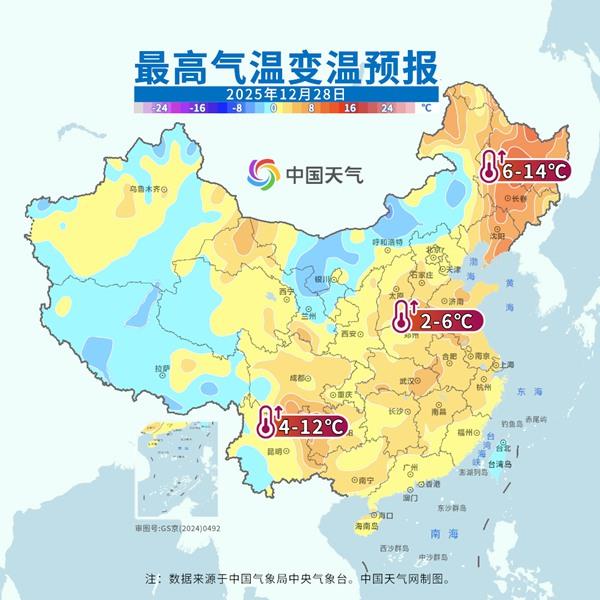
Core Viewpoint - A significant warming trend is occurring across most of China, expected to last until December 29, 2025, followed by a strong cold air mass that will lead to temperature fluctuations [1][3][5]. Group 1: Temperature Trends - The warming trend will see northern regions reaching high temperatures, with the 0°C line moving unusually north into central Jilin, and southern regions experiencing temperatures above 20°C [1]. - After the warming period, two cold air events are forecasted, with temperatures in northern areas dropping by 4-6°C, and some regions in Inner Mongolia and Northeast China experiencing drops of over 10°C [3]. - A strong cold air mass is expected to impact central and eastern regions from December 30, 2025, to January 3, 2026, causing temperature drops of 6-8°C, with local areas experiencing drops exceeding 10°C [5]. Group 2: Regional Impacts - The Northeast region will experience the most significant temperature fluctuations, with current temperatures being 8-10°C above the average for late December, but expected to drop by 10-20°C by January 1 [7]. - Southern regions will also see notable temperature changes, with maximum temperatures near 20°C before the cold air arrives, dropping to single digits during the New Year holiday [8]. - The cold air mass will also bring widespread rain and snow from December 30 to January 3, affecting various regions including the Northwest, North China, and parts of the South [8].