气象灾害风险

Search documents
@长沙人 寒潮大风降温将至!
Xin Lang Cai Jing· 2026-01-18 04:03
转自:长沙发布 小布获悉,长沙市气象台发布最新气象预报,预报结论如下:一是本轮雨雪天气过程相态转换更复杂,有雨、冻雨、冰粒、雨夹雪、雪等多相态转换; 二是冻雨转雪时间提早,20日白天开始自西向东冻雨转雨夹雪或雪,22日下午趋于结束。本次过程最大积冰厚度5~8毫米、山区10毫米以上,最大积雪 深度3~5厘米、山区7厘米以上;过程最低气温-5~-3℃左右(23日清晨)。 一、具体天气预报 18日至19日白天,阴天转小雨,北风加大至5~6级、阵风8~9级,3~14℃; 19日晚上,大部分地区小雨转冻雨、山区有雨夹雪或冰粒,北风4~5级,0~3℃; 20日白天,冻雨转冰粒或小到中雪、山区大雪,北风4级,-2~0℃; 20日晚至22日白天,中到大雪、山区大到暴雪,北风3~4级,-3~-1℃。 22日晚上至23日,多云到晴天,北风3级,-4~6℃。 二、气象灾害风险与应对建议 二是重点关注19日晚上至22日低温雨雪冰冻对城市运行、交通运输、能源保供、电力设施、农业生产等的不利影响。 来源丨长沙发布 供稿丨长沙气象 通讯员丨吴瑕 编辑丨陈叶灵 校对丨王宙 审核丨杜进 一是关注18日下午至19日寒潮大风降温过程,做好户外围挡 ...


注意驾驶安全!国家气象中心:12月31日多地雨雪较强 可能会造成路面湿滑
Zhong Guo Xin Wen Wang· 2025-12-30 05:39
Core Viewpoint - The National Meteorological Center warns of strong rain and snow in several regions on December 31, which may lead to slippery roads and increased risks for self-driving activities during the holiday period [1] Group 1: Weather Impact on Travel - On December 31, regions including Shaanxi, Shanxi, Henan, and Hubei are expected to experience strong rain and snow, potentially causing slippery roads and ice accumulation [1] - The cold air process during the New Year period (January 1 to 3) will have a minimal impact on travel in North China, Northeast China, Jiangnan, and South China, making travel conditions generally favorable [1] - Specific highways in Jiangsu, Hubei, Sichuan, Yunnan, and Tibet may face adverse effects from light snow or sleet, leading to road icing and slippery conditions [1] Group 2: Public Safety Measures - The China Meteorological Administration, in collaboration with the Ministry of Public Security, has released a meteorological disaster risk map for 14 highways in the Beijing-Harbin, Beijing-Hong Kong-Macao, and Yangtze River Delta regions to assist public travel [1] - The public is advised to pay attention to meteorological disaster warnings and travel service tips issued by meteorological stations, and to prepare adequately before traveling [1]
国家气候中心:2026年1月需关注低温雨雪可能带来的不利影响
Zhong Guo Xin Wen Wang· 2025-12-30 04:11
Core Viewpoint - The National Climate Center of China has issued a climate trend forecast for January 2026, highlighting potential adverse impacts from low temperatures and precipitation, particularly in specific regions of the country [1][2]. Group 1: Temperature Trends - In January 2026, regions such as northeastern Inner Mongolia, most of Northeast China, southeastern East China, southeastern South China, southern Southwest China, and western Xinjiang are expected to experience temperatures lower than the historical average by 1-2°C [1]. - Conversely, areas like northwestern Sichuan, southern Gansu, southern Qinghai, and northeastern Tibet may see temperatures 1-2°C higher than the historical average [1]. Group 2: Precipitation Trends - Precipitation is predicted to be above the historical average in northeastern regions, eastern Inner Mongolia, northwestern central China, southeastern Northwest China, northeastern Southwest China, and western Xinjiang, with some areas experiencing increases of 20-50% [1]. - Other regions, including central and southern Jiangsu, Shanghai, central southern Anhui, Zhejiang, Fujian, eastern Hubei, eastern Hunan, northern Guangdong, northeastern Guangxi, and central western Tibet, may see precipitation 20-50% below the historical average [2]. Group 3: Key Areas of Concern - Attention is required for the adverse effects of low temperatures and rain/snow, particularly in northeastern regions, eastern Inner Mongolia, and western Xinjiang, where risks of meteorological disasters such as low temperatures, strong winds, snow disasters, and ice storms are present [1]. - There is a need for proactive measures in agriculture and livestock sectors to prepare for cold weather, as well as contingency plans for transportation, energy, and power sectors [1]. - The potential for meteorological drought is a concern in central East China and southern central China due to significantly reduced precipitation, necessitating monitoring and management of water resources [2]. - Adverse atmospheric diffusion conditions are expected in the Beijing-Tianjin-Hebei region and the Fenwei Plain, which may lead to low visibility and impact production, daily life, and transportation [2].
雨带维持川陕至华北等地 江南华南北部高温天气持续
Zhong Guo Xin Wen Wang· 2025-10-09 02:02
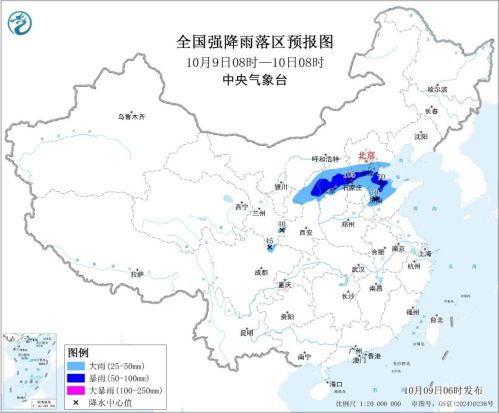
Group 1 - The central weather station has issued a blue rainstorm warning, predicting heavy rainfall in regions including northern Shaanxi, central Shanxi, central Hebei, Tianjin, and northern Shandong today [1][2] - The forecast indicates that from October 10 to 13, there will be moderate to heavy rain in the northern Sichuan Basin, eastern Northwest China, southern North China, and northern Huanghuai, with significant cumulative rainfall expected [2][4] - The high-temperature weather in Jiangnan and southern China is expected to persist, with temperatures exceeding 35°C in several areas, and some regions may reach above 38°C [4]
西南地区华南等地持续降雨 福建广东局地有大暴雨
Yang Shi Wang· 2025-07-11 01:07
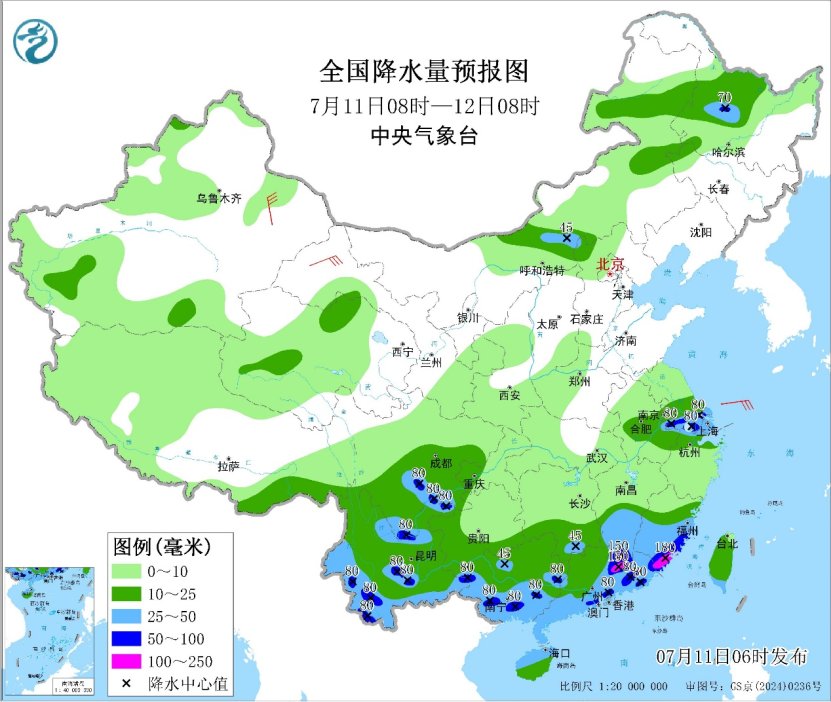
Group 1 - The core viewpoint of the articles highlights the severe weather conditions caused by the residual vortex of "Danas," leading to heavy rainfall and potential natural disasters in various regions of China, particularly in Guangdong and Fujian [1][3] - On July 10, parts of the coastal areas of Fujian, Guangdong, Hong Kong, and central-southern Taiwan experienced heavy to extremely heavy rainfall, with some areas in Guangdong's Jieyang exceeding 400 millimeters in a single day [1] - The Central Meteorological Observatory issued a blue rainstorm warning, predicting continued heavy rainfall in regions such as northeastern Guangdong and southeastern Fujian, with rainfall amounts expected to reach between 100 to 150 millimeters in some areas [3] Group 2 - Meteorological experts have warned of high risks for mountain floods in eastern Guangdong and geological disasters in southeastern Fujian and eastern Guangdong due to the ongoing heavy rainfall [3] - The forecast for the next three days indicates thunderstorms and heavy rain in regions including Inner Mongolia, northern Hebei, and the Sichuan basin, while high temperatures are expected to develop in North China and the Huanghuai region, with Jinan projected to exceed 37°C for the week [3]
7月上旬高温暴雨将影响哪里
Jing Ji Ri Bao· 2025-07-02 22:07
Summary of Key Points Core Viewpoint - The Central Meteorological Observatory forecasts significant rainfall and potential secondary disaster risks in regions including Sichuan, Gansu, and Yunnan from July 2 to July 6, with extreme weather conditions expected to impact transportation and safety [1][2]. Group 1: Weather Forecast and Impact - The rain belt is expected to primarily affect areas from Yunnan, Sichuan, and Gansu to North China and Northeast China, with continuous rainfall and high disaster risk in Sichuan, Gansu, and Yunnan [1]. - From July 2 to July 6, the western Sichuan Basin, western Yunnan, and parts of Gansu and Shaanxi are predicted to experience significant rainfall, with cumulative precipitation ranging from 40 to 80 millimeters, and localized areas exceeding 400 millimeters [1][2]. - The forecast indicates that the rainfall will have extreme characteristics, with short-term rainfall intensity potentially reaching 70 to 100 millimeters per hour [1][2]. Group 2: Disaster Risks - The meteorological risk for mountain floods in the western Sichuan Basin is assessed as very high, with certain rivers in western and southern Yunnan also at risk of exceeding guaranteed water levels [2]. - Geological disaster risks are high in the western and northern Sichuan Basin, southern Gansu, and western and southern Yunnan, with urban flooding risks also elevated in these areas [2]. - Since late June, precipitation in the Sichuan Basin, southern Gansu, and southern Yunnan has been 1 to 2 times higher than the historical average for the same period, indicating a significant increase in rainfall intensity and duration [2].
华南等地仍有较强降水 四川盆地华北黄淮等地有高温天气
Zhong Guo Xin Wen Wang· 2025-06-17 00:51
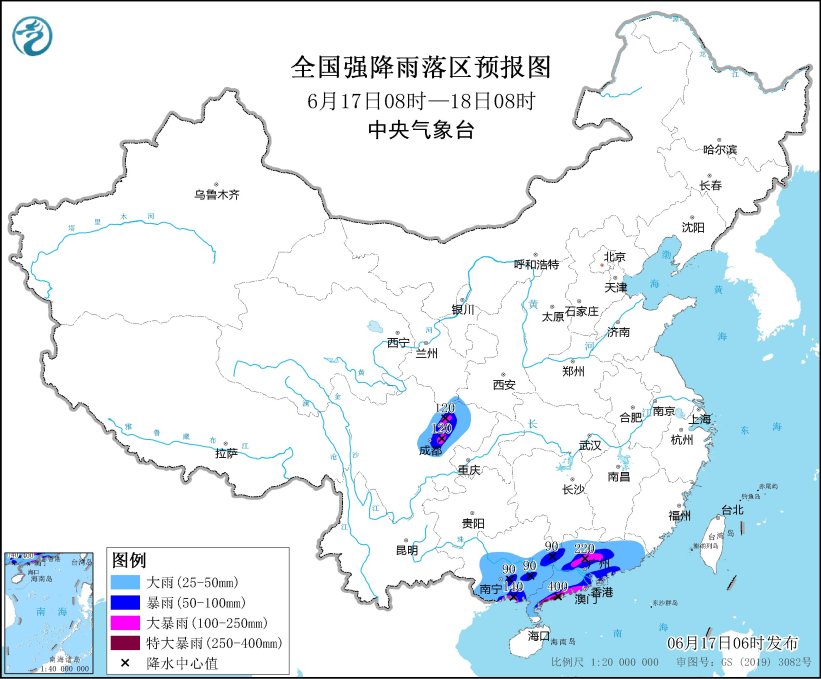
Summary of Key Points Core Viewpoint - The article discusses the ongoing severe weather conditions in China, including heavy rainfall in southern regions and high temperatures in northern areas, which may impact energy supply and public health. Group 1: Heavy Rainfall Forecast - Strong rainfall is expected in Guangdong, Guangxi, and parts of the Sichuan Basin, with some areas experiencing heavy to torrential rain, particularly in southern Guangdong and southeastern Guangxi, where rainfall could reach 250 to 400 millimeters [2][6] - A blue rain alert has been issued by the Central Meteorological Observatory, indicating the potential for short-term heavy rainfall and severe convective weather, including thunderstorms and strong winds [2][3] Group 2: High Temperature Forecast - High temperatures ranging from 35 to 39 degrees Celsius are forecasted for regions including southern Hebei, northern Henan, and the Turpan Basin in Xinjiang, with some areas potentially exceeding 40 degrees Celsius [4] - A yellow heat alert has been issued, although the intensity and range of high temperatures are expected to decrease starting June 18 [4] Group 3: Future Weather Predictions - From June 18 to 21, a significant rainfall event is anticipated across various regions, including the southeastern Northwest, southwestern areas, Jiangnan, and Huanghuai, with localized heavy rain expected [3][8] - Specific forecasts indicate that from June 19 to 20, areas such as Huanghuai and Jiangnan may experience heavy rainfall, with some regions receiving 100 to 180 millimeters [10]